
previous
  • 15 Deer-Resistant Plants
    15 Deer-Resistant Plants
  • The Only Shrubs You Need to Grow
    The Only Shrubs You Need to Grow
  • Off With Their Heads: Deadheading Perennials
    Off With Their Heads: Deadheading Perennials
  • Soil Testing is Worth the Effort
    Soil Testing is Worth the Effort
  • Make Your Own Hypertufa Container
    Make Your Own Hypertufa Container
  • Perfect Edges for Your Beds and Borders
    Perfect Edges for Your Beds and Borders
  • All About Starting Seeds
    All About Starting Seeds
  • 10 Perennials Easily Grown from Seed
    10 Perennials Easily Grown from Seed
  • Video: Make a Straw-Bale Garden
    Video: Make a Straw-Bale Garden
  • Lilacs: Time for a Fresh Look
    Lilacs: Time for a Fresh Look
  • Enchanting Japanese Maples
    Enchanting Japanese Maples
  • Garden Catalog Collector
    Garden Catalog Collector
  • Free Download: Rose Pruning and Bed Prep
    Free Download: Rose Pruning and Bed Prep
  • How to Start a Vegetable Garden
    How to Start a Vegetable Garden
  • Viburnums are Versatile Shrubs
    Viburnums are Versatile Shrubs
  • Find the Perfect Tomato
    Find the Perfect Tomato
  • A gardener's checklist for early summer
    A gardener's checklist for early summer
  • Bold and Beautiful Zinnias
    Bold and Beautiful Zinnias
  • How to Grow Raspberries
    How to Grow Raspberries
  • Big Flowers from Bigleaf Hydrangeas
    Big Flowers from Bigleaf Hydrangeas
  • Building a Compost Bin
    Building a Compost Bin
  • Backyard Makeover Game
    Backyard Makeover Game
  • Friendly Ways to Battle Garden Pests
    Friendly Ways to Battle Garden Pests
  • 25 Robust Summer Bloomers
    25 Robust Summer Bloomers
  • Variegated Plants Create Drama
    Variegated Plants Create Drama
next

Genus Pieris (Andromeda)

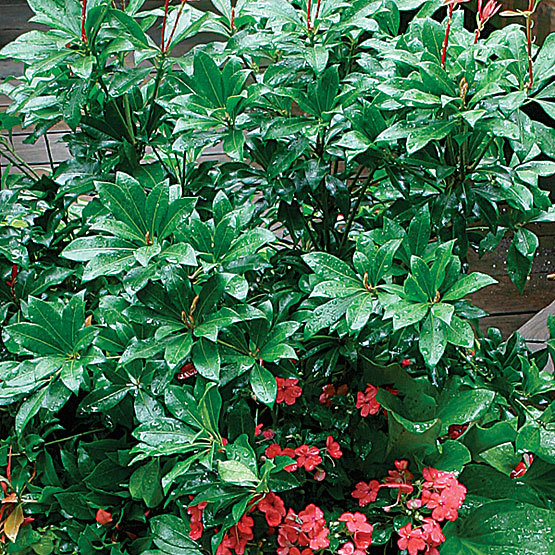
Pieris Pieris japonica Photo/Illustration: Steve Aitken
pee-AIR-iss Common Name: Andromeda
The Pieris genus is made up of 7 species of evergreen shrubs from forested and hilly landscapes in the Himalayas, East Asia, North America, and the West Indies. They are grown for their attractive, glossy foliage, which is often colored when young, and their panicles of springtime flowers. They are frequently called Andromeda, which actually denotes a separate genus within the same family. Their small, glossy leaves are numerous, providing ornamental texture throughout the year. In late winter and early spring, they produce pendulous clusters of dainty, urn-shaped flowers, which resemble Lily-of-the-valley and cover the plant. 
Noteworthy characteristics: These neatly shaped, low-maintenance shrubs are suitable planted singly or en masse in woodland borders, foundation plantings, or rock gardens. Leaves may cause severe discomfort if ingested. These shrubs offer year-round beauty with their attractive leaves and profusion of delicate blossoms.
Care: Moderately fertile, moist but well-drained acidic soil, rich in organic matter. Full sun or light shade. Cut back dead or diseased wood in mid-spring.
Propagation:

Sow seed in containers in a cold frame in spring or autumn. Take greenwood cuttings in early summer, or semi-ripe cuttings in mid- to late summer and provide bottom heat. 


Problems:

Canker, dieback, Phytophthora root rot, lacebug, nematodes.



Species, varieties and cultivars for genus Pieris

Pieris japonica Pieris japonica
(Lily-of-the-valley bush, Japanese pieris, Japanese andromeda)
Be the first to rate this plant
Hardiness Zones: 1 2 3 4 5 6 7 8 9 10 11

This neat, rounded shrub has given rise to many noteworthy cultivars. It grows to 12 feet tall and 10 feet wide, producing drooping clusters of delicate white blossoms in winter and spring. Use this shrub in a woodland, rock garden, container, or as a foundation plant.

no image available Pieris japonica 'Dorothy Wyckoff'
(Dorothy Wyckoff andromeda, Lily-of-the-valley bush, Japanese pieris, Japanese andromeda)
Be the first to rate this plant
Hardiness Zones: 1 2 3 4 5 6 7 8 9 10 11

This compact, rounded shrub produces reddish-purple buds that first open as soft-pink then mature to white. It grows to about 5 feet high and wide, making it a superb specimen for a container or small garden.


