
previous
  • Colorful Selections for Shade
    Colorful Selections for Shade
  • Lawn Alternatives
    Lawn Alternatives
  • Comfortable Alfresco Dining
    Comfortable Alfresco Dining
  • Save Money by Growing Your Own
    Save Money by Growing Your Own
  • Fragrant Plants for Pathways
    Fragrant Plants for Pathways
  • Stylish Shady Containers
    Stylish Shady Containers
  • Plants that Spark!
    Plants that Spark!
  • Building a Compost Bin
    Building a Compost Bin
  • Containers as Focal Points
    Containers as Focal Points
  • Slideshow: Beautiful Clematis
    Slideshow: Beautiful Clematis
  • Homegrown / Homemade
    Homegrown / Homemade
  • Fast-Growing Trees for Impatient Gardeners
    Fast-Growing Trees for Impatient Gardeners
  • Garden Confidential: A Plant Walks into a Bar
    Garden Confidential: A Plant Walks into a Bar
  • Dwarf Citrus Trees
    Dwarf Citrus Trees
  • Thoughts From a Foreign Field
    Thoughts From a Foreign Field
  • Pretty in Pink
    Pretty in Pink
  • Make a Succulent Topiary
    Make a Succulent Topiary
  • In Pursuit of the Perfect Potting Shed
    In Pursuit of the Perfect Potting Shed
  • Mulch for a Healthy Garden
    Mulch for a Healthy Garden
  • NEW Video Series: There's a Better Way
    NEW Video Series: There's a Better Way
  • Plant an Easy-to-Water Strawberry Jar
    Plant an Easy-to-Water Strawberry Jar
  • Designing with Curved Terraces
    Designing with Curved Terraces
  • Elephant's Ears
    Elephant's Ears
  • 6 Tips for Weed Control
    6 Tips for Weed Control
  • Indeterminate or Determinate Tomatoes?
    Indeterminate or Determinate Tomatoes?
next

Genus Passiflora (Granadilla, Passionflower)

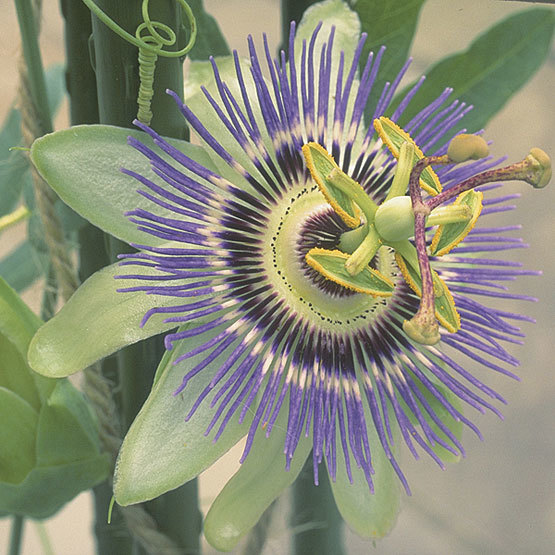
Passiflora Passiflora caerulea Photo/Illustration: Delilah Smittle
pass-ih-FLOOR-ah Common Name: Granadilla, Passionflower
Passiflora is a very large genus of more than 400 tropical climbers, annuals, perennials, shrubs, and trees. They are grown mainly for their exotic flowers with prominent central stalks. Yellow fruits are edible when fully ripe and resemble small chicken eggs. The vast majority of Passiflora species are climbers, and they are excellent for growing on a wall or trellis. They use tendrils to grab their supports.
Noteworthy characteristics: Stiking tropical flowers. Ripe fruit is edible. The name "passionflower" is a Biblical reference.
Care: In the garden, grow in a sheltered spot in full sun or partial shade, and moist but well-drained soil. Indoors, grow in full light with protection from the hottest sun. Water sparingly in winter.
Propagation: Layer in spring of fall, or take semi-ripe cuttings in summer. May also be grown from seed sown at 55-64°F in spring.
Problems: Spider mites, whiteflies, scale insects. Also can be affected by leaf spots, viruses, and iron deficiency.

Species, varieties and cultivars for genus Passiflora

Passiflora caerulea Passiflora caerulea
(Blue passion flower)
(4 user reviews)
Hardiness Zones: 1 2 3 4 5 6 7 8 9 10 11

This plant produces 3- to 4-inch-diameter, slightly scented flowers sporadically during summer, increasing in late summer through autumn. Intricate blossoms have an outer ruffle of petals and sepals; an inner disc of filaments composed of rings of blue, white and purple; and a central “antenna.” Deeply lobed dark green leaves cover stems that grasp supports with tendrils. Blue passion flower can reach 10 feet tall in one season. The ovoid, orange-yellow fruit is edible.


