
previous
  • Designing with Curved Terraces
    Designing with Curved Terraces
  • Mulch for a Healthy Garden
    Mulch for a Healthy Garden
  • Garden Confidential: A Plant Walks into a Bar
    Garden Confidential: A Plant Walks into a Bar
  • Elephant's Ears
    Elephant's Ears
  • Plant an Easy-to-Water Strawberry Jar
    Plant an Easy-to-Water Strawberry Jar
  • Comfortable Alfresco Dining
    Comfortable Alfresco Dining
  • NEW Video Series: There's a Better Way
    NEW Video Series: There's a Better Way
  • Slideshow: Beautiful Clematis
    Slideshow: Beautiful Clematis
  • Indeterminate or Determinate Tomatoes?
    Indeterminate or Determinate Tomatoes?
  • Pretty in Pink
    Pretty in Pink
  • Dwarf Citrus Trees
    Dwarf Citrus Trees
  • Fragrant Plants for Pathways
    Fragrant Plants for Pathways
  • Plants that Spark!
    Plants that Spark!
  • Save Money by Growing Your Own
    Save Money by Growing Your Own
  • Make a Succulent Topiary
    Make a Succulent Topiary
  • Thoughts From a Foreign Field
    Thoughts From a Foreign Field
  • 6 Tips for Weed Control
    6 Tips for Weed Control
  • Homegrown / Homemade
    Homegrown / Homemade
  • Stylish Shady Containers
    Stylish Shady Containers
  • Colorful Selections for Shade
    Colorful Selections for Shade
  • Building a Compost Bin
    Building a Compost Bin
  • Containers as Focal Points
    Containers as Focal Points
  • Fast-Growing Trees for Impatient Gardeners
    Fast-Growing Trees for Impatient Gardeners
  • In Pursuit of the Perfect Potting Shed
    In Pursuit of the Perfect Potting Shed
  • Lawn Alternatives
    Lawn Alternatives
next

Genus Hypericum (St. John's wort)

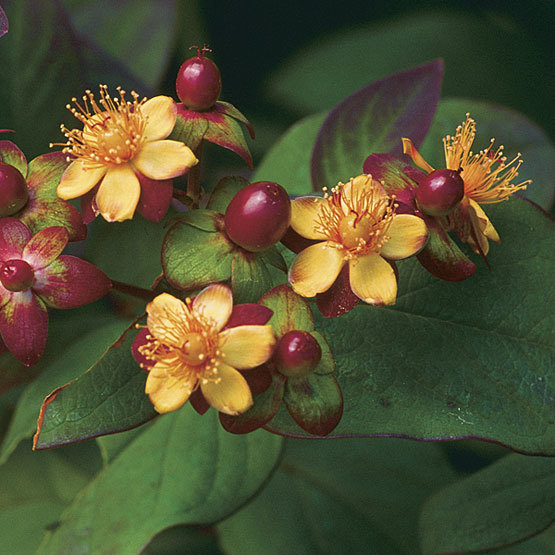
Hypericum Hypericum androsaemum 'Albury Purple' Photo/Illustration: Steve Silk
hy-PARE-ih-kum Common Name: St. John's wort
The more than 400 species of Hypericum are annuals, perennials, shrubs, and trees that are found world-wide in a myriad of habitats. They may be decidous, semi-evergreen, or evergreen.
Noteworthy characteristics: Various species have attractive autumn color and showy fruit. There is a species for nearly every growing climate and landscape situation.
Care: Moist but well-drained soil of moderate fertility. Sun and pruning requirements vary by species.
Propagation: For perennials, root softwood cuttings in late spring or divide in spring or fall. For shrubs, root greenwood or semi-ripe cuttings in summer. Sow seed in containers in a cold frame in fall.
Problems: Thrips, scale, anthracnose, rust, leaf spots.

Species, varieties and cultivars for genus Hypericum

Hypericum androsaemum 'Albury Purple' Hypericum androsaemum 'Albury Purple'
(Tutsan)
(1 user review)
Hardiness Zones: 1 2 3 4 5 6 7 8 9 10 11

This is a bushy, deciduous shrub with upright branches. Purple-flushed green leaves grow up to 4 inches long and are mildly resin scented when bruised. 'Albury Purple' bears stalked, star-shaped or cupped yellow flowers, up to 11 per cluster on distinctive 2-edged stems. Round, red berry-like fruit follows.

Hypericum calycinum 'Brigadoon' Hypericum calycinum 'Brigadoon'
(Aaron's beard, St. John's wort)
Be the first to rate this plant
Hardiness Zones: 1 2 3 4 5 6 7 8 9 10 11

'Brigadoon' is a new St. John's wort with brilliant chartreuse-yellow foliage that looks great next to dark-foliaged plants. It grows 12 to 16 inches tall and spreads quickly to about 2 feet wide, making it an excellent groundcover when planted in groups. In the sun, the small, oval leaves turn a dazzling orange-gold. The fuzzy, rather inconspicuous yellow flowers appear in midsummer. 'Brigadoon' tolerates heat, most any type of well-drained soil, and shade.

Hypericum frondosum ‘Sunburst’ Hypericum frondosum ‘Sunburst’
(St. John's wort)
Be the first to rate this plant
Hardiness Zones: 1 2 3 4 5 6 7 8 9 10 11

This is a small, upright, mounded, deciduous shrub with attractive, flaking reddish-brown bark on mature stems and striking, linear to oblong blue green leaves. Midsummer to early autumn, this plant bears golden yellow flowers with striking, bushy center stamens. Reddish-brown fruit capsules ripen in September and persist well into the winter. St. John's wort excels in the Midwest.


