
previous
  • How to Grow Raspberries
    How to Grow Raspberries
  • Viburnums are Versatile Shrubs
    Viburnums are Versatile Shrubs
  • Friendly Ways to Battle Garden Pests
    Friendly Ways to Battle Garden Pests
  • Free Download: Rose Pruning and Bed Prep
    Free Download: Rose Pruning and Bed Prep
  • Make Your Own Hypertufa Container
    Make Your Own Hypertufa Container
  • Video: Make a Straw-Bale Garden
    Video: Make a Straw-Bale Garden
  • Perfect Edges for Your Beds and Borders
    Perfect Edges for Your Beds and Borders
  • The Only Shrubs You Need to Grow
    The Only Shrubs You Need to Grow
  • Variegated Plants Create Drama
    Variegated Plants Create Drama
  • Big Flowers from Bigleaf Hydrangeas
    Big Flowers from Bigleaf Hydrangeas
  • Lilacs: Time for a Fresh Look
    Lilacs: Time for a Fresh Look
  • Find the Perfect Tomato
    Find the Perfect Tomato
  • All About Starting Seeds
    All About Starting Seeds
  • Building a Compost Bin
    Building a Compost Bin
  • 15 Deer-Resistant Plants
    15 Deer-Resistant Plants
  • Bold and Beautiful Zinnias
    Bold and Beautiful Zinnias
  • 10 Perennials Easily Grown from Seed
    10 Perennials Easily Grown from Seed
  • How to Start a Vegetable Garden
    How to Start a Vegetable Garden
  • A gardener's checklist for early summer
    A gardener's checklist for early summer
  • Enchanting Japanese Maples
    Enchanting Japanese Maples
  • Soil Testing is Worth the Effort
    Soil Testing is Worth the Effort
  • Off With Their Heads: Deadheading Perennials
    Off With Their Heads: Deadheading Perennials
  • 25 Robust Summer Bloomers
    25 Robust Summer Bloomers
  • Garden Catalog Collector
    Garden Catalog Collector
  • Backyard Makeover Game
    Backyard Makeover Game
next

Genus Fagus (Beech)

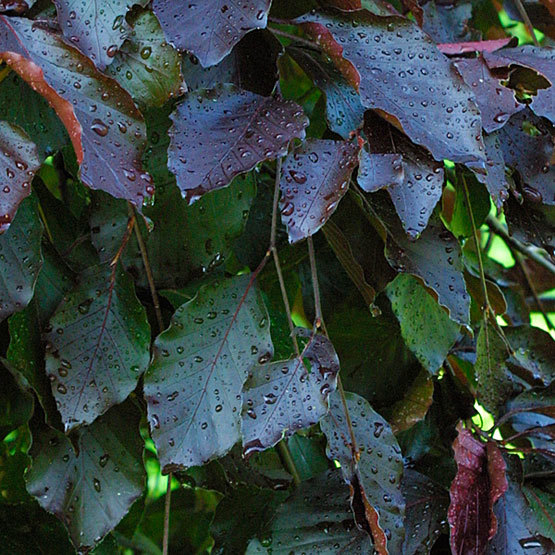
Fagus Fagus sylvatica 'Purple Fountain' Photo/Illustration: Jennifer Benner
FAY-gus Common Name: Beech
These deciduous woodland trees in ten or so species are grown for their nice growth habit, their neat foliage (which exhibits good fall color), and their smooth gray bark. Grow beeches as specimen trees or in a woodland garden. F. sylvatica can be pleached or used as a hedge.
Noteworthy characteristics: Smooth gray bark; nice autumn color.
Care: Full sun or partial shade. Beech tolerates most soil, as long as it is well-drained. Prune when dormant.
Propagation: Sow seed in autumn outdoors in a seedbed or stratify over winter and sow in spring.
Problems: Limb canker, powdery mildew, butt rot, wood rot, bracket fungi.

Species, varieties and cultivars for genus Fagus

Fagus sylvatica

Fagus sylvatica


(European beech)
Be the first to rate this plant
Hardiness Zones: 1 2 3 4 5 6 7 8 9 10 11

An excellent shade tree, this European-native deciduous tree grows to 80 feet tall and 50 feet wide and features an upright, oval form and dark shiny green leaves that turn yellow to rust-colored in fall. Its spring flowers are insignificant, though the small nuts that follow are favored by birds and squirrels. This tree is slow-growing. Several cultivars are available, including those with differing forms and foliage colors.

Fagus sylvatica 'Purple Fountain' Fagus sylvatica 'Purple Fountain'
(Purple fountain beech, European beech)
(1 user review)
Hardiness Zones: 1 2 3 4 5 6 7 8 9 10 11

'Purple Fountain' is a deciduous, columnar, dark-leaved tree with bronze-purple, wavy margined leaves and cascading branches. Leaves become more green as summer wears on. It can be used as a specimen tree or for pleaching. It is similar to the purple weeping beech but is much more columnar. Fall color is yellow, then orange-brown.


