OR Browse All Plants
This cross of E. purpurea 'Alba' and E. paradoxa bears narrow coppery-orange ray petals and prominent deep brown central cones. The fragrant blooms open from early to late summer with sporadic later bloom. It has semi-glossy leaves and grows 2 to 3 feet tall.
This is one of the exceptional Big Sky™ series (E. paradoxa crossed with E. purpurea), bearing fragrant, earthy-gold petals and golden orange central cones. These hybrids have all inherited the large green leaves, strong branching stems, wide flower petals, and profuse blooming tendencies of E. purpurea.
This is one of the exceptional Big Sky™ series (E. paradoxa crossed with E. purpurea), bearing fragrant, russet-orange petals and reddish-brown central cones. These hybrids have all inherited the large green leaves, strong branching stems, wide flower petals, and profuse blooming tendencies of E. purpurea.
This is one of the exceptional Big Sky™ series (E. paradoxa crossed with E. purpurea), bearing fragrant, pale citron petals and green-maturing-to-copper central cones. These hybrids have all inherited the large green leaves, strong branching stems, wide flower petals, and profuse blooming tendencies of E. purpurea.
This is one of the exceptional Big Sky™ series (E. paradoxa crossed with E. purpurea), bearing fragrant, vibrant salmon-orange petals and brown central cones. These hybrids have all inherited the large green leaves, strong branching stems, wide flower petals, and profuse blooming tendencies of E. purpurea.
This is one of the exceptional Big Sky™ series (E. paradoxa crossed with E. purpurea), bearing fragrant rose-colored petals and stunning red central cones on 24-inch plants. These hybrids have all inherited the large green leaves, strong branching stems, wide flower petals, and profuse blooming tendencies of E. purpurea.
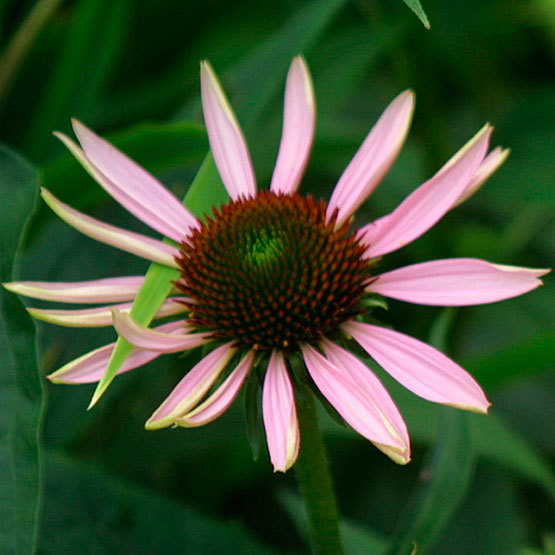
This native meadow perennial has daisy-like blossoms in early summer. It bears copper-orange central cones surrounded by short, arching, ray petals in pink or purple-pink, and occasionally white.
Because of its carefree performance, this native meadow perennial with daisy-like flowers appropriately inhabits the gardens of many. It blooms from midsummer into early autumn, with prominent, copper-orange central cones surrounded by rose-purple, ray petals (to 5 inches across).
This classic garden perennial is an eastern US native that is a staple in American gardens. It grows to 5 feet tall and 2 feet wide with both basal and stem leaves that are bright green and lance-shaped. Its 6-inch-wide flowers are a combination of deep pink rays and a tall, golden brown, spiky disk, and they appear in midsummer and keep going into midfall.
Coneflowers have much to offer the garden, and now they have fragrance, too. 'Fragrant Angel' has large, sweetly scented flowers made up of two rows of white petals surrounding a greenish orange cone. The plants grow to 40 inches and attract butterflies. Grow them in a border, meadow, cottage garden, or cut flower garden.
This native meadow derivative is a compact version of the species. It blooms from midsummer into early autumn, with prominent, copper-orange central cones surrounded by drooping, rose- or purple-pink ray petals. It will reach 24 inches if not cut back.
This native meadow derivative has vibrant, daisy-like flowers that bloom from midsummer into early autumn. Its prominent, dark orange central cones are surrounded by larger (to 7 inches across) and more horizontal, reddish-pink, ray petals than the species.
This native meadow derivative with daisy-like flowers blooms from early summer into early autumn. 'Bright Star' has prominent, copper-orange central cones surrounded by red-purple ray petals (to 5 inches across), and grows to less than 3 feet tall.
This cultivar of a native meadow coneflower has white, daisy-like flowers from early summer into early autumn. Its prominent, coppery-green, central cones are surrounded by large white ray petals that reach 4.5 inches long.
The 'Rocky Top' hybrid offers the garden an abundance of pastel pink coneflowers with greenish-black cones on plants 2 to 3 feet tall and 1 foot wide. Interestingly, the flowers follow the sun like sunflowers and the petals sometimes curl upward slightly. Use this compact coneflower in borders, meadows, or as cut and dried flowers. E. tennesseensis was thought to be extinct in the 1960s, but was rediscovered and is now widely available as a garden plant.
Spectacular Spring Bloomers These perennials are the light at the end of the long, wintry tunnel by Dave Demers
VIDEO Potting Soil Recipe for Woody Plants and Perennials This long-lasting mixture is the perfect medium for long-term plants by Rita Randolph
VIDEO The Hunt for the Best Heucheras A plant expert tells us which cultivars stand out from the rest by Allan Armitage
The Season's First Flowers For a welcome ray of sunshine, try these 10 plants that bloom in winter by Mike Lee
Be Bold with Fine Texture by Megan Smith
Great Plants, Vol.2Learn how to choose and use the best plant varieties for your gardenMore Info
The Gardener’s Guide to Common-Sense Pest ControlLeast-toxic solutions for your gardenMore Info
The Complete Book of Plant PropagationDemystifying this essential artMore Info