
previous
  • Off With Their Heads: Deadheading Perennials
    Off With Their Heads: Deadheading Perennials
  • A gardener's checklist for early summer
    A gardener's checklist for early summer
  • Find the Perfect Tomato
    Find the Perfect Tomato
  • Viburnums are Versatile Shrubs
    Viburnums are Versatile Shrubs
  • How to Start a Vegetable Garden
    How to Start a Vegetable Garden
  • Perfect Edges for Your Beds and Borders
    Perfect Edges for Your Beds and Borders
  • The Only Shrubs You Need to Grow
    The Only Shrubs You Need to Grow
  • 25 Robust Summer Bloomers
    25 Robust Summer Bloomers
  • Backyard Makeover Game
    Backyard Makeover Game
  • 10 Perennials Easily Grown from Seed
    10 Perennials Easily Grown from Seed
  • 15 Deer-Resistant Plants
    15 Deer-Resistant Plants
  • Video: Make a Straw-Bale Garden
    Video: Make a Straw-Bale Garden
  • Soil Testing is Worth the Effort
    Soil Testing is Worth the Effort
  • All About Starting Seeds
    All About Starting Seeds
  • Enchanting Japanese Maples
    Enchanting Japanese Maples
  • Friendly Ways to Battle Garden Pests
    Friendly Ways to Battle Garden Pests
  • How to Grow Raspberries
    How to Grow Raspberries
  • Garden Catalog Collector
    Garden Catalog Collector
  • Free Download: Rose Pruning and Bed Prep
    Free Download: Rose Pruning and Bed Prep
  • Variegated Plants Create Drama
    Variegated Plants Create Drama
  • Bold and Beautiful Zinnias
    Bold and Beautiful Zinnias
  • Building a Compost Bin
    Building a Compost Bin
  • Make Your Own Hypertufa Container
    Make Your Own Hypertufa Container
  • Lilacs: Time for a Fresh Look
    Lilacs: Time for a Fresh Look
  • Big Flowers from Bigleaf Hydrangeas
    Big Flowers from Bigleaf Hydrangeas
next

Genus Cynara

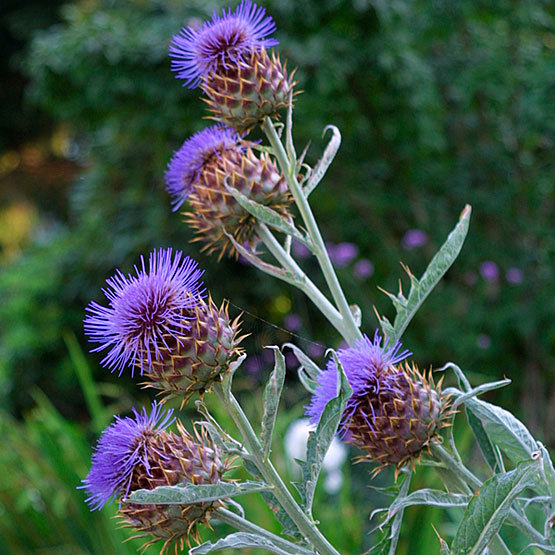
Cynara Cynara cardunculus Photo/Illustration: Steve Aitken
sih-NAR-ah
In the genus Cynara are ten or so species of clumping perennials from the Mediterranean, Africa, and the Canary Islands grown for their spiny, or at least pointed, large and silvery leaves and tall, thistle-like flowers. Grow them for their imposing growth habit in a border or as specimens.
Noteworthy characteristics: Silvery foliage and thistle-like flowers on tall plants. Flowers attract insects and are nice in dried arrangements. Some species are edible.
Care: Grow in a sheltered spot in full sun with well-drained soil. Give Cynara plenty of space. Removing the flowering stems will keep the attention on the architectural foliage, but is not mandatory.
Propagation: Sow seed in a cold frame or divide in spring, or take root cuttings in winter.
Problems: Aphids and slugs can be troublesome, as can gray mold and root rot.

Species, varieties and cultivars for genus Cynara

Cynara cardunculus Cynara cardunculus
(Cardoon)
Be the first to rate this plant
Hardiness Zones: 1 2 3 4 5 6 7 8 9 10 11

Cardoon is an architectural splendor with bold texture, thanks to its large, prickly, almost dagger-shaped gray-green arching leaves and a statuesque, vase-shaped frame. It is topped with round, purple, thistlelike flowers in midsummer. Cardoon can reach up to 5 feet tall and 4 feet wide.


