previous
  • Perfect Edges for Your Beds and Borders
    Perfect Edges for Your Beds and Borders
  • Backyard Makeover Game
    Backyard Makeover Game
  • Lilacs: Time for a Fresh Look
    Lilacs: Time for a Fresh Look
  • A gardener's checklist for early summer
    A gardener's checklist for early summer
  • 10 Perennials Easily Grown from Seed
    10 Perennials Easily Grown from Seed
  • Find the Perfect Tomato
    Find the Perfect Tomato
  • All About Starting Seeds
    All About Starting Seeds
  • 15 Deer-Resistant Plants
    15 Deer-Resistant Plants
  • Viburnums are Versatile Shrubs
    Viburnums are Versatile Shrubs
  • Garden Catalog Collector
    Garden Catalog Collector
  • Bold and Beautiful Zinnias
    Bold and Beautiful Zinnias
  • Off With Their Heads: Deadheading Perennials
    Off With Their Heads: Deadheading Perennials
  • Make Your Own Hypertufa Container
    Make Your Own Hypertufa Container
  • Variegated Plants Create Drama
    Variegated Plants Create Drama
  • The Only Shrubs You Need to Grow
    The Only Shrubs You Need to Grow
  • How to Grow Raspberries
    How to Grow Raspberries
  • Video: Make a Straw-Bale Garden
    Video: Make a Straw-Bale Garden
  • 25 Robust Summer Bloomers
    25 Robust Summer Bloomers
  • Big Flowers from Bigleaf Hydrangeas
    Big Flowers from Bigleaf Hydrangeas
  • Free Download: Rose Pruning and Bed Prep
    Free Download: Rose Pruning and Bed Prep
  • How to Start a Vegetable Garden
    How to Start a Vegetable Garden
  • Friendly Ways to Battle Garden Pests
    Friendly Ways to Battle Garden Pests
  • Soil Testing is Worth the Effort
    Soil Testing is Worth the Effort
  • Enchanting Japanese Maples
    Enchanting Japanese Maples
  • Building a Compost Bin
    Building a Compost Bin
next

Genus Cortaderia (Pampas grass, Tussock grass)

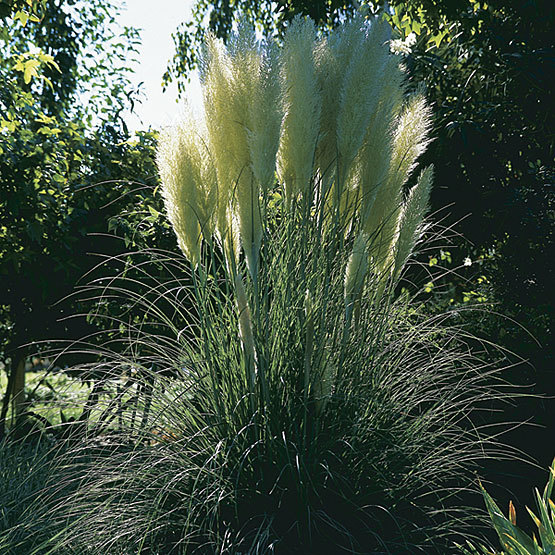
Cortaderia Cortaderia selloana 'Pumila' Photo/Illustration: Lee Anne White
kor-tah-DARE-ee-ah Common Name: Pampas grass, Tussock grass
In the genus Cortaderia are a couple of dozen species of grasses from New Zealand, New Guinea, and South America. They are often found near water. Their rough-edged foliage forms dense clumps of narrow blades. Flowers rise from the clumps in silver, gold, or pale pink plumes. Grow these grasses as specimens, at waterside, as screening, or in a border, giving them plenty of space.
Noteworthy characteristics: Dense tufts of sharp-edged foliage and plumes of flowers. Good cut or dried flowers.
Care: Give plants plenty of room and full sun. Prefer fertile, well-drained soil. Cut back and groom plants before new growth begins each year, being careful of the sharp leaf edges.
Propagation: In spring, divide clumps or start seed indoors at 55° to 64°F.
Problems: Generally easy to grow, but leaf spots are common problems.

Species, varieties and cultivars for genus Cortaderia

no image available Cortaderia selloana
(Pampas grass)
(3 user reviews)
Hardiness Zones: 1 2 3 4 5 6 7 8 9 10 11

This stunning grass has 1- to 3-foot-long, densely tufted plumes atop tall, upright stalks and arching mid-green leaves. Plumes come in white, cream, or beige-pink and appear in late summer.

Cortaderia selloana 'Gold Band' Cortaderia selloana 'Gold Band'
('Gold Band' pampas grass)
Be the first to rate this plant
Hardiness Zones: 1 2 3 4 5 6 7 8 9 10 11

This clumping, drought-tolerant grass is one of the best pampas grasses you could grow. It has the showy, late-summer plumes common to this group, but they grow straight up, not willy-nilly like many other varieties; they eventually stand 4 to 6 feet above the foliage. Even better news is that this cultivar does not set seed, so it is noninvasive. The foliage features distinct golden edges, which, for a grass, usually menas that it loves shade or moisture. But 'Gold Band' tolerates heat and drought, making it great for large containers, and it can handle coastal conditions, too.

Cortaderia selloana ‘Pumila” Cortaderia selloana ‘Pumila”
(Pampas grass)
(1 user review)
Hardiness Zones: 1 2 3 4 5 6 7 8 9 10 11

This dwarf cultivar has mid-green leaves and densely tufted plumes atop tall, upright stalks and arching mid-green leaves. Masses of silvery yellow plumes appear in late summer.