
previous
  • Indeterminate or Determinate Tomatoes?
    Indeterminate or Determinate Tomatoes?
  • Fragrant Plants for Pathways
    Fragrant Plants for Pathways
  • Dwarf Citrus Trees
    Dwarf Citrus Trees
  • Plants that Spark!
    Plants that Spark!
  • 6 Tips for Weed Control
    6 Tips for Weed Control
  • Plant an Easy-to-Water Strawberry Jar
    Plant an Easy-to-Water Strawberry Jar
  • Designing with Curved Terraces
    Designing with Curved Terraces
  • Save Money by Growing Your Own
    Save Money by Growing Your Own
  • Homegrown / Homemade
    Homegrown / Homemade
  • Fast-Growing Trees for Impatient Gardeners
    Fast-Growing Trees for Impatient Gardeners
  • Make a Succulent Topiary
    Make a Succulent Topiary
  • Colorful Selections for Shade
    Colorful Selections for Shade
  • Comfortable Alfresco Dining
    Comfortable Alfresco Dining
  • Garden Confidential: A Plant Walks into a Bar
    Garden Confidential: A Plant Walks into a Bar
  • Thoughts From a Foreign Field
    Thoughts From a Foreign Field
  • Stylish Shady Containers
    Stylish Shady Containers
  • In Pursuit of the Perfect Potting Shed
    In Pursuit of the Perfect Potting Shed
  • Mulch for a Healthy Garden
    Mulch for a Healthy Garden
  • Lawn Alternatives
    Lawn Alternatives
  • NEW Video Series: There's a Better Way
    NEW Video Series: There's a Better Way
  • Containers as Focal Points
    Containers as Focal Points
  • Slideshow: Beautiful Clematis
    Slideshow: Beautiful Clematis
  • Pretty in Pink
    Pretty in Pink
  • Elephant's Ears
    Elephant's Ears
  • Building a Compost Bin
    Building a Compost Bin
next

Genus Arum (Lords and ladies)

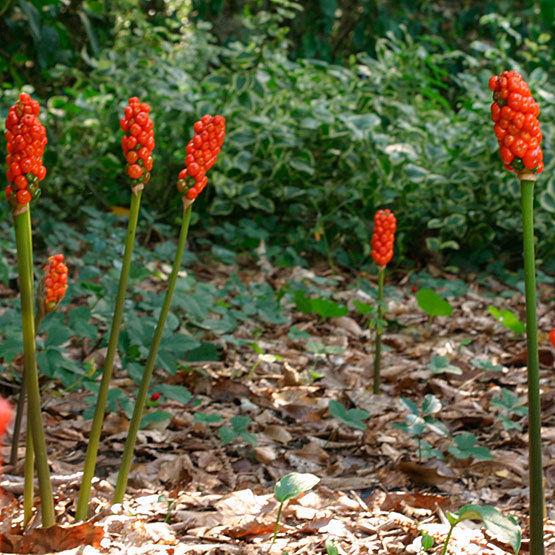
Arum Arum italicum Photo/Illustration: Colleen Fitzpatrick
AIR-um Common Name: Lords and ladies
Arum are spring-flowering, tuberous perennials with attractively marked, arrow- or heart-shaped leaves. The flowers are small but are enclosed in large spathes. They may have a sweet or unpleasant fragrance. Spikes of red or orange berries appear after the flowers. The genus contains about 26 species from a range of partially shaded habitats in Europe, Africa, and Asia. Arum are useful in shrub borders, in the greenhouse, or in flower arrangements.
Noteworthy characteristics: Attractive leaves, large spathes of flowers, spikes of berries. All parts may cause severed discomfort if ingested. Contact with the sap may irritate skin.
Care: In the garden, grow in a sheletered area in well-drained, organically rich soil in full sun or part shade. Indoors, grow in full or filtered light and provide ample water during the growing season. Keep almost dry when dormant.
Propagation: Divide after flowering, or sow seed in autumn in a cold frame after removing the pulp from the berries, which may be caustic.
Problems: Infrequent.

Species, varieties and cultivars for genus Arum

Arum italicum Arum italicum
(Italian arum, Orange candleflower)
(3 user reviews)
Hardiness Zones: 1 2 3 4 5 6 7 8 9 10 11

A. italicum will add great color and diversity to the garden with their attractively marked leaves, which may be arrow- or spear-shaped. Leaves are veined with mid-green to white. In early summer, white spathes of flowers are followed by spikes of bright orange red berries.


