
previous
  • Variegated Plants Create Drama
    Variegated Plants Create Drama
  • Perfect Edges for Your Beds and Borders
    Perfect Edges for Your Beds and Borders
  • The Only Shrubs You Need to Grow
    The Only Shrubs You Need to Grow
  • Viburnums are Versatile Shrubs
    Viburnums are Versatile Shrubs
  • How to Grow Raspberries
    How to Grow Raspberries
  • Find the Perfect Tomato
    Find the Perfect Tomato
  • 15 Deer-Resistant Plants
    15 Deer-Resistant Plants
  • A gardener's checklist for early summer
    A gardener's checklist for early summer
  • 10 Perennials Easily Grown from Seed
    10 Perennials Easily Grown from Seed
  • Building a Compost Bin
    Building a Compost Bin
  • Friendly Ways to Battle Garden Pests
    Friendly Ways to Battle Garden Pests
  • Bold and Beautiful Zinnias
    Bold and Beautiful Zinnias
  • Video: Make a Straw-Bale Garden
    Video: Make a Straw-Bale Garden
  • Soil Testing is Worth the Effort
    Soil Testing is Worth the Effort
  • Enchanting Japanese Maples
    Enchanting Japanese Maples
  • Off With Their Heads: Deadheading Perennials
    Off With Their Heads: Deadheading Perennials
  • Lilacs: Time for a Fresh Look
    Lilacs: Time for a Fresh Look
  • Make Your Own Hypertufa Container
    Make Your Own Hypertufa Container
  • Big Flowers from Bigleaf Hydrangeas
    Big Flowers from Bigleaf Hydrangeas
  • 25 Robust Summer Bloomers
    25 Robust Summer Bloomers
  • How to Start a Vegetable Garden
    How to Start a Vegetable Garden
  • Free Download: Rose Pruning and Bed Prep
    Free Download: Rose Pruning and Bed Prep
  • Backyard Makeover Game
    Backyard Makeover Game
  • Garden Catalog Collector
    Garden Catalog Collector
  • All About Starting Seeds
    All About Starting Seeds
next

Genus Antirrhinum (Snapdragon)

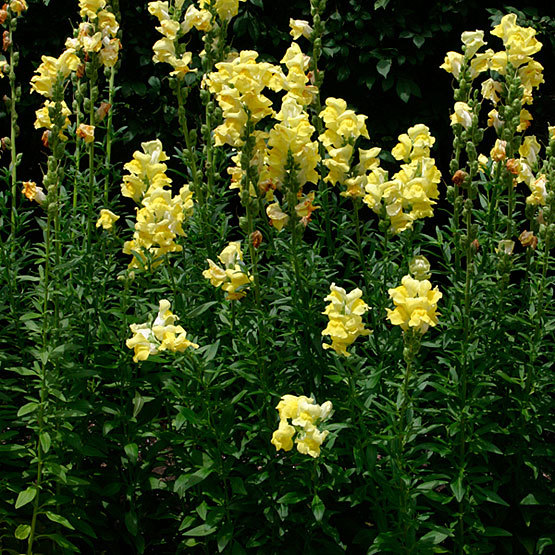
Antirrhinum Antirrhinum majus Photo/Illustration: Melissa Lucas
an-ter-REE-num Common Name: Snapdragon
The genus Antirrhinum includes 30 to 40 species of annuals, perennials, and subshrubs from rocky sites in Europe, the U.S., and North Africa. They are grown for their showy spikes of tubular, 2-lipped flowers. The leaves, on branching stems, are lance-shaped to ovate. A. majus is the familiar garden snapdragon. It is a perennial, most often grown as an annual, but can survive a winter if mulched. Grow snapdragons as bedding, in borders, or for cut flowers. Shrubby perennial species are great in rock gardens or walls.
Noteworthy characteristics: Spikes of tubular, 2-lipped flowers from early summer to fall.
Care: Species grown as annuals need full sun and fertile, sharply drained soil. Deadhead to prolong flowering. They can sometimes overwinter in Zones 5-7 if given a deep, loose mulch. Perennial species need very well-drained soil and a shelted site, as they are very fragile and do not tolerate winter moisture.
Propagation: Propagate A. majus from seed sown at 61° to 64°F in winter. Take softwood cuttings of shrubby species in summer, or sow seeds in a cold frame in autumn or spring.
Problems: Gray mold, many fungal leaf spots, rust, and root rots are common. In some areas, aphids and leaf miners are problems.

Species, varieties and cultivars for genus Antirrhinum

Antirrhinum majus Antirrhinum majus
(Snapdragons)
Be the first to rate this plant
Hardiness Zones: 1 2 3 4 5 6 7 8 9 10 11

This plant produces upright racemes of two-lipped flowers with spreading, rounded lobes in a vast arrray of warm colors. It flowers profusely summer through autumn.


