
previous
  • Pretty in Pink
    Pretty in Pink
  • Fragrant Plants for Pathways
    Fragrant Plants for Pathways
  • Building a Compost Bin
    Building a Compost Bin
  • Comfortable Alfresco Dining
    Comfortable Alfresco Dining
  • Containers as Focal Points
    Containers as Focal Points
  • Elephant's Ears
    Elephant's Ears
  • Make a Succulent Topiary
    Make a Succulent Topiary
  • Save Money by Growing Your Own
    Save Money by Growing Your Own
  • NEW Video Series: There's a Better Way
    NEW Video Series: There's a Better Way
  • Plants that Spark!
    Plants that Spark!
  • In Pursuit of the Perfect Potting Shed
    In Pursuit of the Perfect Potting Shed
  • Plant an Easy-to-Water Strawberry Jar
    Plant an Easy-to-Water Strawberry Jar
  • Lawn Alternatives
    Lawn Alternatives
  • Dwarf Citrus Trees
    Dwarf Citrus Trees
  • Homegrown / Homemade
    Homegrown / Homemade
  • Mulch for a Healthy Garden
    Mulch for a Healthy Garden
  • 6 Tips for Weed Control
    6 Tips for Weed Control
  • Colorful Selections for Shade
    Colorful Selections for Shade
  • Fast-Growing Trees for Impatient Gardeners
    Fast-Growing Trees for Impatient Gardeners
  • Designing with Curved Terraces
    Designing with Curved Terraces
  • Garden Confidential: A Plant Walks into a Bar
    Garden Confidential: A Plant Walks into a Bar
  • Slideshow: Beautiful Clematis
    Slideshow: Beautiful Clematis
  • Stylish Shady Containers
    Stylish Shady Containers
  • Thoughts From a Foreign Field
    Thoughts From a Foreign Field
  • Indeterminate or Determinate Tomatoes?
    Indeterminate or Determinate Tomatoes?
next

Genus Amelanchier (Juneberry, Shadbush, Snowy mespilus)

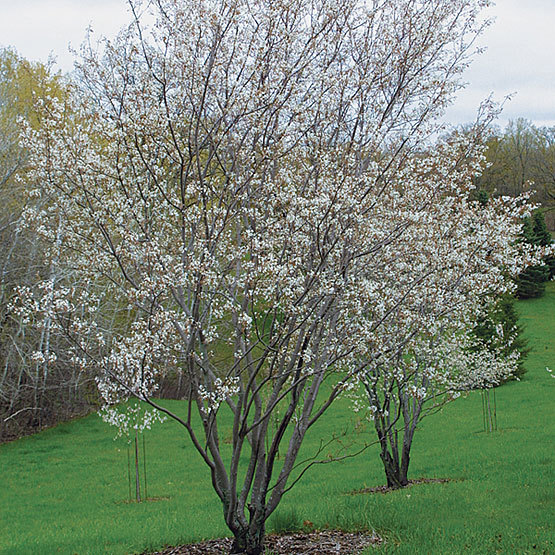
Amelanchier Amelanchier X grandiflora Photo/Illustration: Jennifer Benner
am-el-AN-keer Common Name: Juneberry, Shadbush, Snowy mespilus
Amelanchier is a woodland genus of shrubs and small trees, many with suckering growths creating small colonies. Their star-shaped, flat to saucer shaped flowers are usually white with some pink blushing. Leaves turn a nice yellow-orange in fall and are accompanied by fruit that ripens in summer and is edible in some species. Birds will feast on the berries if not picked soon after ripening.
Noteworthy characteristics: Noted for their fine five-petaled showy racemes of white-to-pink-flushed flowers in spring. Also prized for beautiful fall foliage and fruit.
Care: Grow in acidic, moist soil in sun to part shade. Needs minimal pruning. Prune in autumn to avoid excessive sap loss.
Propagation: Root greenwood or semi-ripe cuttings in summer.
Problems: Fireblight and a varity of fungal leaf spots. Rust and powdery mildew are common.

Species, varieties and cultivars for genus Amelanchier

Amelanchier × grandiflora 'Autumn Brilliance' Amelanchier × grandiflora 'Autumn Brilliance'
(Apple serviceberry)
(3 user reviews)
Hardiness Zones: 1 2 3 4 5 6 7 8 9 10 11

This shrubby tree has leaves that emerge bronze, mature green, and fade to orange and red in autumn. It bears 3-inch-long racemes of white flowers in spring, followed by edible, juicy blue-black fruit.

Amelanchier alnifolia Amelanchier alnifolia
(Alder-leaved serviceberry, Saskatoon)
(1 user review)
Hardiness Zones: 1 2 3 4 5 6 7 8 9 10 11

This multi-stemmed shrub or tree can reach almost 20 feet tall. At one time, it was used medicinally for many conditions. Its autumn color is bright red or yellow and its small, edible black fruits attract much wildlife.

Amelanchier alnifolia 'Regent' Amelanchier alnifolia 'Regent'
('Regent' serviceberry)
Be the first to rate this plant
Hardiness Zones: 1 2 3 4 5 6 7 8 9 10 11

A compact shrub form of serviceberry, 'Regent' produces finely toothed, rounded leaves that are bluish on top and gray-green on the bottom. In fall, they change to vibrant yellow and red. Spring finds the shrub sporting white flowers in upright clusters that give way to fruit in June. Birds as well as humans appreciate the tasty berries, which make great jellies and jams and are more abundant in full sun. This plant is native to the Great Plains and tolerates harsh, dry, or alkaline conditions when mature.


