
Genus Amaranthus

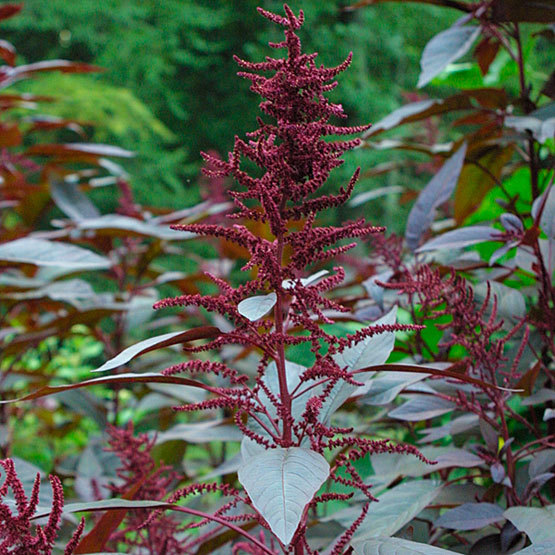
Amaranthus Amaranthus cruentus Photo/Illustration: Jennifer Benner
am-ah-RAN-thus
Plants in this genus are annuals and short-lived perennials often used as summer bedding, in containers or hanging baskets, as cut or dried flowers, or as houseplants. They are native to a range of habitats in temperate and tropical regions around the world. Their alternate leaves are often colorful. The large, catkin-like cymes of small red or green flowers are sometimes pendent and sometimes upright, and are followed by often attractive seedheads. There are about 60 species in this genus.
Noteworthy characteristics: Leaves, flowers, and seedheads are often colorful.
Care: Most species need moderately fertile, humusy, moist soil in full sun, and extra water during dry periods in summer. Indoors, grow in full light with ample water and high humidity.
Propagation: Sow seed at 68°F in mid-spring. A. caudatus can also be sown in situ.
Problems: White rust, brown rust, Cercospora leaf spot, and Phyllosticta leaf spot affect foliage, and root rot can also be troublesome. Also prone to aster yellows, viruses, and aphids.

Species, varieties and cultivars for genus Amaranthus

Amaranthus cruentus Amaranthus cruentus
(Prince's feather, Purple amaranth, Red amaranth)
(1 user review)

Amaranthus cruentus makes a striking statement in beds or borders. Growing to 6 feet in height, it bears somewhat fuzzy-looking spires of purplish red flowers in summer, followed by seed heads that can be red, purple, or yellow. It is native to tropical regions of North and South America, and is one of three Amaranthus species cultivated for their grain.

Amaranthus tricolor and cvs. Amaranthus tricolor and cvs.
(Chinese spinach, Tampala, Joseph's coat)
Be the first to rate this plant

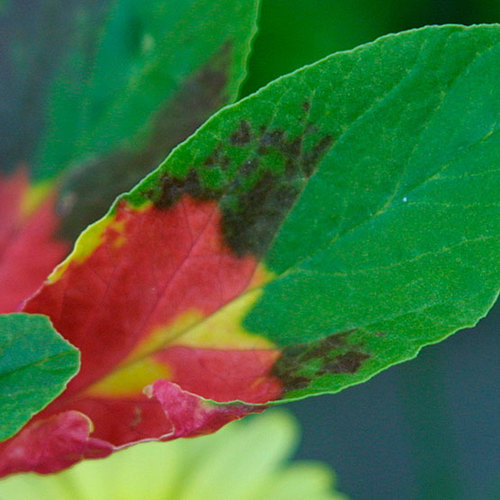
This hardy annual has vibrant, ornamental red, yellow, and green foliage that lends a tropical effect to the garden. Small flowers, borne from summer to early autumn, are inconspicuous in comparison to the effect of the foliage. Cultivars feature yellow and maroon-shaded leaves, but the species still offers the showiest foliage.


