
previous
  • Comfortable Alfresco Dining
    Comfortable Alfresco Dining
  • Dwarf Citrus Trees
    Dwarf Citrus Trees
  • NEW Video Series: There's a Better Way
    NEW Video Series: There's a Better Way
  • Save Money by Growing Your Own
    Save Money by Growing Your Own
  • Make a Succulent Topiary
    Make a Succulent Topiary
  • Homegrown / Homemade
    Homegrown / Homemade
  • Colorful Selections for Shade
    Colorful Selections for Shade
  • Fragrant Plants for Pathways
    Fragrant Plants for Pathways
  • Stylish Shady Containers
    Stylish Shady Containers
  • Thoughts From a Foreign Field
    Thoughts From a Foreign Field
  • 6 Tips for Weed Control
    6 Tips for Weed Control
  • Fast-Growing Trees for Impatient Gardeners
    Fast-Growing Trees for Impatient Gardeners
  • Garden Confidential: A Plant Walks into a Bar
    Garden Confidential: A Plant Walks into a Bar
  • Lawn Alternatives
    Lawn Alternatives
  • Slideshow: Beautiful Clematis
    Slideshow: Beautiful Clematis
  • Building a Compost Bin
    Building a Compost Bin
  • Plant an Easy-to-Water Strawberry Jar
    Plant an Easy-to-Water Strawberry Jar
  • In Pursuit of the Perfect Potting Shed
    In Pursuit of the Perfect Potting Shed
  • Elephant's Ears
    Elephant's Ears
  • Designing with Curved Terraces
    Designing with Curved Terraces
  • Plants that Spark!
    Plants that Spark!
  • Mulch for a Healthy Garden
    Mulch for a Healthy Garden
  • Indeterminate or Determinate Tomatoes?
    Indeterminate or Determinate Tomatoes?
  • Pretty in Pink
    Pretty in Pink
  • Containers as Focal Points
    Containers as Focal Points
next

Genus Ageratum (Floss flower)

Ageratum Ageratum houstonianum
a-jer-AY-tum Common Name: Floss flower
Plants in the genus Ageratum include 40 or so species of annuals, perennials, and shrubs from North and South America. Most are grown as annuals in the garden, and most form dozens of small flowerheads in the form of soft, rounded clusters in summer and fall. They are good choices for edging, bedding, or containers.
Noteworthy characteristics: Clusters of 30 to 50 small flowerheads. Attractive to butterflies. Usually grown as annuals.
Care: Provide full sun to part shade. Soil should be fertile and moist but well-drained.
Propagation: In early spring, sow seed at 61° to 64°F. Or, sow in autumn and overwinter at 50°F.
Problems: Southern blight, crown rot, root rot. During cool, wet weather Botrytis blight may affect plants, while rust and powdery mildew can be problems in dry summers.

Species, varieties and cultivars for genus Ageratum

Ageratum houstonianum Ageratum houstonianum
(1 user review)
Hardiness Zones: 1 2 3 4 5 6 7 8 9 10 11

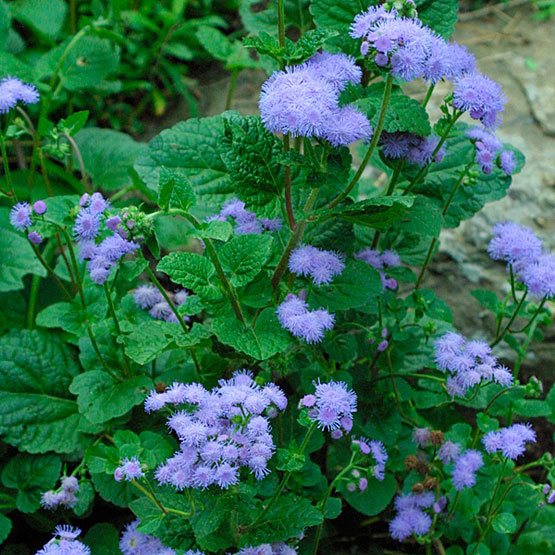
There are many cultivars available of this fast-growing annual. They are best used as bedding, edging, or container plants. Panicles of blue, pink, purple, or white flowerheads arise from oval, downy leaves in midsummer and continue until frost. They have a soft, fuzzy appearance and attract butterflies.

Ageratum houstonianum 'Blue Danube' Ageratum houstonianum 'Blue Danube'
('Blue Danube' ageratum, 'Blue Danube' floss flower)
Be the first to rate this plant

This early, compact bloomer grows to only about 6 or 7 inches tall. With its icy blue-purple flowers, it works well when planted tightly along the foreground of a bed. Its color blends easily with most other hues and textures. -Julia Jones, Designing with annueals, Fine Gardening issue #120


