
previous
  • Make a Succulent Topiary
    Make a Succulent Topiary
  • Mulch for a Healthy Garden
    Mulch for a Healthy Garden
  • Plant an Easy-to-Water Strawberry Jar
    Plant an Easy-to-Water Strawberry Jar
  • Containers as Focal Points
    Containers as Focal Points
  • Save Money by Growing Your Own
    Save Money by Growing Your Own
  • 6 Tips for Weed Control
    6 Tips for Weed Control
  • Dwarf Citrus Trees
    Dwarf Citrus Trees
  • Designing with Curved Terraces
    Designing with Curved Terraces
  • Elephant's Ears
    Elephant's Ears
  • Comfortable Alfresco Dining
    Comfortable Alfresco Dining
  • NEW Video Series: There's a Better Way
    NEW Video Series: There's a Better Way
  • Homegrown / Homemade
    Homegrown / Homemade
  • Garden Confidential: A Plant Walks into a Bar
    Garden Confidential: A Plant Walks into a Bar
  • Fast-Growing Trees for Impatient Gardeners
    Fast-Growing Trees for Impatient Gardeners
  • Indeterminate or Determinate Tomatoes?
    Indeterminate or Determinate Tomatoes?
  • Stylish Shady Containers
    Stylish Shady Containers
  • In Pursuit of the Perfect Potting Shed
    In Pursuit of the Perfect Potting Shed
  • Thoughts From a Foreign Field
    Thoughts From a Foreign Field
  • Colorful Selections for Shade
    Colorful Selections for Shade
  • Building a Compost Bin
    Building a Compost Bin
  • Pretty in Pink
    Pretty in Pink
  • Slideshow: Beautiful Clematis
    Slideshow: Beautiful Clematis
  • Fragrant Plants for Pathways
    Fragrant Plants for Pathways
  • Lawn Alternatives
    Lawn Alternatives
  • Plants that Spark!
    Plants that Spark!
next

Genus Agastache

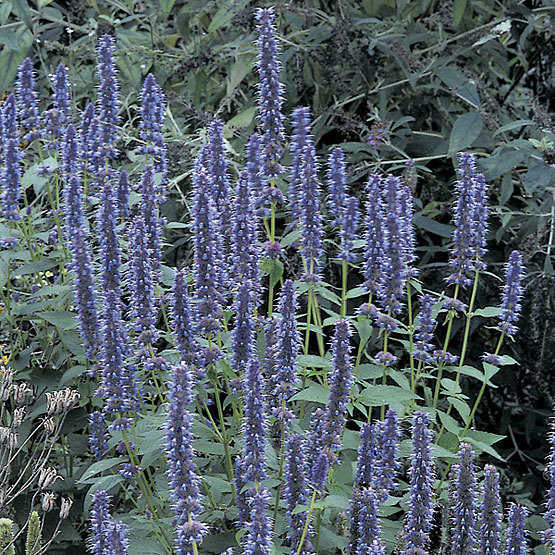
Agastache Agastache 'Blue Fortune' Photo/Illustration: Courtesy of White Flower Farm
ag-ah-STAK-ee
Thirty species of aromatic perennials make up this genus. They are known for their long-lasting flower spikes and ability to tolerate heat and early frosts. Hummingbirds, bees, butterflies, and other insects love them. Some are native to the U.S.
Noteworthy characteristics: Long bloom time; aromatic foliage; beautiful flower spikes. Many cultivars are available.
Care: Agastache like well-drained, fertile soil in full sun. May be grown as annuals and in containers where not hardy.
Propagation: Divide in spring. Sow seed at 55° to 64°F in early spring. Root semi-ripe cuttings in summer.
Problems: Generally trouble free, but mildew and rust may affect leaves in dry weather. Downy mildew and other fungal leaf diseases are less common.

Species, varieties and cultivars for genus Agastache

Agastache 'Desert Sunrise' Agastache 'Desert Sunrise'
(Hummingbird mint)
(2 user reviews)
Hardiness Zones: 1 2 3 4 5 6 7 8 9 10 11

This hummingbird mint boasts large spikes of reddish-pink tubular flowers with an orange tint over a long season in summer and early fall. The whole plant is aromatic. Grow in a bed, border, rock garden, or xeric garden.

Agastache ‘Summer Breeze’ Agastache ‘Summer Breeze’
(1 user review)
Hardiness Zones: 1 2 3 4 5 6 7 8 9 10 11

Agastache ‘Summer Breeze’ produces hundreds of 1.5-inch-long translucent, tubular blossoms. The flowers are painted in luscious sunset shades and appear from late spring to frost. In hot weather, peach, champagne, and soft pink are its colors, while in cooler months the flowers darken to pale copper and medium rose. It forms an open, airy, 2- to 3-foot-tall clump, and the upper third of each stem bears a long succession of hummingbird-attracting blooms.

Agastache ‘Blue Fortune’ Agastache ‘Blue Fortune’
(Blue Fortune hyssop)
(2 user reviews)
Hardiness Zones: 1 2 3 4 5 6 7 8 9 10 11

'Blue Fortune' produces spikes of powder-blue flowers held over large, deep green foliage. The plant stands approximately 36 inches tall with a mature width of 18 inches. Peak bloom occurs in midsummer when butterflies are plentiful.

Agastache ‘Tutti Frutti’ Agastache ‘Tutti Frutti’
(1 user review)
Hardiness Zones: 1 2 3 4 5 6 7 8 9 10 11

This is an erect, bushy perennial with scented gray-green leaves. Its raspberry-red flowers grow on loose, foot-long spikes from midsummer to late fall. The flower spikes have a long bloom period and attract hummingbirds, butterflies, and other insects.  

Agastache aurantiaca 'Just Peachy' Agastache aurantiaca 'Just Peachy'
('Just Peachy' hummingbird mint, 'Just Peachy' hyssop)
Be the first to rate this plant
Hardiness Zones: 1 2 3 4 5 6 7 8 9 10 11

A cultivar discovered at High Country Gardens in Santa Fe, New Mexico, this aromatic, water-wise perennial grows to 30 inches tall and 18 inches wide and features fine, mint-scented, gray-green leaves and spikes of tubular flowers in shades of  soft pink and peach from summer to early fall. The plant is hugely attractive to hummingbirds, hence its common name. It is resistant to heat and drought, and can be used in both mixed borders and containers.

Agastache aurantiaca 'Shades of Orange' Agastache aurantiaca 'Shades of Orange'
('Shades of Orange' hummingbird mint, 'Shades of Orange' hyssop)
Be the first to rate this plant
Hardiness Zones: 1 2 3 4 5 6 7 8 9 10 11

A cultivar discovered at High Country Gardens in Santa Fe, New Mexico, this aromatic, water-wise perennial grows to 30 inches tall and 18 inches wide and features fine, mint-scented, gray-green leaves and spikes of tubular flowers in shade of orange from mid-summer to fall. The plant is hugely attractive to hummingbirds, hence the common name.

Agastache cana Agastache cana
(Texas hummingbird mint, Mosquito plant, Wild hyssop)
(2 user reviews)
Hardiness Zones: 1 2 3 4 5 6 7 8 9 10 11

This is a 36-inch-tall hyssop with showy rose-pink flower spikes in late summer and fall and licorice-mint scented foliage. It is native to New Mexico and western Texas and attracts butterflies and hummingbirds. Grow in a border, herb garden, rock garden, or butterfly garden. Rubbing the foliage on skin reportedly repels mosquitoes.

Agastache foeniculum Agastache foeniculum
(Anise hyssop)
(2 user reviews)
Hardiness Zones: 1 2 3 4 5 6 7 8 9 10 11

A classic plant for both herb gardens and borders, anise hyssop is composed of erect branches of mint-and-licorice-scented, medium green leaves ending in fuzzy spikes of small lavender flowers. The plant grows to 3 to 5 feet tall and 1 foot wide and reseeds freely. The flowers are edible and are charming crumbled into salads. The flowers are highly attractive to bees, butterflies, and hummingbirds.

Agastache foeniculum 'Golden Jubilee' Agastache foeniculum 'Golden Jubilee'
(Anise hyssop)
(1 user review)
Hardiness Zones: 1 2 3 4 5 6 7 8 9 10 11

Anise hyssop has subtle but eye-catching chartreuse foliage. Its powder-blue, long-lasting flowers contrast nicely with its leaves.

Agastache rugosa Agastache rugosa
(Wrinkled giant hyssop, Korean hyssop, purple giant hyssop)
Be the first to rate this plant
Hardiness Zones: 1 2 3 4 5 6 7 8 9 10 11

This 4-foot-tall and 18-ich-wide, bushy perennial, very similar to the more common anise hyssop (Agastache foeniculum) has strongly mint-and-licorice-scented leaves and short spikes of lavender-blue flowers from midsummer to early fall. Unlike most agastaches, both of these species can tolerate more moisture and humity, making them highly suited to climates outside the arid west.

Agastache rupestris Agastache rupestris
(Sunset hyssop)
(1 user review)
Hardiness Zones: 1 2 3 4 5 6 7 8 9 10 11

True to its name, sunset hyssop encapsulates a Western sunset in its flowers: bronze with hints of orange and yellow, and streaks of magenta and pink along the margins. More and more flowers emerge as summer progresses. The plant blooms heavily in August, and continues into autumn.


