
Genus Actaea (Baneberry)

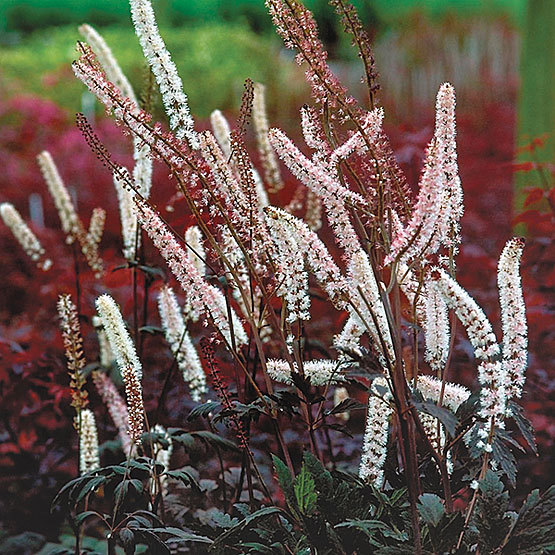
Actaea Actaea simplex Photo/Illustration: Courtesy of Monrovia
ak-TAY-ah Common Name: Baneberry
Actaea is comprised of eight species of woodland perennials with toothed leaves, fluffy flowers, and conspicuous berries. They are from temperate regions of the Northern hemisphere and make useful additions to a woodland garden or shady border. The flowers are generally not showy, but the leaves are often attractive and the colorful berries, sometimes resembling doll's eyes, stand out in the garden. Some species will thrive even in dry, full shade.
Noteworthy characteristics: Berries are highly toxic. Good woodland garden plants.
Care: Prefers cool, moist soil of moderate fertility that has been enriched with leaf mold in partial shade. Water during dry spells.
Propagation: Sow seed in autumn in a cold frame, or divide in early spring.
Problems: Ramularia and Ascochyta leaf spots and leaf smut can affect plants.

Species, varieties and cultivars for genus Actaea

Actaea pachypoda Actaea pachypoda
(White baneberry, White cohosh)
Be the first to rate this plant
Hardiness Zones: 1 2 3 4 5 6 7 8 9 10 11

This 3-foot-tall and 2-foot-wide clumping perennial displays spiky racemes of white flowers in late spring and early summer followed by bright white berries with dark tips on bright red stalks. The berries are exceptionally showy and especially effective in shady woodland beds.

Actaea racemosa Actaea racemosa
(Black cohosh, Black snakeroot, Bugbane)
Be the first to rate this plant
Hardiness Zones: 1 2 3 4 5 6 7 8 9 10 11

Actaea racemosa is a native woodland perennial with white, somewhat fuzzy flowers in midsummer that wave above astilbe-like, deeply cut foliage. The flowers can be unpleasantly scented, thus the name "bugbane." Formerly in the genus Cimicifuga, this plant is great for use in a woodland garden or moist border.

Actaea rubra Actaea rubra
(Red baneberry, Snakeberry)
(1 user review)
Hardiness Zones: 1 2 3 4 5 6 7 8 9 10 11

Actaea rubra bears white flowers from spring to early summer on plants up to 2 feet tall and 1 foot wide. In late summer, glossy red berries develop. A few cultivars exist. This woodland perennial is native to the U.S.

Actaea simplex Actaea simplex
(Autumn bugbane, Autumn snakeroot)
Be the first to rate this plant
Hardiness Zones: 1 2 3 4 5 6 7 8 9 10 11

This clumping woodland perennial with deep green foliage up to 4 feet tall and 2 feet wide bears spikes of  fragrant white flowers 1 to 2 feet long in fall. Cultivars exist with varying leaf colors and forms.

Actaea simplex 'Brunette' Actaea simplex 'Brunette'
(Baneberry, Snakeroot)
(1 user review)
Hardiness Zones: 1 2 3 4 5 6 7 8 9 10 11

This chocolate-leaved cultivar up to 4 feet tall and 2 feet wide bears compact spikes of white flowers in late summer. This plant may languish in very warm temperatures. The flowers remain ornamental for three to four weeks.

Actaea simplex ‘Hillside Black Beauty’ Actaea simplex ‘Hillside Black Beauty’
(Bugbane, Autumn snakeroot, black cohosh)
Be the first to rate this plant
Hardiness Zones: 1 2 3 4 5 6 7 8 9 10 11

'Hillside Black Beauty' differs from other bugbanes because of its deep purple–black foliage. From late spring to late summer, it provides the perfect backdrop for colorful foliage and flowering shade plants (it’s even deer resistant). In fall, fragrant, cream-colored flowers emerge on wandlike, 5- to 6-foot-tall wiry stems.


