previous
  • Soil Testing is Worth the Effort
    Soil Testing is Worth the Effort
  • 15 Deer-Resistant Plants
    15 Deer-Resistant Plants
  • Find the Perfect Tomato
    Find the Perfect Tomato
  • Enchanting Japanese Maples
    Enchanting Japanese Maples
  • Bold and Beautiful Zinnias
    Bold and Beautiful Zinnias
  • Garden Catalog Collector
    Garden Catalog Collector
  • Friendly Ways to Battle Garden Pests
    Friendly Ways to Battle Garden Pests
  • 10 Perennials Easily Grown from Seed
    10 Perennials Easily Grown from Seed
  • Off With Their Heads: Deadheading Perennials
    Off With Their Heads: Deadheading Perennials
  • Viburnums are Versatile Shrubs
    Viburnums are Versatile Shrubs
  • Video: Make a Straw-Bale Garden
    Video: Make a Straw-Bale Garden
  • Building a Compost Bin
    Building a Compost Bin
  • The Only Shrubs You Need to Grow
    The Only Shrubs You Need to Grow
  • 25 Robust Summer Bloomers
    25 Robust Summer Bloomers
  • How to Grow Raspberries
    How to Grow Raspberries
  • Backyard Makeover Game
    Backyard Makeover Game
  • Lilacs: Time for a Fresh Look
    Lilacs: Time for a Fresh Look
  • How to Start a Vegetable Garden
    How to Start a Vegetable Garden
  • Make Your Own Hypertufa Container
    Make Your Own Hypertufa Container
  • Free Download: Rose Pruning and Bed Prep
    Free Download: Rose Pruning and Bed Prep
  • A gardener's checklist for early summer
    A gardener's checklist for early summer
  • All About Starting Seeds
    All About Starting Seeds
  • Big Flowers from Bigleaf Hydrangeas
    Big Flowers from Bigleaf Hydrangeas
  • Variegated Plants Create Drama
    Variegated Plants Create Drama
  • Perfect Edges for Your Beds and Borders
    Perfect Edges for Your Beds and Borders
next

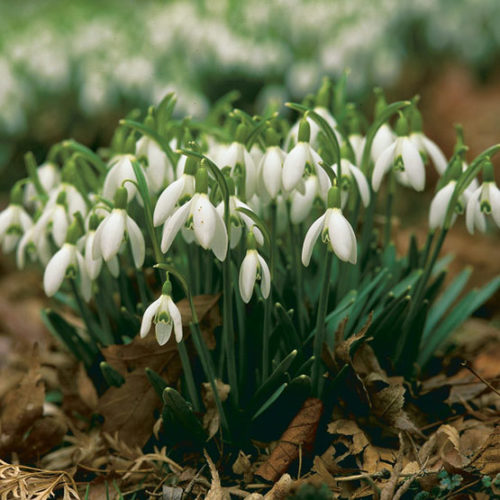
Galanthus nivalis (common snowdrop)

Galanthus nivalis Photo/Illustration: Steve Silk


Be the first to rate this plant

Plant Showcase - from our advertisers


Hardiness Zones: 1 2 3 4 5 6 7 8 9 10 11
Botanical Name: Galanthus nivalis gah-LAN-thuss niv-ALL-iss Common Name: common snowdrop Genus: Galanthus
Snowdrops are some of the earliest bulbs, and flowers in general, to bloom in spring. Galanthus nivalis is the most common species, and its cultivars are the most commonly grown snowdrops on the market. They are reliably hardy and perennial. They grow to 4 inches tall and wide and flower in mid- to late winter, long before most other plants. They are the first sign of spring around the corner. Flowers are nodding and white.
Care: Plant bulbs in fall at a depth three times the height of the bulb. Provide full sun to partial shade and moist, well-drained soil in USDA Hardiness Zones 3 to 8.
Propagation:

 Lift and divide clumps just after flowering. Replant and allow leaves to die back naturally.


Problems:

 No serious problems


Height Less than 6 in.
Spread Less than 6 in.
Growth Habit Clumps
Growth Pace Moderate Grower
Light Full Sun Only;Full Sun to Part Shade;Part Shade Only
Moisture Medium Moisture
Maintenance Low
Tolerance Frost Tolerant
Characteristics Showy Flowers
Bloom Time Early Spring; Spring; Winter
Flower Color White Flower
Uses Beds and Borders, Naturalizing
Style Cottage Garden, Meadow Garden
Seasonal Interest Winter Interest, Spring Interest
Type Bulbs

Plants you might also like

Galanthus elwesii Galanthus elwesii
(giant snowdrop)
Be the first to rate this plant
Hardiness Zones: 1 2 3 4 5 6 7 8 9 10 11

The giant snowdrop has larger flowers and broader leaves than the more common G. nivalis, but grows to the same 4 inches tall and wide. Its white, nodding blooms appear in late winter, signalling spring around the corner.

Crocus vernus Crocus vernus
(Dutch crocus)
(1 user review)
Hardiness Zones: 1 2 3 4 5 6 7 8 9 10 11

Dutch crocus is one of the hardiest, if not the hardiest, crocus species readily available to home gardeners. A true harbinger of spring, it can be planted in borders, rock gardens, and even lawns. After flowering, the foliage must be left intact until it withers, which may cause lawn-mower anxiety in some gardeners. Often sold as "mixed crocus," cultivars of this species are typically white, lilac, or purple and white striped.

Narcissus 'Ceylon' Narcissus 'Ceylon'
(Large-Cupped Daffodil)
Be the first to rate this plant
Hardiness Zones: 1 2 3 4 5 6 7 8 9 10 11

This daffodil has large, long-lasting flowers that are a deep, sunny yellow with orange cups. Plant these in large groups for a specular mid-season show. Great for forcing indoors.

Narcissus 'Jack Snipe' Narcissus 'Jack Snipe'
(Daffodil)
Be the first to rate this plant
Hardiness Zones: 1 2 3 4 5 6 7 8 9 10 11

Generally speaking, daffodils perform best in full sun and well-drained soil, in areas where there is a fair amount of rainfall in the fall and spring and where the summer is relatively dry. However, cyclamineus-type daffodils seem to tolerate at least partial shade and more moisture than others do. Narcissus ‘Jack Snipe’ (pre-1951, Zones 3–8) is a charming example of this type of daffodil. Its white petals are swept back, as if it were standing in front of a fan, and its medium-length, buttercup-yellow trumpet (or nose) sticks straight out at a 90 degree angle from the stem.  ‘Jack Snipe’ is an intermediate-size daffodil, standing only 8 to 10 inches tall, and is perfect for a rock garden or the front of a flower border. This whole division of daffodils is becoming more popular not only because it tolerates some shade but also because the shape of the flower is so handsome.

Tulipa greigii 'Calypso' Tulipa greigii 'Calypso'
(Tulip)
Be the first to rate this plant
Hardiness Zones: 1 2 3 4 5 6 7 8 9 10 11

The 12-inch-tall Tulipa 'Calypso' (1992) is known for being reliably perennial. It has decorative stippled leaves and large orange-red flowers rimmed with primrose and a black base.