previous
  • Comfortable Alfresco Dining
    Comfortable Alfresco Dining
  • Garden Confidential: A Plant Walks into a Bar
    Garden Confidential: A Plant Walks into a Bar
  • Designing with Curved Terraces
    Designing with Curved Terraces
  • Elephant's Ears
    Elephant's Ears
  • Fragrant Plants for Pathways
    Fragrant Plants for Pathways
  • Plant an Easy-to-Water Strawberry Jar
    Plant an Easy-to-Water Strawberry Jar
  • Colorful Selections for Shade
    Colorful Selections for Shade
  • NEW Video Series: There's a Better Way
    NEW Video Series: There's a Better Way
  • Thoughts From a Foreign Field
    Thoughts From a Foreign Field
  • In Pursuit of the Perfect Potting Shed
    In Pursuit of the Perfect Potting Shed
  • Mulch for a Healthy Garden
    Mulch for a Healthy Garden
  • Lawn Alternatives
    Lawn Alternatives
  • Homegrown / Homemade
    Homegrown / Homemade
  • Containers as Focal Points
    Containers as Focal Points
  • Save Money by Growing Your Own
    Save Money by Growing Your Own
  • Dwarf Citrus Trees
    Dwarf Citrus Trees
  • Plants that Spark!
    Plants that Spark!
  • Slideshow: Beautiful Clematis
    Slideshow: Beautiful Clematis
  • 6 Tips for Weed Control
    6 Tips for Weed Control
  • Fast-Growing Trees for Impatient Gardeners
    Fast-Growing Trees for Impatient Gardeners
  • Make a Succulent Topiary
    Make a Succulent Topiary
  • Indeterminate or Determinate Tomatoes?
    Indeterminate or Determinate Tomatoes?
  • Stylish Shady Containers
    Stylish Shady Containers
  • Pretty in Pink
    Pretty in Pink
  • Building a Compost Bin
    Building a Compost Bin
next

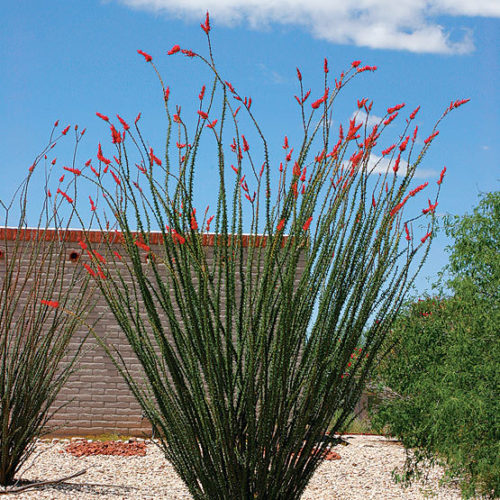
Fouquieria splendens (Ocotillo)

Fouquieria splendens Photo/Illustration: Jennifer Benner


Be the first to rate this plant

Plant Showcase - from our advertisers


Hardiness Zones: 1 2 3 4 5 6 7 8 9 10 11
Botanical Name:Fouquieria splendens fo-kwee-AIR-ee-ah SPLEN-denz Common Name: Ocotillo Genus: Fouquieria
This southwestern native shrub grows to 20 feet tall and 15 feet wide and sports long, dull, spiny stems that green up and leaf out after a rain, followed by long, scarlet flowers that attract hummingbirds.When dry conditions return, ocotillo drops its leaves again. This cycle can replay several times a season. Great as a surprising specimen or forbidding hedge.
Care: Situate ocotillo in full sun and well-drained soil, preferably in an arid region. Ocotillo prefers lean, neutral to alkaline soil. Supply minimal supplemental water.
Propagation:

 Grow new plants from seeds or cuttings.


Problems:

 Aphids, spider mites, stem borers, or powdery mildew may be a problem.


Height 15 ft. to 30 ft.
Spread 10 ft. to 15 ft.
Growth Pace Moderate Grower
Light Full Sun Only
Moisture Dry;Dry to Medium
Tolerance Drought Tolerant
Characteristics Attracts Hummingbirds; Native; Showy Flowers; Showy Foliage
Bloom Time Fall; Spring; Summer
Flower Color Red Flower
Uses Texture, Hedge, Specimen Plant/ Focal Point, Desert Garden, Xeric Bed, Summer Interest
Type Shrubs,Natives

Plants you might also like

Robinia hispida Robinia hispida
(Rose acacia, Bristly locust)
Be the first to rate this plant
Hardiness Zones: 1 2 3 4 5 6 7 8 9 10 11

This showy flowering shrub grows to 8 feet tall and wide and features dark green, compound pinnate leaves on bristly stems and pendant clusters of fragrant, pea-like, rose-pink flowers that are attractive to bees and butterflies in late spring and early summer. The flowers are occasionally followed by bristly, reddish-brown seed pods. Native to the southeastern United States, this aggressive shrub spreads by suckers and is considered invasive in Michigan, New Jersey, Ohio, Pennsylvania, and Washington. All parts of this plant are at least mildly poisonous.

Heteromeles arbutifolia Heteromeles arbutifolia
(Toyon, Christmas berry, California holly)
Be the first to rate this plant
Hardiness Zones: 1 2 3 4 5 6 7 8 9 10 11

This evergreen, California-native shrub grows to 20 feet tall and wide and produces abundant clusters of tiny white flowers in early summer, which attract beneficial insects that help control pests. This is followed by bright red berries that feed wildlife in fall and winter. The only species of its genus, Toyon is closely related to the genus Photinia.

Ruellia peninsularis Ruellia peninsularis
(Desert ruellia)
Be the first to rate this plant
Hardiness Zones: 1 2 3 4 5 6 7 8 9 10 11

This southern California native shrub produces a dense mass of small, glossy leaves and purple, petunia-like flowers in late spring and early summer. Sporadic flowering can occur throughout the season. It grows up to 4 feet tall and 6 feet wide.

Hydrangea quercifolia Hydrangea quercifolia
(Oakleaf hydrangea)
(2 user reviews)
Hardiness Zones: 1 2 3 4 5 6 7 8 9 10 11

Oakleaf hydrangeas originated along the sandy streams of the southeastern United States, and they are more drought tolerant than many other hydrangeas. Their matte green leaves are coarsely textured and deeply lobed, and in fall they turn red and purple. White flower heads form in spring, and as summer draws to a close they turn shades of pink, green, and ecru. -Nellie Neal, Regional Picks: Southeast, Fine Gardening issue #127

Fothergilla 'Blue Shadow' Fothergilla 'Blue Shadow'
(Dwarf Fothergilla, Dwarf Witch Alder )
Be the first to rate this plant
Hardiness Zones: 1 2 3 4 5 6 7 8 9 10 11

These shrubs are beautiful, compact, and easy to grow, making them obvious choices for mixed borders, foundation plantings, and naturalizing. The fragrant, bottlebrush flowers are petalless and sweetly-scented.