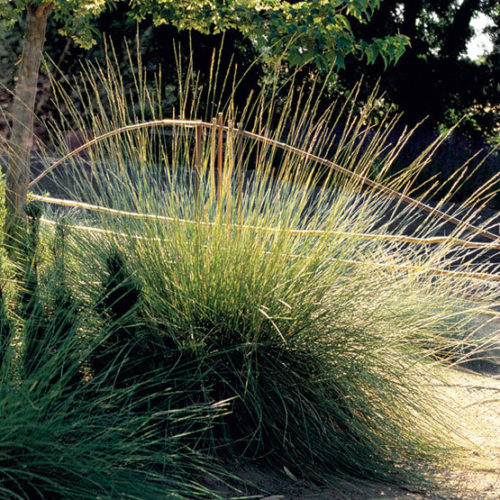
Festuca mairei (Atlas fescue)

Festuca mairei Photo/Illustration: Saxon Holt


Be the first to rate this plant

Plant Showcase - from our advertisers


Hardiness Zones: 1 2 3 4 5 6 7 8 9 10 11
Botanical Name:Festuca mairei fess-TOO-kah MARE-ee-eye Common Name: Atlas fescue Genus: Festuca
This sturdy groundcover is fast becoming one of the most dependable grasses for creating drought-tolerant meadows. Clumping evergreen foliage is a rich khaki green and grows in an arching clump. The flowers, while noticeable, are not showy. Atlas fescue is at its best in groups and grows in all but hot, humid, and low desert climates.
Care: Provide full sun to light shade. It is tolerant of most any soil, but does not like extreme heat, cold, or humidity.
Propagation: Divide clumps or start from seed.
Problems: Generally trouble-free.
Height 1 ft. to 3 ft.
Spread 1 ft. to 3 ft.
Growth Habit Clumps
Light Full Sun to Part Shade
Moisture Adaptable
Maintenance Low
Tolerance Drought Tolerant
Characteristics Showy Foliage
Bloom Time Summer
Uses , Beds and Borders, Ground Covers
Style , Meadow Garden
Seasonal Interest , Summer Interest, Fall Interest
Type ,Grasses

Plants you might also like

Panicum virgatum 'Ruby Ribbons' Panicum virgatum 'Ruby Ribbons'
(Switch Grass)
Be the first to rate this plant
Hardiness Zones: 1 2 3 4 5 6 7 8 9 10 11

Panicum Ruby Ribbons’ soft blue-green foliage emerges in the spring on upright, clumping plants. The foliage takes on a wine-red color in early summer, which intensifies as the season progresses. Flower heads appear in late summer, followed by ornamental seed heads, which, if left uncut, provide long-lasting winter interest.

Elymus arenarius Elymus arenarius
(2 user reviews)
Hardiness Zones: 1 2 3 4 5 6 7 8 9 10 11

This plant has densely tufted, spreading clumps of strap-like, flowing foliage. Pale blue-gray leaves arch loosely. In summer, it produces stiff, upright, blue-gray spikes of flowers that turn buff.

Sporobolus heterolepsis Sporobolus heterolepsis
(Prairie dropseed)
(1 user review)
Hardiness Zones: 1 2 3 4 5 6 7 8 9 10 11

The finely textured, green leaves of this slow-growing, clump-forming perennial turn golden yellow in autumn. It bears cloudy panicles of fragrant, pale-pink to tawny flowers 5 to 10 inches long in late summer, reaching 3 feet tall.

Schizachyrium scoparium Schizachyrium scoparium
(Little bluestem, Prairie beard grass)
(1 user review)
Hardiness Zones: 1 2 3 4 5 6 7 8 9 10 11

Little bluestem is a tidy, finely textured clumping grass with a blue-green summer color. Its silvery seed heads rise to a height of nearly 2 feet in late summer and are at their best when backlit in the morning or afternoon sun. In fall, the grass turns a rosy rust color that lasts all winter.

Carex divulsa Carex divulsa
(Berkeley sedge)
(1 user review)
Hardiness Zones: 1 2 3 4 5 6 7 8 9 10 11

This sedge is one of the most adaptable of the ground-cover grasses. Its ability to look the same in sun or shade makes it a valuable asset in plantings that go in and out of full sun. Berkeley sedge is a good solution for areas under stress where lawn grasses often fail. The flowers are not particularly noteworthy.