previous
  • In Pursuit of the Perfect Potting Shed
    In Pursuit of the Perfect Potting Shed
  • Slideshow: Beautiful Clematis
    Slideshow: Beautiful Clematis
  • Mulch for a Healthy Garden
    Mulch for a Healthy Garden
  • Plants that Spark!
    Plants that Spark!
  • Garden Confidential: A Plant Walks into a Bar
    Garden Confidential: A Plant Walks into a Bar
  • Make a Succulent Topiary
    Make a Succulent Topiary
  • Elephant's Ears
    Elephant's Ears
  • Thoughts From a Foreign Field
    Thoughts From a Foreign Field
  • Designing with Curved Terraces
    Designing with Curved Terraces
  • Fast-Growing Trees for Impatient Gardeners
    Fast-Growing Trees for Impatient Gardeners
  • NEW Video Series: There's a Better Way
    NEW Video Series: There's a Better Way
  • Lawn Alternatives
    Lawn Alternatives
  • Homegrown / Homemade
    Homegrown / Homemade
  • Fragrant Plants for Pathways
    Fragrant Plants for Pathways
  • Building a Compost Bin
    Building a Compost Bin
  • Comfortable Alfresco Dining
    Comfortable Alfresco Dining
  • Stylish Shady Containers
    Stylish Shady Containers
  • Dwarf Citrus Trees
    Dwarf Citrus Trees
  • Save Money by Growing Your Own
    Save Money by Growing Your Own
  • 6 Tips for Weed Control
    6 Tips for Weed Control
  • Pretty in Pink
    Pretty in Pink
  • Plant an Easy-to-Water Strawberry Jar
    Plant an Easy-to-Water Strawberry Jar
  • Colorful Selections for Shade
    Colorful Selections for Shade
  • Containers as Focal Points
    Containers as Focal Points
  • Indeterminate or Determinate Tomatoes?
    Indeterminate or Determinate Tomatoes?
next

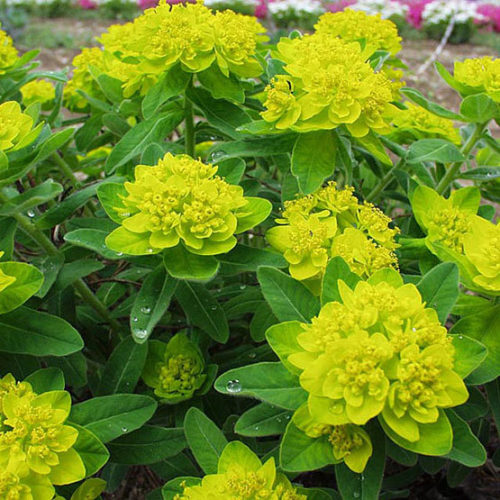
Euphorbia polychroma (Cushion spurge)

Euphorbia polychroma Photo/Illustration: Courtesy of Bluestone Perennials

(Based on 1 user review)

Rate this plant

Plant Showcase - from our advertisers


Hardiness Zones: 1 2 3 4 5 6 7 8 9 10 11
Botanical Name: Euphorbia polychroma yew-FOR-bee-ah pol-ee-KRO-mah Common Name: Cushion spurge Genus: Euphorbia
Electric yellow bracts bloom on a low cushion in April and persist, but gently fade as the stems elongate to form a 16-inch mound by midsummer. The leaves produce shades of red, orange, and purple in autumn.
Noteworthy characteristics: Milky sap may cause irritation to skin and severe discomfort if ingested.
Care: Grow in full sun to partial shade, in moist but well-drained soil. It self-sows regularly. 
Propagation: Sow seeds when ripe or in spring; divide in early spring.
Problems: Nematodes, spider mites, aphids, mealybugs, fungal and bacterial diseases.
Height 1 ft. to 3 ft.
Spread 1 ft. to 3 ft.
Growth Habit Clumps
Growth Pace Moderate Grower
Light Full Sun to Part Shade
Moisture Medium Moisture
Maintenance Low
Tolerance Deer Tolerant
Characteristics Self Seeds; Showy Fall Foliage; Showy Flowers
Bloom Time Early Summer; Late Spring; Spring; Summer
Flower Color Yellow Flower
Uses Beds and Borders, Ground Covers
Seasonal Interest Spring Interest, Summer Interest, Fall Interest
Type Perennials

Plants you might also like

no image available Euphorbia 'Helena’s Blush™'
Be the first to rate this plant
Hardiness Zones: 1 2 3 4 5 6 7 8 9 10 11

This hybrid has petite green-and-cream variegated foliage with a hint of pink on the undersides. It produces chartreuse and apple green bicolored bracts on airy stems.

Corydalis lutea Corydalis lutea
(Yellow corydalis)
(3 user reviews)
Hardiness Zones: 1 2 3 4 5 6 7 8 9 10 11

This species has bluntly spurred golden yellow flowers from late spring to early fall. Its pale green, glaucous leaves form compact, ferny mounds.

Hemerocallis 'Blackeyed Stella' Hemerocallis 'Blackeyed Stella'
(Daylily)
Be the first to rate this plant
Hardiness Zones: 1 2 3 4 5 6 7 8 9 10 11

Daylilies are classic, extremely popular garden plants. They feature long, arching, strappy leaves and long stems of generally 6-petaled flowers, though double flowers are popular as well. Each flower lasts only one day, hence the plant’s common name. Daylilies come in a wide range of colors, from cream and cheery yellow to peach, orange, fiery red, deep burgundy, pink, and purple. Some have contrasting throats and "eye-zones." Daylilies are ideal for a mixed herbaceous perennial border.

Hemerocallis 'Happy Returns' Hemerocallis 'Happy Returns'
(Daylily)
(15 user reviews)
Hardiness Zones: 1 2 3 4 5 6 7 8 9 10 11

This pale-yellow-flowered daylily distinguishes itself with its profuse bloom and compact size (only 16 inches tall), making it good for containers and the borders. It is an early season bloomer with circular flowers that open in late afternoon and last through the night.

Campanula poscharskyana 'Blue Waterfall' Campanula poscharskyana 'Blue Waterfall'
(Serbian bellflower)
(3 user reviews)
Hardiness Zones: 1 2 3 4 5 6 7 8 9 10 11

Serbian bellflowers have an easy, undemanding habit. Creating a stream of lavender blue, the 1-inch-diameter star-shaped blossoms bloom reliably from late spring to early fall. The foliage remains evergreen in mild winters and needs to be sheared only once in a while to keep its appearance tidy. 'Blue Waterfall' flows beautifully along bed edges and through rock gardens in full sun to partial shade.