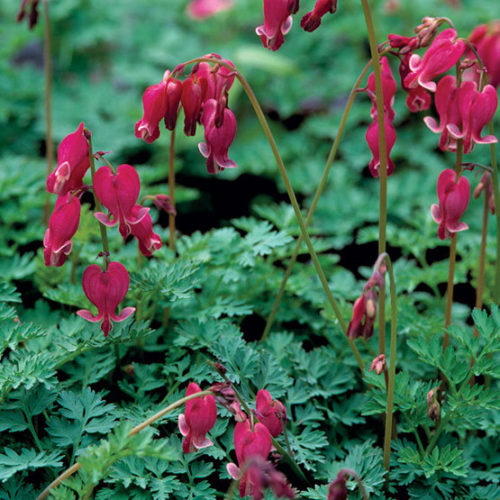
Dicentra formosa (Western bleeding heart)

Dicentra formosa Photo/Illustration: Bill Johnson

(Based on 1 user review)

Rate this plant

Plant Showcase - from our advertisers


Hardiness Zones: 1 2 3 4 5 6 7 8 9 10 11
Botanical Name: Dicentra formosa dy-SEN-trah for-MOE-sah Common Name: Western bleeding heart Genus: Dicentra
Don't let its delicate appearance fool you: Western bleeding heart is hardy and tenacious. This elegant, herbaceous perennial spreads slowly from rhizomes to form drifts of soft blue-green, ferny foliage in shady woodland areas. Above the leaves in late spring, pink heart-shaped flowers hang gracefully from long, arched stems, attracting scores of hummingbirds but not the local deer. It is surprisingly drought tolerant during the summer months.
Noteworthy characteristics: Ferny foliage; pink, heart-shaped flowers; attracts hummingbirds.
Care: Grow in partial shade and moist, fertile soil.
Propagation: Divide in early spring.
Height 6 in. to 12 in.
Spread 1 ft. to 3 ft.
Growth Habit Spreads
Light Part Shade Only
Moisture Medium Moisture
Maintenance Low
Tolerance Deer Tolerant;Drought Tolerant
Characteristics Attracts Hummingbirds; Native; Showy Flowers; Showy Foliage
Bloom Time Late Spring
Flower Color Pink Flower
Uses , Beds and Borders, Ground Covers
Style , Woodland Garden
Seasonal Interest , Spring Interest
Type ,Perennials

Plants you might also like

Dicentra eximia ‘Alba’ Dicentra eximia ‘Alba’
(Fringed bleeding heart, Turkey corn)
(1 user review)
Hardiness Zones: 1 2 3 4 5 6 7 8 9 10 11

Rows of white flowers dangle above the fern-like foliage, opening in April and continuing intermittently until October.

Phlox divaricata 'Clouds of Perfume' Phlox divaricata 'Clouds of Perfume'
(Blue phlox, Wild sweet William, Woodland phlox)
Be the first to rate this plant
Hardiness Zones: 1 2 3 4 5 6 7 8 9 10 11

This is a very fragrant native woodland phlox with powder-blue flowers in spring. Reaching only 1 foot tall, it can spread to almost 2 feet and makes an attractive groundcover under shrubs or planted with other spring-blooming wildflowers. Leaves are semi-evergreen and hairy; stems root along their length. The blue flowers are salverform with petal lobes. This plant attracts hummingbirds and butterflies.

Pulmonaria saccharata 'Mrs. Moon' Pulmonaria saccharata 'Mrs. Moon'
(Bethlehem sage, lungwort)
Be the first to rate this plant
Hardiness Zones: 1 2 3 4 5 6 7 8 9 10 11

This cheerful, reliable plant brings a nice touch of color to the garden in spring. The leaves are pointed and hairy and splattered with silvery blotches. As the plant grows, the leaves overlap, creating a swirly pattern. In spring, clusters of silky pink flowers appear. They fade to a soft blue that harmonizes well with the leaf color.

no image available Euphorbia 'Helena’s Blush™'
Be the first to rate this plant
Hardiness Zones: 1 2 3 4 5 6 7 8 9 10 11

This hybrid has petite green-and-cream variegated foliage with a hint of pink on the undersides. It produces chartreuse and apple green bicolored bracts on airy stems.

Convallaria majalis Convallaria majalis
(Lily of the Valley, May bells)
(1 user review)
Hardiness Zones: 1 2 3 4 5 6 7 8 9 10 11

Lily of the valley's bell-shaped, sweetly scented flowers bloom in early spring. It likes partial to full shade and is perfect for a woodland garden. It may not be the best choice for your beds and borders because it tends to spread, but it is a perfect ground cover if you have a large shady spot under some trees.