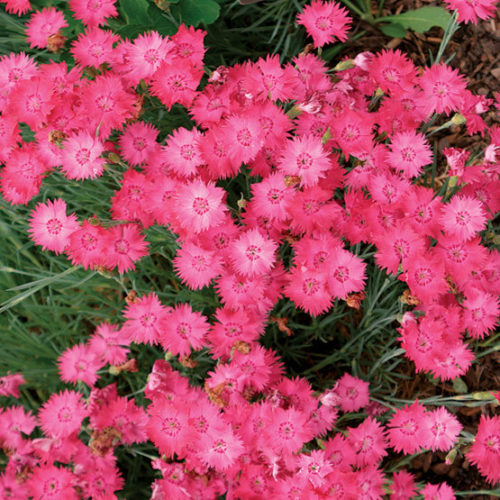
Dianthus gratianopolitanus (Cheddar pink)

Dianthus gratianopolitanus Photo/Illustration: Jennifer Benner


Be the first to rate this plant

Plant Showcase - from our advertisers


Hardiness Zones: 1 2 3 4 5 6 7 8 9 10 11
Botanical Name: Dianthus gratianopolitanus dy-ANN-thus grah-tee-ah-no-pol-ih-TAY-nus Common Name: Cheddar pink Synonyms: D. caesius Genus: Dianthus
This compact species forms broad mats of blue-gray linear leaves and is perfect for a rock garden setting. The purplish-pink flowers are solitary, toothed, and deliciously fragrant. 
Noteworthy characteristics: Long-lasting, fragrant flowers on low-growing mats.
Care: Grow in full sun and well-drained, neutral to slightly alkaline soil. Will not tolerate standing water. It is best to avoid organic mulches.
Propagation: Sow seed in a cold frame in fall. Take cuttings in summer.
Problems: Crown rot, slugs, sow bugs, grasshoppers, chipmunks, squirrels, deer.
Height 6 in. to 12 in.
Spread 1 ft. to 3 ft.
Growth Habit Spreads
Growth Pace Moderate Grower
Light Full Sun Only
Moisture Dry to Medium
Maintenance Moderate
Characteristics Attracts Butterflies; Fragrant Flowers; Showy Flowers; Showy Foliage
Bloom Time Early Summer; Late Summer; Summer
Flower Color Pink Flower; Purple/ Lavender Flower
Uses , Ground Covers
Style , Rock Garden
Seasonal Interest , Summer Interest
Type ,Perennials

Plants you might also like

Dianthus gratianopolitanus 'Firewitch' Dianthus gratianopolitanus 'Firewitch'
(Cheddar pink)
(2 user reviews)
Hardiness Zones: 1 2 3 4 5 6 7 8 9 10 11

A compact species that forms broad mats of blue-gray, linear leaves, this plant is perfect for a rock garden setting. The flowers are intense magenta with a white center, and their scent is spicy. 

Dianthus 'Bath's Pink' Dianthus 'Bath's Pink'
(Cheddar pink)
Be the first to rate this plant
Hardiness Zones: 1 2 3 4 5 6 7 8 9 10 11

Dianthus 'Bath's Pink' is a stunning, wide-spreading ground cover with grassy, blue-green foliage and pink flowers. Use it to edge a bed or grow it in your rock garden for a splash of cool color. To keep its blooms going, be sure to deadhead.

Viola ‘Etain’ Viola ‘Etain’
Be the first to rate this plant
Hardiness Zones: 1 2 3 4 5 6 7 8 9 10 11

A hardworking, compact perennial, ‘Etain’ violet forms well-behaved clumps and blooms from time to time from spring through fall. The attractive, fleshy, bright green foliage needs protection from slugs.

Salvia pratensis Salvia pratensis
(Meadow clary)
Be the first to rate this plant
Hardiness Zones: 1 2 3 4 5 6 7 8 9 10 11

This woody-stemmed perennial produces sticky spikes of deep violet or, rarely, white to pink flowers. It blooms from early summer to autumn; reblooming is most reliable if spent flowers are deadheaded promptly. It has wrinkled leaves and forms an upright clump 3 feet tall by 1 foot wide. This salvia is most noted for its many hybirds with S. nemerosa.  

Phlox paniculata 'John Fanick' Phlox paniculata 'John Fanick'
('John Fanick' garden phlox)
Be the first to rate this plant
Hardiness Zones: 1 2 3 4 5 6 7 8 9 10 11

This garden phlox has striking, bicolor lavender-and-pink flowers beginning in early summer and displays a pleasing compact form. Its slightly waxy leaves hold powdery mildew at bay, and the plant doesn't even flinch in heat, humidity, or drought. 'John Fanick' grows to 3 feet tall and 2 feet wide.