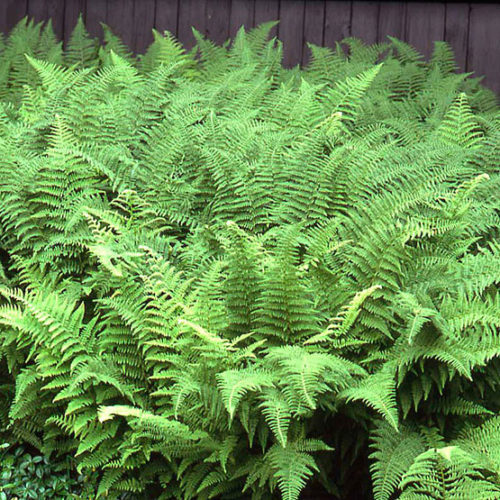
Dennstaedtia punctilobula (North American hay-scented fern)

Dennstaedtia punctilobula Photo/Illustration: Courtesy of White Flower Farm


Be the first to rate this plant

Plant Showcase - from our advertisers


Hardiness Zones: 1 2 3 4 5 6 7 8 9 10 11
Botanical Name: Dennstaedtia punctilobula den-STET-ee-ah punk-tih-LOBE-yew-lah Common Name: North American hay-scented fern Genus: Dennstaedtia
This fern's lacy foliage smells of freshly mown grass and carpets the woodland or a moist, partially sunny site. The green lushness turns golden in the fall. It is a good choice for rapid naturalizing. Use in a woodland garden or near water features.
Noteworthy characteristics: Native to North America. May be invasive.
Care: It prefers part to full shade and moist, acidic soil, but with consistent moisture it can tolerate more sun.
Propagation: Divide in spring.
Problems: Slugs, snails.
Height 1 ft. to 3 ft.
Spread Over 30 ft.
Growth Habit Spreads
Growth Pace Fast Grower;Invasive/Aggressive Grower
Light Part Shade to Full Shade
Moisture Dry to Medium
Maintenance Low
Tolerance Deer Tolerant;Frost Tolerant
Characteristics Fragrant Foliage; Native; Showy Foliage
Uses , Ground Covers, Naturalizing
Style , Woodland Garden
Seasonal Interest , Spring Interest, Summer Interest, Fall Interest
Type ,Fern

Plants you might also like

Polystichum munitum Polystichum munitum
(Western sword fern)
Be the first to rate this plant
Hardiness Zones: 1 2 3 4 5 6 7 8 9 10 11

Western sword ferns abound in the forests of the Northwestern U.S. They are robust, reliable, and virtually maintenance-free. They put up with difficult soil and manage to keep up appearances even in hot, dry weather. Their deep green, leathery fronds are attractive year-round.

Adiantum pedatum Adiantum pedatum
(Northern maidenhair fern)
Be the first to rate this plant
Hardiness Zones: 1 2 3 4 5 6 7 8 9 10 11

Northern maidenhair fern's curved fronds have wiry black stems that wave in the wind. This plant spreads slowly (by branching rhizomes) and eventually forms large colonies. Its delicate texture looks most beautiful when paired with broad-leaved plants.

Pteridium aquilinum Pteridium aquilinum
(Bracken)
Be the first to rate this plant
Hardiness Zones: 1 2 3 4 5 6 7 8 9 10 11

A native fern with triangular-shaped, stiff, upright fronds that can tolerate dry soil and full sun. Bracken can make very large colonies and are found in a variety of habitats ranging from dry and wet forests to meadows and bogs. They grow up to 4.5 feet tall.

Athyrium 'Ghost' Athyrium 'Ghost'
(Ghost fern)
Be the first to rate this plant
Hardiness Zones: 1 2 3 4 5 6 7 8 9 10 11

Here's a fern with an upright habit and silvery fronds that give it a ghostly look, hence the name. Emerging new fronds have a shimmering whitish color that darkens slowly to a silvery green with burgundy accents. 'Ghost' spreads slowly by shallow rhizomes, eventuallly becoming an excellent ground cover

Polystichum acrostichoides Polystichum acrostichoides
(Christmas fern)
Be the first to rate this plant
Hardiness Zones: 1 2 3 4 5 6 7 8 9 10 11

The Christmas fern is a particularly accommodating garden plant. It is adapted to a wide range of conditions, from very dry to moist, and is hardy to Zone 3. The plant’s 1- to 2-foot fronds are dependably evergreen—hence the common name—but they lie flat on the ground through the winter. Few hardy ferns have more beautiful deep, glossy green foliage.