previous
  • Fast-Growing Trees for Impatient Gardeners
    Fast-Growing Trees for Impatient Gardeners
  • Designing with Curved Terraces
    Designing with Curved Terraces
  • Stylish Shady Containers
    Stylish Shady Containers
  • Indeterminate or Determinate Tomatoes?
    Indeterminate or Determinate Tomatoes?
  • Plant an Easy-to-Water Strawberry Jar
    Plant an Easy-to-Water Strawberry Jar
  • Plants that Spark!
    Plants that Spark!
  • In Pursuit of the Perfect Potting Shed
    In Pursuit of the Perfect Potting Shed
  • Fragrant Plants for Pathways
    Fragrant Plants for Pathways
  • Containers as Focal Points
    Containers as Focal Points
  • Garden Confidential: A Plant Walks into a Bar
    Garden Confidential: A Plant Walks into a Bar
  • Save Money by Growing Your Own
    Save Money by Growing Your Own
  • Homegrown / Homemade
    Homegrown / Homemade
  • NEW Video Series: There's a Better Way
    NEW Video Series: There's a Better Way
  • Thoughts From a Foreign Field
    Thoughts From a Foreign Field
  • Mulch for a Healthy Garden
    Mulch for a Healthy Garden
  • Comfortable Alfresco Dining
    Comfortable Alfresco Dining
  • Colorful Selections for Shade
    Colorful Selections for Shade
  • Elephant's Ears
    Elephant's Ears
  • Make a Succulent Topiary
    Make a Succulent Topiary
  • 6 Tips for Weed Control
    6 Tips for Weed Control
  • Dwarf Citrus Trees
    Dwarf Citrus Trees
  • Lawn Alternatives
    Lawn Alternatives
  • Pretty in Pink
    Pretty in Pink
  • Slideshow: Beautiful Clematis
    Slideshow: Beautiful Clematis
  • Building a Compost Bin
    Building a Compost Bin
next

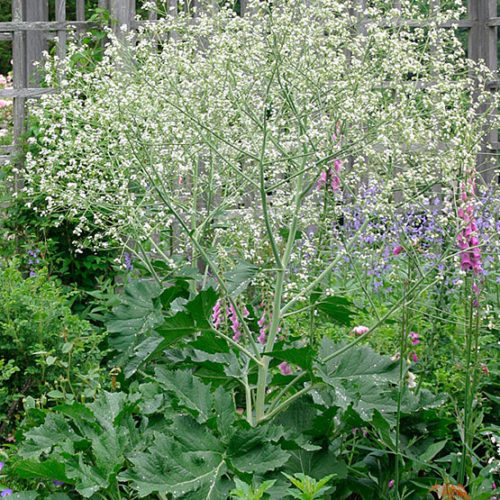
Crambe cordifolia (Colewort)

Crambe cordifolia Photo/Illustration: Michelle Gervais

(Based on 1 user review)

Rate this plant

Plant Showcase - from our advertisers


Hardiness Zones: 1 2 3 4 5 6 7 8 9 10 11
Botanical Name: Crambe cordifolia KRAM-bee kor-dih-FOE-lee-ah Common Name: Colewort Genus: Crambe
This species is notable in stature, forming a giant mound and producing a profusion of airy white flowers on tall stems in late spring to midsummer and then dying down in midsummer to late summer. Colewort can reach 8 feet high and about half as wide. Grow in a large border or open woodland.
Noteworthy characteristics: Large leaves and abundant flowers.
Care: Prefers fertile, well-drained soil in full sun, but will tolerate poorer soils in partial shade. It is susceptible to rot in moist soils, and may be short-lived. It tends to survive winters beyond Zone 6.
Propagation: Sow seed in a cold frame in spring or fall.
Problems: Clubroot, black rot, slugs, snails.
Height 6 ft. to 10 ft.
Spread 3 ft. to 6 ft.
Growth Habit Clumps
Growth Pace Fast Grower
Light Full Sun to Part Shade
Moisture Dry to Medium
Maintenance Low
Characteristics Self Seeds; Showy Flowers; Showy Foliage
Bloom Time Early Summer; Late Spring; Spring; Summer
Flower Color White Flower
Uses Beds and Borders, Specimen Plant/ Focal Point
Style Cottage Garden
Seasonal Interest Spring Interest, Summer Interest
Type Perennials

Plants you might also like

Corydalis lutea Corydalis lutea
(Yellow corydalis)
(3 user reviews)
Hardiness Zones: 1 2 3 4 5 6 7 8 9 10 11

This species has bluntly spurred golden yellow flowers from late spring to early fall. Its pale green, glaucous leaves form compact, ferny mounds.

Clematis integrifolia Mongolian Bells™ Clematis integrifolia Mongolian Bells™
Be the first to rate this plant
Hardiness Zones: 1 2 3 4 5 6 7 8 9 10 11

Clematis integrifolia is no longer only blue. This selection produces progeny with pink, white, and lavender blooms from midspring until late summer. The flowers are followed by attractive seed heads in fall. It has a compact, herbaceous form and grows to just 10 to 14 inches tall.

no image available Digitalis purpurea 'Pam's Choice'
(Common Foxglove)
Be the first to rate this plant
Hardiness Zones: 1 2 3 4 5 6 7 8 9 10 11

This is a biennial or short-lived perennial, which may last longer and rebloom if deadheaded. It sports dramatic blossoms in contrasting colors in spires reaching six feet high in rich soil, but more likely to 3 or 4 feet. 

Dianthus deltoides Dianthus deltoides
(Maiden pink)
(1 user review)
Hardiness Zones: 1 2 3 4 5 6 7 8 9 10 11

This mat-forming species with dark green leaves is one of the easiest to grow.  Blossoms range from white to red and are usually single and without fragrance. Use as bedding or in rock gardens.

Achillea millefolium

Achillea millefolium


(Yarrow)
(2 user reviews)
Hardiness Zones: 1 2 3 4 5 6 7 8 9 10 11

This rhizomic, mat-forming and aggressive perennial frows to 2 feet tall and wide with ferny, finely-textured, green foliage. Flowers are produced in flat corymbs in early to late summer.