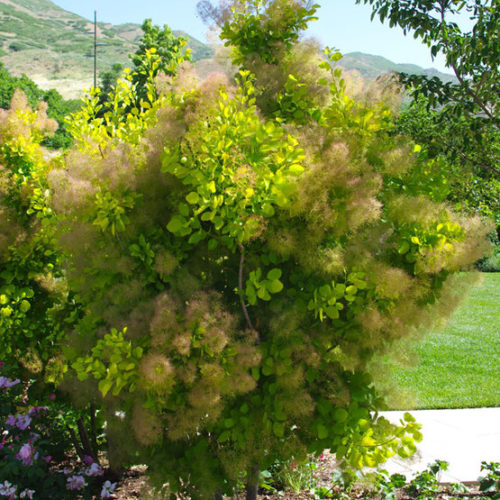
Cotinus coggygria 'Ancot'

Hardiness Zones: 1 2 3 4 5 6 7 8 9 10 11
Botanical Name: Cotinus coggygria 'Ancot' koe-TY-nus koe-GIG-ree-ah Synonyms: 'Golden Spirit' Genus: Cotinus
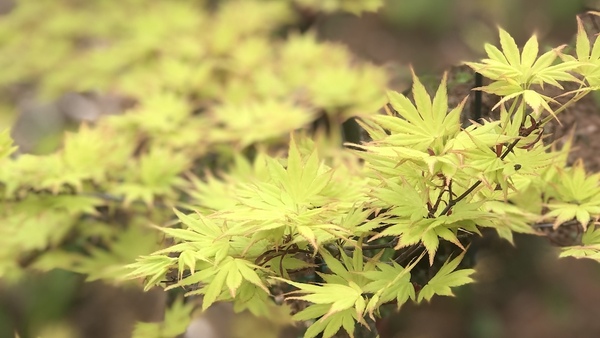
This specimen is grown for its stunning golden leaves, which turn to brilliant shades of orange and red in autumn. It may or may not produce the smoke-like plumes typical of the genus. 
Noteworthy characteristics: Cotinus are outstanding specimens in a shrub border, and are a great choice for massing or for hedges. 
Care: Grow in moderately fertile, moist but well-drained soil in full sun or partial shade. These plants are tolerant of alkaline soils; moist, clay soils; and dry, rocky soils. The leaves may scorch in full sun, but only during stress by drought. They need minimal pruning to maintain a healthy framework, or alternatively, may be coppiced to produce large, dramatic foliage on varieties with colorful foliage (this is at the expense of generous flowering).
Propagation: Sow seed in autumn, layer in spring, and take softwood cuttings in summer.
Problems: Verticillium wilt.
Height 6 ft. to 10 ft.
Spread 3 ft. to 6 ft.
Growth Pace Moderate Grower
Light Full Sun to Part Shade
Moisture Medium Moisture
Maintenance Low
Characteristics Showy Foliage; Showy Seed Heads
Bloom Time Early Summer; Late Summer; Summer
Foliage Color Colorful/Burgundy Foliage
Flower Color Yellow Flower
Uses Beds and Borders, Flowering Tree, Hedge, Specimen Plant/ Focal Point
Style Cottage Garden
Seasonal Interest Spring Interest, Summer Interest, Fall Interest
Type Shrubs

Plants you might also like

no image available Cornus alba
(Red-twig dogwood)
Be the first to rate this plant
Hardiness Zones: 1 2 3 4 5 6 7 8 9 10 11

These showy shrubs have two distinct phases of garden interest. In winter, they display boldly colorful bark—red, yellow, or orange—on twiggy stems to make a striking scene. In spring, the stems lose their vivid color and produce bright green, gold, or variegated foliage that accents the garden through the fall. Twig and leaf color vary acording to the cultivar.

Rosa rugosa var. alba Rosa rugosa var. alba
(Hedgehog rose, Ramanas rose, Japanese rose, Sea tomato)
Be the first to rate this plant
Hardiness Zones: 1 2 3 4 5 6 7 8 9 10 11

This variety has single, papery white blossoms that open from light pink buds and have contrasting yellow stamens. The heavily-scented flowers are followed by reddish-orange hips. It grows up to 6 feet high.

Rosa rugosa 'Agnes' Rosa rugosa 'Agnes'
('Agnes' rugosa rose)
Be the first to rate this plant
Hardiness Zones: 1 2 3 4 5 6 7 8 9 10 11

Yellow is an unusual color among rugosa roses, and 'Agnes' is unquestionably the best of the bunch. This variety presents the finest rugosa attributes in both leaf and overall form. The doubled blooms present an old-fashioned appearance and a delightful fragrance more akin to antique roses. Sporting an apricot hue in cooler weather, 'Agnes' turns a soft yellow with warm temperatures.

Rosa 'Blanc Double de Coubert' Rosa 'Blanc Double de Coubert'
(Hedgehog rose, Ramanas rose, Japanese rose, Sea tomato)
(1 user review)
Hardiness Zones: 1 2 3 4 5 6 7 8 9 10 11

The white of this rose has a purity of color that is without equal. It produces semi-double, very fragrant flowers from spring to fall, which are sometimes followed by orange hips. It grows to 6 feet high and wide.   

Rosa 'Frau Dagmar Hastrup' Rosa 'Frau Dagmar Hastrup'
(Hedgehog rose, Ramanas rose, Japanese rose, Sea tomato)
(1 user review)
Hardiness Zones: 1 2 3 4 5 6 7 8 9 10 11

This choice rose has single, gently cupped light-pink flowers that exude an intense, clove-scented perfume. It blooms in spring and sporadically throughout the season, and produces red hips. In autumn, the foliage turns deep maroon, which changes to yellow tinged with coppery highlights. It grows to 3 to 4 feet high and wide.