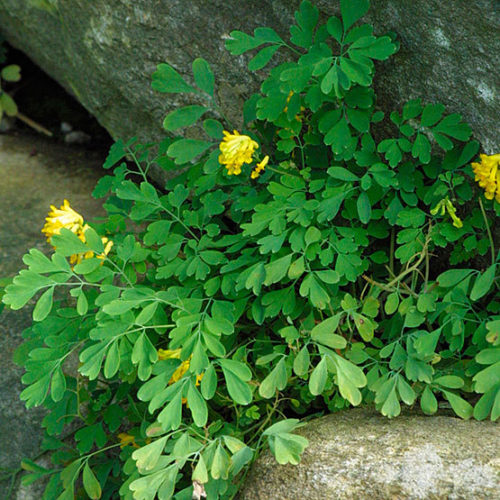
Corydalis lutea (Yellow corydalis)

Corydalis lutea Photo/Illustration: Michelle Gervais

(Based on 2 user reviews)

Rate this plant

Hardiness Zones: 1 2 3 4 5 6 7 8 9 10 11
Botanical Name: Corydalis lutea kor-ID-ah-liss LOO-tee-ah Common Name: Yellow corydalis Synonyms: Pseudofumaria lutea Genus: Corydalis
This species has bluntly spurred golden yellow flowers from late spring to early fall. Its pale green, glaucous leaves form compact, ferny mounds.
Noteworthy characteristics: This adaptable species is suitable for borders, rock, cottage and woodland gardens. It tolerates most well-drained soils in full sun to partial shade. 
Care: This woodland species does not tolerate high humidity and high temperatures during the summer months or wet soils during winter, but is otherwise adaptable as long as it is planted in full sun or part shade.
Propagation: Sow seed when fresh; germination may be erratic; divide in spring.
Problems: Downy mildew, rust, aphids, slugs, snails.
Height 1 ft. to 3 ft.
Spread 6 in. to 12 in.
Growth Habit Clumps
Growth Pace Moderate Grower
Light Full Sun to Part Shade
Moisture Dry to Medium
Maintenance Low
Characteristics Self Seeds; Showy Flowers; Showy Foliage
Bloom Time Early Fall; Early Summer; Fall; Late Spring; Late Summer; Spring; Summer
Flower Color Yellow Flower
Uses Beds and Borders, Ground Covers, Naturalizing
Style Cottage Garden, Rock Garden, Woodland Garden
Seasonal Interest Spring Interest, Summer Interest, Fall Interest
Type Perennials

Plants you might also like

Dianthus 'Bath's Pink' Dianthus 'Bath's Pink'
(Cheddar pink)
Be the first to rate this plant
Hardiness Zones: 1 2 3 4 5 6 7 8 9 10 11

Dianthus 'Bath's Pink' is a stunning, wide-spreading ground cover with grassy, blue-green foliage and pink flowers. Use it to edge a bed or grow it in your rock garden for a splash of cool color. To keep its blooms going, be sure to deadhead.

Echinacea purpurea ‘Bright Star’ Echinacea purpurea ‘Bright Star’
(Purple coneflower)
Be the first to rate this plant
Hardiness Zones: 1 2 3 4 5 6 7 8 9 10 11

This native meadow derivative with daisy-like flowers blooms from early summer into early autumn. 'Bright Star' has prominent, copper-orange central cones surrounded by red-purple ray petals (to 5 inches across), and grows to less than 3 feet tall.

Campanula poscharskyana 'Blue Waterfall' Campanula poscharskyana 'Blue Waterfall'
(Serbian bellflower)
(2 user reviews)
Hardiness Zones: 1 2 3 4 5 6 7 8 9 10 11

Serbian bellflowers have an easy, undemanding habit. Creating a stream of lavender blue, the 1-inch-diameter star-shaped blossoms bloom reliably from late spring to early fall. The foliage remains evergreen in mild winters and needs to be sheared only once in a while to keep its appearance tidy. 'Blue Waterfall' flows beautifully along bed edges and through rock gardens in full sun to partial shade.

Viola tricolor Viola tricolor
(Heartsease, Johnny-jump-up, Love-in-idleness, Wild pansy)
(3 user reviews)
Hardiness Zones: 1 2 3 4 5 6 7 8 9 10 11

This annual, biennial, or short-lived perennial is grown for its long season of pansy flowers in shades of purple, blue, yellow, and white. Viola tricolor is pretty in containers, as edging, or as a companion for bulbs. It self-seeds readily.

Hemerocallis 'Happy Returns' Hemerocallis 'Happy Returns'
(Daylily)
(13 user reviews)
Hardiness Zones: 1 2 3 4 5 6 7 8 9 10 11

This pale-yellow-flowered daylily distinguishes itself with its profuse bloom and compact size (only 16 inches tall), making it good for containers and the borders. It is an early season bloomer with circular flowers that open in late afternoon and last through the night.