previous
  • Plant an Easy-to-Water Strawberry Jar
    Plant an Easy-to-Water Strawberry Jar
  • Make a Succulent Topiary
    Make a Succulent Topiary
  • Save Money by Growing Your Own
    Save Money by Growing Your Own
  • Thoughts From a Foreign Field
    Thoughts From a Foreign Field
  • Homegrown / Homemade
    Homegrown / Homemade
  • Colorful Selections for Shade
    Colorful Selections for Shade
  • Indeterminate or Determinate Tomatoes?
    Indeterminate or Determinate Tomatoes?
  • Elephant's Ears
    Elephant's Ears
  • Garden Confidential: A Plant Walks into a Bar
    Garden Confidential: A Plant Walks into a Bar
  • Fragrant Plants for Pathways
    Fragrant Plants for Pathways
  • Meet Our Mini-Magazines
    Meet Our Mini-Magazines
  • 6 Tips for Weed Control
    6 Tips for Weed Control
  • Dwarf Citrus Trees
    Dwarf Citrus Trees
  • Building a Compost Bin
    Building a Compost Bin
  • Comfortable Alfresco Dining
    Comfortable Alfresco Dining
  • Mulch for a Healthy Garden
    Mulch for a Healthy Garden
  • Containers as Focal Points
    Containers as Focal Points
  • Stylish Shady Containers
    Stylish Shady Containers
  • Fast-Growing Trees for Impatient Gardeners
    Fast-Growing Trees for Impatient Gardeners
  • Fine Gardening's Tip Off!
    Fine Gardening's Tip Off!
  • Designing with Curved Terraces
    Designing with Curved Terraces
  • Slideshow: Beautiful Clematis
    Slideshow: Beautiful Clematis
  • In Pursuit of the Perfect Potting Shed
    In Pursuit of the Perfect Potting Shed
  • NEW Video Series: There's a Better Way
    NEW Video Series: There's a Better Way
  • Pretty in Pink
    Pretty in Pink
next

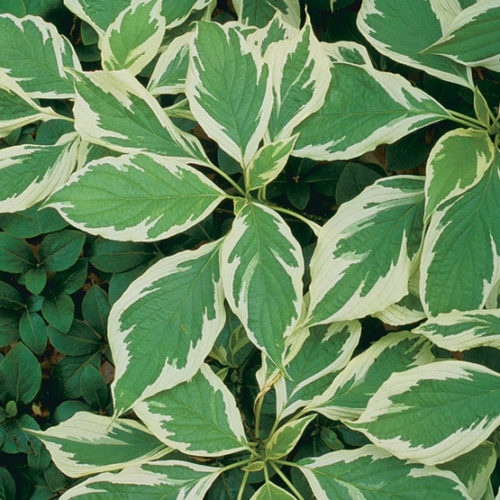
Cornus controversa 'Variegata' (Giant dogwood)

Cornus controversa 'Variegata' Photo/Illustration: Chris Curless

(Based on 1 user review)

Rate this plant

Plant Showcase - from our advertisers


Hardiness Zones: 1 2 3 4 5 6 7 8 9 10 11
Botanical Name: Cornus controversa 'Variegata' Common Name: Giant dogwood Genus: Cornus
This rounded, deciduous tree with spreading, tiered branches is especially dramatic in the landscape. Its branches stand out in winter while the leaves, edged in a bold creamy white, add superb color and texture to the garden. In early summer, single white flowers are borne in large, flattened clusters up to 7 inches across. Blue-black fruit follows in autumn, attracting birds.
Noteworthy characteristics: Prefers acidic to neutral soils, but is adaptable to most types. Great specimen tree.
Care: Adaptable to a variety of soils and light conditions, but do not overwater.
Propagation: Graft cultivars in winter. Root greenwood cuttings in summer.
Problems: Dogwood blight, powdery mildew, Discula blight, canker, bacterial leaf spot, and mushroom root rot. Common: twig borers, weevils, sawfly, scale insects, aphids, leafhoppers, root knot nematodes, and thrips.
Height Over 30 ft.
Spread Over 30 ft.
Light Full Sun to Part Shade
Moisture Medium Moisture
Maintenance Moderate
Characteristics Attracts Birds; Showy Foliage; Showy Fruit
Bloom Time Early Summer; Summer
Foliage Color Variegated Foliage
Flower Color White Flower
Uses Flowering Tree, Specimen Plant/ Focal Point
Seasonal Interest Winter Interest, Spring Interest, Summer Interest, Fall Interest
Type Trees

Plants you might also like

Ilex opaca Ilex opaca
(American holly)
Be the first to rate this plant
Hardiness Zones: 1 2 3 4 5 6 7 8 9 10 11

This erect, evergreen large shrub or tree reaches 40 to 50 feet in height and 20 to 40 feet wide. Leathery dark green leaves have pointy, scalloped edges. Small green berries appear in late summer, maturing to crimson by autumn and persisting through the winter. Some ripen to yellow or orange. Use American holly as a specimen tree or in a woodland garden.

Magnolia macrophylla Magnolia macrophylla
(Bigleaf magnolia, Large-leaved cucumber tree, Umbrella tree)
Be the first to rate this plant
Hardiness Zones: 1 2 3 4 5 6 7 8 9 10 11

This deciduous species has remarkable leaves that are over 3 feet long and 1 foot wide. They are light green above and silvery beneath. It flowers in early summer with creamy-white, fragrant blossoms that reach a foot across. Magnolia macrophylla grows up to 40 feet tall and wide. It is native to North America.

Robinia pseudoacacia 'Frisia' Robinia pseudoacacia 'Frisia'
(Golden locust)
Be the first to rate this plant
Hardiness Zones: 1 2 3 4 5 6 7 8 9 10 11

This large, fast-growing tree has droopy leaves that stay sunny yellow from spring until frost, spiny shoots, and fragrant white flowers in late spring and early summer on pendent racemes. The flowers are followed by smooth brown seed pods that are also interesting. 'Frisia' is one of the cultivars that is grown more for foliage than for its flowers and it does not flower as freely as the species.

Cedrus atlantica f. glauca Cedrus atlantica f. glauca
(Blue Atlas cedar)
Be the first to rate this plant
Hardiness Zones: 1 2 3 4 5 6 7 8 9 10 11

This stunning evergreen conifer can be a very large specimen tree (to over 100 feet) in the landscape. Its young, silvery foliage turns vivid glaucous blue as it ages; the sharply pointed leaves are arranged in whorls. Female cones are green and can be up to 4 inches long; they ripen slowly over 2 years to pale brown. This tree needs a lot of space to reach its majestic potential.

Viburnum prunifolium Viburnum prunifolium
(Blackhaw Viburnum)
Be the first to rate this plant
Hardiness Zones: 1 2 3 4 5 6 7 8 9 10 11

Blackhaw Viburnum is a large shrub or small tree with clusters of creamy white flowers followed by pink-rose berries, which birds love to eat. Its distinctive bronze-green foliage on reddish purple stems turns blue-black in the fall. Blackhaw grows to 12 to 15 feet high and 8 to12 feet wide.