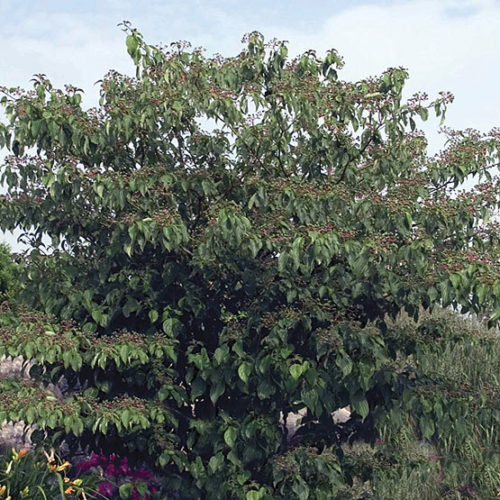
Cornus alternifolia (Pagoda dogwood, Green osier)

Cornus alternifolia Cornus alternifolia Photo/Illustration: Courtesy of Bailey Nurseries

(Based on 1 user review)

Rate this plant

Hardiness Zones: 1 2 3 4 5 6 7 8 9 10 11
Botanical Name: Cornus alternifolia KOR-nus all-ter-nih-FOE-lee-ah Common Name: Pagoda dogwood, Green osier Genus: Cornus
This plant owes its name to its distinctive layered branches, which resemble the tiered, spreading roofline of an elaborate pagoda. Pagoda dogwoods are especially striking when accented by masses of small, fragrant creamy white flowers in early summer. Small, round fruits ripen to a deep blue-purple in late summer.
Noteworthy characteristics: Native to North America, from Newfoundland to Minnesota, southward to the extreme southern Appalachians, and westward to Missouri. Performs best near its native range. Tolerates more cold, wind, and alkaline soil than flowering dogwood.
Care: Grow in moist soil in partial shade.
Propagation: Root from softwood and hardwood cuttings. Also grown from seed.
Problems: Dogwood blight, powdery mildew, canker, bacterial leaf spot, and mushroom root rot. Common: twig borers, weevils, sawfly, scale insects, aphids, leafhoppers, root knot nematodes, and thrips.
Height 15 ft. to 30 ft.
Spread 15 ft. to 30 ft.
Light Part Shade Only
Moisture Medium Moisture
Maintenance Moderate
Characteristics Fragrant Flowers; Native; Showy Fruit
Bloom Time Early Summer; Summer
Flower Color White Flower
Uses Flowering Tree
Style Woodland Garden
Seasonal Interest Spring Interest, Summer Interest, Fall Interest
Type Trees

Plants you might also like

Robinia pseudoacacia 'Frisia' Robinia pseudoacacia 'Frisia'
(Golden locust)
Be the first to rate this plant
Hardiness Zones: 1 2 3 4 5 6 7 8 9 10 11

This large, fast-growing tree has droopy leaves that stay sunny yellow from spring until frost, spiny shoots, and fragrant white flowers in late spring and early summer on pendent racemes. The flowers are followed by smooth brown seed pods that are also interesting. 'Frisia' is one of the cultivars that is grown more for foliage than for its flowers and it does not flower as freely as the species.

Amelanchier × grandiflora 'Autumn Brilliance' Amelanchier × grandiflora 'Autumn Brilliance'
(Apple serviceberry)
(1 user review)
Hardiness Zones: 1 2 3 4 5 6 7 8 9 10 11

This shrubby tree has leaves that emerge bronze, mature green, and fade to orange and red in autumn. It bears 3-inch-long racemes of white flowers in spring, followed by edible, juicy blue-black fruit.

Rhus typhina 'Tigereye Bailtiger' Rhus typhina 'Tigereye Bailtiger'
(Tiger eyes sumac, Staghorn sumac, Velvet sumac)
(1 user review)
Hardiness Zones: 1 2 3 4 5 6 7 8 9 10 11

Lemon-lime foliage, fuzzy stems, and intense fall color make this sumac cultivar a standout. It grows into an upright, rounded form about 6 feet tall and as wide. New growth emerges chartreuse. Fall brings leaves of yellow, scarlet, and orange. Flowers are yellowish green and followed, on female plants, by hairy, dark red fruit. This plant spreads by suckers and can be invasive. The species is native to North America.

Cladrastis lutea Cladrastis lutea
(Yellowwood)
Be the first to rate this plant
Hardiness Zones: 1 2 3 4 5 6 7 8 9 10 11

Yellowwood is a vase-shaped spreading tree with dark green foliage that turns a delicate yellow or orange in the fall and smooth light gray bark. Breathtaking, pendulous, foot-long, wisteria-like clusters of fragrant white flowers appear in late spring and early summer, often in alternate years.

Acer rubrum ‘Red Sunset’ Acer rubrum ‘Red Sunset’
(Red maple, Scarlet maple)
Be the first to rate this plant
Hardiness Zones: 1 2 3 4 5 6 7 8 9 10 11

This is a rounded to open-crown deciduous tree up to 70 feet tall and 30 feet wide with early, brilliant red fall coloring.