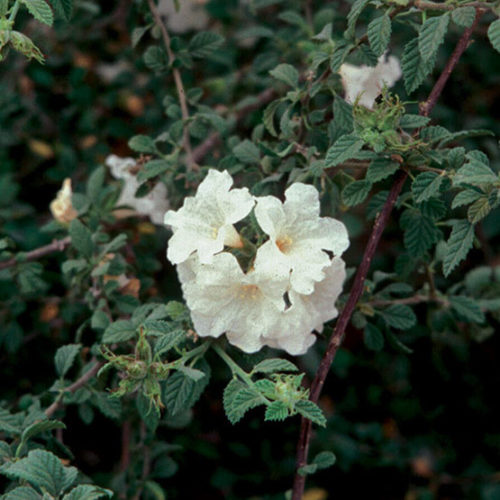
Cordia parvifolia (Littleleaf cordia)

Cordia parvifolia Photo/Illustration: Courtesy of Kirti Mathura


Be the first to rate this plant

Plant Showcase - from our advertisers


Hardiness Zones: 1 2 3 4 5 6 7 8 9 10 11
Botanical Name: Cordia parvifolia KOR-dee-ah par-vih-FOE-lee-ah Common Name: Littleleaf cordia Genus: Cordia
Though its leaves are small, this semi-deciduous shrub stands out in the landscape. Littleleaf cordia has a prolifically branching, slightly open form that looks good year-round. Its roughly textured, dark gray-green foliage contrasts nicely with its coppery brown young stems. From late spring into fall, branch tips bear clusters of pristine, white, funnel-shaped flowers to provide a visually cooling effect during the peak of summer heat. It grows to 6 to 8 feet tall and wide.
Noteworthy characteristics: This Southwestern U.S. native shrub is low-maintenance and drought-tolerant.
Care: Provide full sun to partial shade and well-drained soil.
Propagation: From cuttings.
Problems: Infrequent.
Height 6 ft. to 10 ft.
Spread 6 ft. to 10 ft.
Growth Habit Clumps
Growth Pace Fast Grower
Light Full Sun to Part Shade
Moisture Dry to Medium
Maintenance Low
Tolerance Drought Tolerant
Characteristics Native; Showy Flowers
Bloom Time Early Fall; Early Summer; Late Spring; Late Summer; Summer
Flower Color White Flower
Uses , Beds and Borders, Hedge
Style , Desert Garden, Xeric Bed
Seasonal Interest , Spring Interest, Summer Interest, Fall Interest
Type ,Shrubs

Plants you might also like

Yucca filamentosa ‘Golden Sword’ Yucca filamentosa ‘Golden Sword’
(Adam's needle, Bear grass, Weak-leaf yucca, Golden Sword soapwort)
Be the first to rate this plant
Hardiness Zones: 1 2 3 4 5 6 7 8 9 10 11

This easy to grow evergreen yucca bears dramatic, sword-shaped yellow leaves with a dark green edge. Not as staunchly upright as some yuccas, its leaf tips sometimes droop with age. Its foliage color is best from fall to spring. Plants grow to nearly 2 feet in height and 3 feet in width. In summer, it produces a 6-foot-tall spike covered with nodding, fragrant, white bell-shaped flowers.

Ziziphus obtusifolia Ziziphus obtusifolia
(Graythorn)
Be the first to rate this plant
Hardiness Zones: 1 2 3 4 5 6 7 8 9 10 11

Appropriately named, this open shrub has grayish green leaves and stiff, thorn-tipped branches. With inconspicuous, pale yellow-green flowers in late spring, the pea-size fruits that follow are a showy blue-black. These fruits appeal to birds, and the thorny branches are ideal protection for nesting. Graythorn is a fine backdrop for bold plantings of succulents.

Melampodium leucanthum Melampodium leucanthum
(Blackfoot daisy)
(1 user review)
Hardiness Zones: 1 2 3 4 5 6 7 8 9 10 11

A native perennial shrub that grows to about 2 feet tall and wide and covers itself the whole season with honey-scented, white and yellow daisy flowers. The foliage is typical of the aster family. Plant en masse in a well-drained border or use in a rock garden. Blackfoot daisy can be short-lived.

no image available Nerium oleander ‘Little Red’
('Little Red' oleander)
(1 user review)
Hardiness Zones: 1 2 3 4 5 6 7 8 9 10 11

'Little Red' is a dwarf selection of oleander, which is a large evergreen shrub. Its flowers are deep red and bloom all summer long. This plant is tough and drought-tolerant.

Clematis texensis 'Duchess of Albany' Clematis texensis 'Duchess of Albany'
(Scarlet clematis, Leather flower, Texas clematis)
Be the first to rate this plant
Hardiness Zones: 1 2 3 4 5 6 7 8 9 10 11

This vigorous climber can easily cover a support of 8 to 10 feet tall once established. Finely textured, dense light-green foliage makes an excellent foil for dainty, pink and carmine teardrop-shaped flowers 2 inches across. Blooms appear in early August and continue well into autumn.