previous
  • Garden Confidential: A Plant Walks into a Bar
    Garden Confidential: A Plant Walks into a Bar
  • Lawn Alternatives
    Lawn Alternatives
  • Colorful Selections for Shade
    Colorful Selections for Shade
  • Pretty in Pink
    Pretty in Pink
  • Save Money by Growing Your Own
    Save Money by Growing Your Own
  • NEW Video Series: There's a Better Way
    NEW Video Series: There's a Better Way
  • Plants that Spark!
    Plants that Spark!
  • Elephant's Ears
    Elephant's Ears
  • Homegrown / Homemade
    Homegrown / Homemade
  • In Pursuit of the Perfect Potting Shed
    In Pursuit of the Perfect Potting Shed
  • Comfortable Alfresco Dining
    Comfortable Alfresco Dining
  • Make a Succulent Topiary
    Make a Succulent Topiary
  • 6 Tips for Weed Control
    6 Tips for Weed Control
  • Indeterminate or Determinate Tomatoes?
    Indeterminate or Determinate Tomatoes?
  • Designing with Curved Terraces
    Designing with Curved Terraces
  • Dwarf Citrus Trees
    Dwarf Citrus Trees
  • Plant an Easy-to-Water Strawberry Jar
    Plant an Easy-to-Water Strawberry Jar
  • Containers as Focal Points
    Containers as Focal Points
  • Fast-Growing Trees for Impatient Gardeners
    Fast-Growing Trees for Impatient Gardeners
  • Stylish Shady Containers
    Stylish Shady Containers
  • Slideshow: Beautiful Clematis
    Slideshow: Beautiful Clematis
  • Building a Compost Bin
    Building a Compost Bin
  • Mulch for a Healthy Garden
    Mulch for a Healthy Garden
  • Fragrant Plants for Pathways
    Fragrant Plants for Pathways
  • Thoughts From a Foreign Field
    Thoughts From a Foreign Field
next

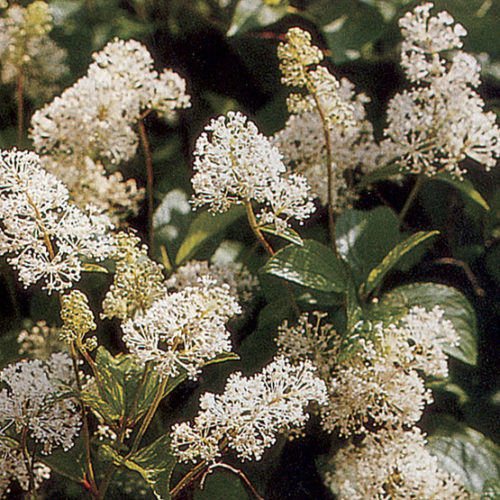
Ceanothus americanus (Mountain sweet, New Jersey tea, Redroot, Wild snowball)

Ceanothus americanus Photo/Illustration: Neil Diboll


Be the first to rate this plant

Plant Showcase - from our advertisers


Hardiness Zones: 1 2 3 4 5 6 7 8 9 10 11
Botanical Name: Ceanothus americanus see-ah-NO-thuss ah-mer-ih-KAY-nus Common Name: Mountain sweet, New Jersey tea, Redroot, Wild snowball Genus: Ceanothus
Mountain sweet is a low-growing, broad, compact, deciduous shrub. Dark-green leaves are irregularly toothed, 2 to 3 inches long, and softly hairy or nearly hairless beneath. This plant bears profuse white flowers in 1- to 2-inch-long terminal clusters.
Noteworthy characteristics: Tolerates poor growing conditions. Native to the eastern U.S.
Care: Ideally, plant in full sun and fertile, well-drained soil. Relatively lime tolerant. Expect 5-10 years' lifespan. Prune in early spring, followed by mulch and balanced fertilizer application.
Propagation: Root greenwood cuttings in mid- or late summer.
Problems: Dieback, powdery mildew, mushroom root rot, fungal leaf spots, and Verticillium wilt are common. Caterpillars, scale insects, lacebug, and mealybugs occur.
Height 3 ft. to 6 ft.
Spread 3 ft. to 6 ft.
Light Full Sun Only
Moisture Dry to Medium
Maintenance Moderate
Characteristics Native; Showy Flowers
Bloom Time Early Summer; Summer
Flower Color White Flower
Uses Beds and Borders, Trellis
Seasonal Interest Summer Interest
Type Shrubs

Plants you might also like

Rosa rugosa 'Henry Hudson' Rosa rugosa 'Henry Hudson'
Be the first to rate this plant
Hardiness Zones: 1 2 3 4 5 6 7 8 9 10 11

'Henry Hudson' has flattened, symmetrical, semi-double, white flowers with a spicy clove scent. The dense and deep green foliage makes a fitting backdrop for this selection's reddish buds and ensuing cream-colored flowers. The blossoms don't drop cleanly, so deadheading is necessary. -Suzanne Verrier, No muss, no fuss rugosa roses, Fine Gardening issue #121

Rosa rugosa 'Polar Ice' Rosa rugosa 'Polar Ice'
('Polar Ice' rugosa rose)
Be the first to rate this plant
Hardiness Zones: 1 2 3 4 5 6 7 8 9 10 11

'Polar Ice' is one of the most vigorous and densely growing rugosa roses and features clusters of double, slightly nodding flowers. Green buds open to creamy white blooms with pink petals and deeper pink centers. The flowers smell lightly of baby powder, and the new lime green foliage smells like strawberries and sweet grass. In autumn, the foliage turns bright yellow. -Suzanne Verrier, No muss, no fuss rugosa roses, Fine Gardening issue #121

Diervilla lonicera Diervilla lonicera
(Northern bush honeysuckle)
Be the first to rate this plant
Hardiness Zones: 1 2 3 4 5 6 7 8 9 10 11

While not a true honeysuckle (Lonicera spp. and cvs., USDA Hardiness Zones 3-10), Northern bush honeysuckle has honeysuckle-like yellow flowers and glossy green foliage on a native, deciduous shrub 3 to 4 feet tall and 3 to 5 feet wide. The flowers appear in early summer and last through summer, and the foliage occasionally exhibits bright red fall color.

Melampodium leucanthum Melampodium leucanthum
(Blackfoot daisy)
(1 user review)
Hardiness Zones: 1 2 3 4 5 6 7 8 9 10 11

A native perennial shrub that grows to about 2 feet tall and wide and covers itself the whole season with honey-scented, white and yellow daisy flowers. The foliage is typical of the aster family. Plant en masse in a well-drained border or use in a rock garden. Blackfoot daisy can be short-lived.

Cephalanthus occidentalis Cephalanthus occidentalis
(Buttonbush, Button willow, Honey balls)
Be the first to rate this plant
Hardiness Zones: 1 2 3 4 5 6 7 8 9 10 11

A native small tree found in wetlands from Minnesota to Florida and from New England to California, buttonbush can reach 8 to 15 feet tall and is often wider than it is tall. Prune it into a small multi-trunked tree to reveal the curly bark of its young stems and the punctuated pale spots of its older stems. Blooms are extremely rich in nectar and attract butterflies and other insects.