previous
  • Soil Testing is Worth the Effort
    Soil Testing is Worth the Effort
  • Building a Compost Bin
    Building a Compost Bin
  • Garden Catalog Collector
    Garden Catalog Collector
  • Backyard Makeover Game
    Backyard Makeover Game
  • Friendly Ways to Battle Garden Pests
    Friendly Ways to Battle Garden Pests
  • Free Download: Rose Pruning and Bed Prep
    Free Download: Rose Pruning and Bed Prep
  • Variegated Plants Create Drama
    Variegated Plants Create Drama
  • Video: Make a Straw-Bale Garden
    Video: Make a Straw-Bale Garden
  • Lilacs: Time for a Fresh Look
    Lilacs: Time for a Fresh Look
  • How to Grow Raspberries
    How to Grow Raspberries
  • The Only Shrubs You Need to Grow
    The Only Shrubs You Need to Grow
  • Big Flowers from Bigleaf Hydrangeas
    Big Flowers from Bigleaf Hydrangeas
  • Off With Their Heads: Deadheading Perennials
    Off With Their Heads: Deadheading Perennials
  • 25 Robust Summer Bloomers
    25 Robust Summer Bloomers
  • Perfect Edges for Your Beds and Borders
    Perfect Edges for Your Beds and Borders
  • Enchanting Japanese Maples
    Enchanting Japanese Maples
  • All About Starting Seeds
    All About Starting Seeds
  • How to Start a Vegetable Garden
    How to Start a Vegetable Garden
  • 10 Perennials Easily Grown from Seed
    10 Perennials Easily Grown from Seed
  • Bold and Beautiful Zinnias
    Bold and Beautiful Zinnias
  • 15 Deer-Resistant Plants
    15 Deer-Resistant Plants
  • A gardener's checklist for early summer
    A gardener's checklist for early summer
  • Make Your Own Hypertufa Container
    Make Your Own Hypertufa Container
  • Viburnums are Versatile Shrubs
    Viburnums are Versatile Shrubs
  • Find the Perfect Tomato
    Find the Perfect Tomato
next

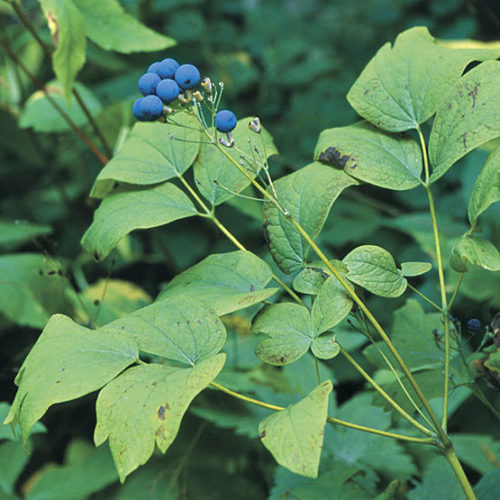
Caulophyllum thalictroides (Blue cohosh)

Caulophyllum thalictroides Photo/Illustration: Virginia Small


Be the first to rate this plant

Plant Showcase - from our advertisers


Hardiness Zones: 1 2 3 4 5 6 7 8 9 10 11
Botanical Name: Caulophyllum thalictroides kawl-oh-FIL-lum thah-lik-TROY-deez Common Name: Blue cohosh Genus: Caulophyllum
This plant's three-lobed, veined leaves are dark purple when they emerge and later turn green. Greenish brown or yellowish brown flowers appear in mid- and late spring, turning into waxy blue berries that dangle beneath the leaves.
Noteworthy characteristics: Berries split open to reveal berry-like seeds that turn from green to blue. Very slow to increase in size.
Care: Grow in moist, humus-rich, acidic soil, in part to full shade in a woodland setting.
Propagation: Divide in spring while dormant or after blooming. Sow seeds in containers in an open frame; germination is slow and erratic.
Problems: Fungal spots sometimes occur.
Height 1 ft. to 3 ft.
Spread 6 in. to 12 in.
Growth Habit Clumps
Growth Pace Slow Grower
Light Part Shade to Full Shade
Moisture Medium Moisture
Characteristics Showy Fruit
Bloom Time Late Spring; Spring
Flower Color Brown Flower; Green Flower; Yellow Flower
Style Woodland Garden
Seasonal Interest Spring Interest
Type Perennials

Plants you might also like

Corydalis lutea Corydalis lutea
(Yellow corydalis)
(3 user reviews)
Hardiness Zones: 1 2 3 4 5 6 7 8 9 10 11

This species has bluntly spurred golden yellow flowers from late spring to early fall. Its pale green, glaucous leaves form compact, ferny mounds.

Aquilegia chrysantha Aquilegia chrysantha
(Golden columbine, Yellow columbine)
Be the first to rate this plant
Hardiness Zones: 1 2 3 4 5 6 7 8 9 10 11

A. chrysantha is a vigorous grower that will add a real burst of color to any southern garden. This southwestern U.S. native has 3-inch yellow flowers in spring and reaches almost 3 feet tall.

Hemerocallis 'Blackeyed Stella' Hemerocallis 'Blackeyed Stella'
(Daylily)
Be the first to rate this plant
Hardiness Zones: 1 2 3 4 5 6 7 8 9 10 11

Daylilies are classic, extremely popular garden plants. They feature long, arching, strappy leaves and long stems of generally 6-petaled flowers, though double flowers are popular as well. Each flower lasts only one day, hence the plant’s common name. Daylilies come in a wide range of colors, from cream and cheery yellow to peach, orange, fiery red, deep burgundy, pink, and purple. Some have contrasting throats and "eye-zones." Daylilies are ideal for a mixed herbaceous perennial border.

Digitalis grandiflora Digitalis grandiflora
(Yellow foxglove)
Be the first to rate this plant
Hardiness Zones: 1 2 3 4 5 6 7 8 9 10 11

Originating in mountainous woodland and stony habitats from Europe to western Asia, yellow foxglove is tolerant of dry shade but flourishes with moisture. Arising in midsummer from neat clumps of fine-toothed foliage, a mass of soft yellow open bells, speckled brown inside, blooms along one side of a 3-foot-tall stem. Usually described as a perennial, it is more accurate to call it a biennial or short-lived perennial. If the flowering stalk is cut down after blooms have faded, it may rebloom in the fall. When a few flower stalks are left, the plant self-seeds. 

Convallaria majalis Convallaria majalis
(Lily of the Valley, May bells)
(1 user review)
Hardiness Zones: 1 2 3 4 5 6 7 8 9 10 11

Lily of the valley's bell-shaped, sweetly scented flowers bloom in early spring. It likes partial to full shade and is perfect for a woodland garden. It may not be the best choice for your beds and borders because it tends to spread, but it is a perfect ground cover if you have a large shady spot under some trees.