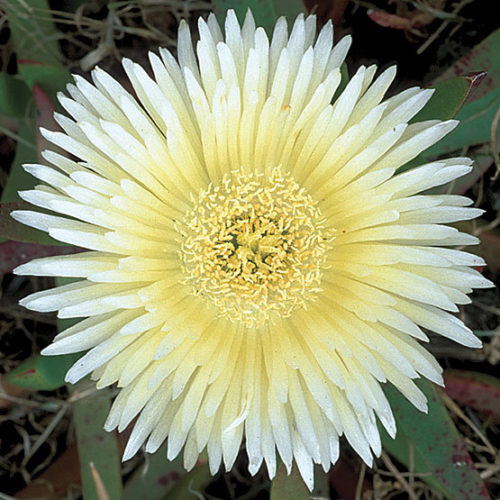
Carpobrotus edulis (Iceplant, Hottentot fig, Kaffir fig)

Carpobrotus edulis Photo/Illustration: Barry Rice/Courtesy of The Nature Conservancy


Be the first to rate this plant

Hardiness Zones: 1 2 3 4 5 6 7 8 9 10 11
Botanical Name: Carpobrotus edulis kar-poe-BRO-tus ED-ew-lis Common Name: Iceplant, Hottentot fig, Kaffir fig Genus: Carpobrotus
This ground-hugging succulent perennial roots at the nodes, has a creeping habit, and often forms deep mats covering large areas. It produces abundant yellow daisy-like flowers that open at noon and turn pink later in the day.
Noteworthy characteristics: Produces edible fig-like fruit. Used for dune stabilization in California, but  now becoming an invasive problem.
Care: In the garden, plant in full sun and poor, very well-drained, sandy, humusy soil. Indoors, grow in full light. Water very little in winter.
Propagation: Root stem cuttings in spring or summer.
Problems: Mealybugs.
Height Less than 6 in.
Spread Over 30 ft.
Growth Habit Runs
Growth Pace Invasive/Aggressive Grower;Moderate Grower
Light Full Sun Only
Moisture Dry to Medium
Tolerance Drought Tolerant
Characteristics Showy Flowers
Bloom Time Early Fall; Early Summer; Fall; Late Spring; Late Summer; Spring; Summer
Foliage Color Evergreen
Flower Color Yellow Flower
Uses Ground Covers, Roadside
Style Desert Garden
Seasonal Interest Summer Interest, Fall Interest
Type Perennials

Plants you might also like

no image available Euphorbia rigida
Be the first to rate this plant
Hardiness Zones: 1 2 3 4 5 6 7 8 9 10 11

This species is similar to E. myrsinites, but its habit is first erect before spreading, and its steely blue leaves are more narrow and pointed. It also bears terminal yellow bracts from early spring to summer.

Salvia microphylla var. neurepia Salvia microphylla var. neurepia
Be the first to rate this plant
Hardiness Zones: 1 2 3 4 5 6 7 8 9 10 11

This native of the American Southwest and Mexico forms an evergreen shrub or shrubby perennial with dark, glossy leaves that are small (but slightly larger than most microphyllas) and softly toothed. It blooms off and on all summer, and again, more vigorously, in late summer and autumn, in blossoms of cherry-red. Its attractive foliage cloaks the plant to the ground, so it is well suited to the front of the border. It can grow to 4 feet tall and twice as wide.

Agastache foeniculum Agastache foeniculum
(Anise hyssop)
(1 user review)
Hardiness Zones: 1 2 3 4 5 6 7 8 9 10 11

A classic plant for both herb gardens and borders, anise hyssop is composed of erect branches of mint-and-licorice-scented, medium green leaves ending in fuzzy spikes of small lavender flowers. The plant grows to 3 to 5 feet tall and 1 foot wide and reseeds freely. The flowers are edible and are charming crumbled into salads. The flowers are highly attractive to bees, butterflies, and hummingbirds.

no image available Euphorbia 'Helena’s Blush™'
Be the first to rate this plant
Hardiness Zones: 1 2 3 4 5 6 7 8 9 10 11

This hybrid has petite green-and-cream variegated foliage with a hint of pink on the undersides. It produces chartreuse and apple green bicolored bracts on airy stems.

Melampodium leucanthum Melampodium leucanthum
(Blackfoot daisy)
Be the first to rate this plant
Hardiness Zones: 1 2 3 4 5 6 7 8 9 10 11

A native perennial shrub that grows to about 2 feet tall and wide and covers itself the whole season with honey-scented, white and yellow daisy flowers. The foliage is typical of the aster family. Plant en masse in a well-drained border or use in a rock garden. Blackfoot daisy can be short-lived.