previous
  • Indeterminate or Determinate Tomatoes?
    Indeterminate or Determinate Tomatoes?
  • Save Money by Growing Your Own
    Save Money by Growing Your Own
  • NEW Video Series: There's a Better Way
    NEW Video Series: There's a Better Way
  • Garden Confidential: A Plant Walks into a Bar
    Garden Confidential: A Plant Walks into a Bar
  • 6 Tips for Weed Control
    6 Tips for Weed Control
  • Plant an Easy-to-Water Strawberry Jar
    Plant an Easy-to-Water Strawberry Jar
  • Elephant's Ears
    Elephant's Ears
  • Designing with Curved Terraces
    Designing with Curved Terraces
  • Slideshow: Beautiful Clematis
    Slideshow: Beautiful Clematis
  • Homegrown / Homemade
    Homegrown / Homemade
  • Stylish Shady Containers
    Stylish Shady Containers
  • Comfortable Alfresco Dining
    Comfortable Alfresco Dining
  • Building a Compost Bin
    Building a Compost Bin
  • Pretty in Pink
    Pretty in Pink
  • Dwarf Citrus Trees
    Dwarf Citrus Trees
  • Plants that Spark!
    Plants that Spark!
  • In Pursuit of the Perfect Potting Shed
    In Pursuit of the Perfect Potting Shed
  • Colorful Selections for Shade
    Colorful Selections for Shade
  • Thoughts From a Foreign Field
    Thoughts From a Foreign Field
  • Make a Succulent Topiary
    Make a Succulent Topiary
  • Containers as Focal Points
    Containers as Focal Points
  • Fragrant Plants for Pathways
    Fragrant Plants for Pathways
  • Lawn Alternatives
    Lawn Alternatives
  • Fast-Growing Trees for Impatient Gardeners
    Fast-Growing Trees for Impatient Gardeners
  • Mulch for a Healthy Garden
    Mulch for a Healthy Garden
next

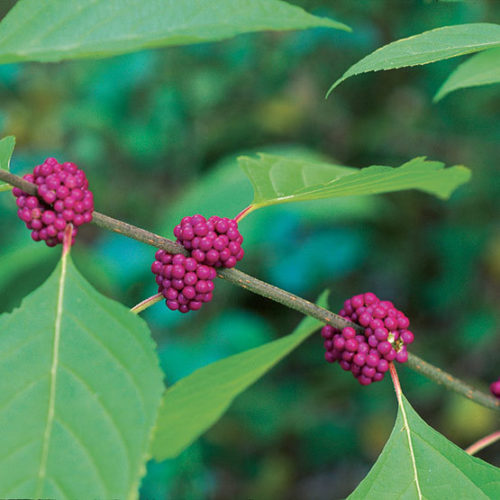
Callicarpa americana (American beautyberry)

Callicarpa americana Photo/Illustration: Jerry Pavia

(Based on 1 user review)

Rate this plant

Plant Showcase - from our advertisers


Hardiness Zones: 1 2 3 4 5 6 7 8 9 10 11
Botanical Name: Callicarpa americana kal-lee-KAR-pah ah-mer-ih-KAY-nah Common Name: American beautyberry Genus: Callicarpa
Although it produces small, lavender-pink flowers in spring, this plant is known mainly for its violet to magenta berries, which start appearing in October. The berries, massed in tight bunches that encircle the branches, are vivid against deep-green leaves.
Noteworthy characteristics: Self-seeds. Looks best planted in groups.
Care: Does well in poor soil and takes sun or part shade.
Propagation: Root softwood cuttings in spring, or semi-ripe cuttings with bottom heat in summer.
Problems: Scale, mildew, dieback, leaf scorch, and fungal leaf spot.
Height 6 ft. to 10 ft.
Spread 3 ft. to 6 ft.
Growth Habit Clumps
Light Full Sun to Part Shade
Moisture Adaptable
Maintenance Low
Characteristics Attracts Birds; Native; Self Seeds; Showy Fruit
Bloom Time Spring
Flower Color Pink Flower; Purple/ Lavender Flower
Uses Beds and Borders
Style Woodland Garden
Seasonal Interest Winter Interest, Fall Interest
Type Shrubs

Plants you might also like

Aucuba japonica Aucuba japonica
(Japanese laurel)
(1 user review)
Hardiness Zones: 1 2 3 4 5 6 7 8 9 10 11

Aucuba are grown for their bold foliage, autumn fruit, and adaptability to shade, dry soil, pollution, and coastal conditions. A. japonica is a rounded, evergreen shrub with small, reddish purple flowers in spring, and red berries (on female plants) in fall. It grows to about 10 feet tall and wide. 'Crotonifolia' has leaves that look like they were speckled with yellow paint. 'Gold Dust' is female with heavy yellow speckling. 'Mr. Goldstrike' is male, more upright, and has gold-splashed leaves. Use as a hedge or specimen, in a container outdoors, or as an imposing houseplant.

Yucca filamentosa ‘Golden Sword’ Yucca filamentosa ‘Golden Sword’
(Adam's needle, Bear grass, Weak-leaf yucca, Golden Sword soapwort)
Be the first to rate this plant
Hardiness Zones: 1 2 3 4 5 6 7 8 9 10 11

This easy to grow evergreen yucca bears dramatic, sword-shaped yellow leaves with a dark green edge. Not as staunchly upright as some yuccas, its leaf tips sometimes droop with age. Its foliage color is best from fall to spring. Plants grow to nearly 2 feet in height and 3 feet in width. In summer, it produces a 6-foot-tall spike covered with nodding, fragrant, white bell-shaped flowers.

no image available Nandina domestica
(Heavenly bamboo)
(2 user reviews)
Hardiness Zones: 1 2 3 4 5 6 7 8 9 10 11

Yellow-white flowers appear in late spring, followed by prolific berries that ripen from green to bright-red or purple in fall. The elegant foliage turns fiery red in fall. There are low, ground-hugging Nandina varieties; medium-sized shrubs for mid-border; and tall, bushy types for the back of the border.

Calamintha nepeta Calamintha nepeta
(Lesser calamint)
Be the first to rate this plant
Hardiness Zones: 1 2 3 4 5 6 7 8 9 10 11

Lesser calamint produces fine, upright stems which are covered with small, shiny, dark green leaves, forming a little bush from 12 to 18 inches tall, and twice as wide. In late August, it produces a cloud of infinitesimal pale lavender flowers that continue blooming for up to six weeks. As the days become cooler, the color of the tiny, lipped blossoms deepens.

Yucca filamentosa ‘Color Guard’ Yucca filamentosa ‘Color Guard’
(Adam's needle)
Be the first to rate this plant
Hardiness Zones: 1 2 3 4 5 6 7 8 9 10 11

This dramatic architectural plant is one of the most beautiful variegated yuccas on the market. Its sword-shaped leaves bear bold central stripes of bright canary-yellow against a rich celadon edge. In cool weather, margins are tinged pink, and the entire yellow stripe turns rose-colored on many of the leaves, lasting through early spring. Plants grow to 2 feet wide and nearly as tall. Branched clusters of nodding, creamy-white bells open in mid-summer on stout stems that reach 6 feet tall.