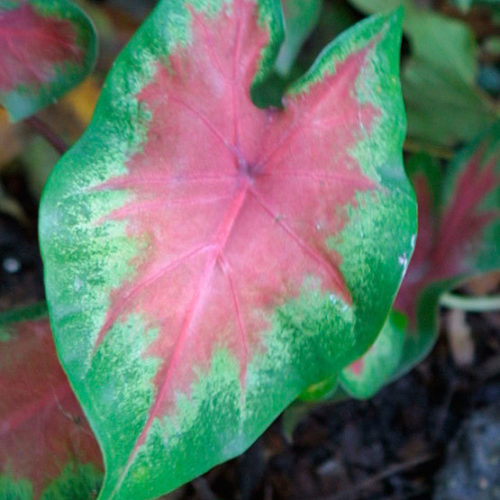
Caladium bicolor 'Freida Hemple' (Angel wings, Elephant's ears, Heart of Jesus, Mother-in-law plant)

Caladium bicolor 'Freida Hemple' Photo/Illustration: Michelle Gervais


Be the first to rate this plant

Botanical Name: Caladium bicolor 'Freida Hemple' kah-LAY-dee-um BY-kul-or Common Name: Angel wings, Elephant's ears, Heart of Jesus, Mother-in-law plant Synonyms: C. × hortulanum Genus: Caladium
C. bicolor is a tuberous-rooted perennial of garden origin often grown in containers, as annuals, and as indoor plants. The large, heart-shaped leaves of 'Freida Hemple' caladium are edged in bright green and have bold red centers. Caladiums are excellent choices to add color, texture, and form to shady areas.
Noteworthy characteristics: Striking red and green leaves. Excellent in shade.
Care: Needs plenty of water, heat, and high humidity. Also prefers slightly acidic soil and part to full shade. Protect from strong winds. Lift and store tubers in the fall and store almost dry in a cool location. Also grown as house plants year-round, where they need bright filtered light, ample water, and high humidity during the growing season.
Propagation: Divide in spring; dust cut portions with fungicide.
Problems: Tuber rot, Southern blight, leaf spot, root-knot nematodes. Indoors, aphids and spider mites may be problems.
Height 1 ft. to 3 ft.
Spread 1 ft. to 3 ft.
Growth Habit Clumps
Growth Pace Moderate Grower
Light Part Shade to Full Shade
Moisture Medium Moisture
Maintenance Moderate
Characteristics Showy Foliage
Bloom Time Spring
Foliage Color Colorful/Burgundy Foliage
Flower Color White Flower
Uses Beds and Borders, Container, Indoor Plant
Seasonal Interest Summer Interest
Type Perennials,Tropicals

Plants you might also like

Caladium bicolor 'White Queen' Caladium bicolor 'White Queen'
(Angel wings, Elephant's ears, Heart of Jesus, Mother-in-law plant)
Be the first to rate this plant

A tuberous-rooted perennial most often grown as an annual or a houseplant, 'White Queen' has large frosted-looking white leaves that have green margins and bright red veins that "bleed". A great plant for full shade, it can also be grown in sun if provided with consistently moist soil. Greenish-white flower spathes appear in spring and are followed by white berries, but the foliage is the main show. Its arrow-shaped leaves light up a dark spot and work well as bedding or in containers. It can also be grown as a houseplant and tubers can be overwintered indoors.

Pentas lanceolata 'New Look Red' Pentas lanceolata 'New Look Red'
(Egyptian star cluster, Star cluster)
(1 user review)
Hardiness Zones: 1 2 3 4 5 6 7 8 9 10 11

Red star-shaped flowers with small white centers bloom atop erect stems from spring to autumn. This evergreen perennial or subshrub is often grown as a summer annual. It generally stays under 2 feet tall in the garden, but the species can reach over 6 feet tall in the wild. Grow in a bed or border, or in containers.

Begonia 'Fireworks' Begonia 'Fireworks'
Be the first to rate this plant
Hardiness Zones: 1 2 3 4 5 6 7 8 9 10 11

The strong dark black, metallic silver, and vivid purple coloration of 'Fireworks' makes it one of the most striking and popular of the new rex begonia cultivars available. Its silvery leaves are edged in purple and have a black burst of fireworks in the center. Use it in a container or shady garden, or grow it as a houseplant.

Begonia 'Cowardly Lion' Begonia 'Cowardly Lion'
Be the first to rate this plant
Hardiness Zones: 1 2 3 4 5 6 7 8 9 10 11

The rich, warm tones of 'Cowardly Lion' rex begonia are a breath of fresh air when compared to the typical cool, blue tones often present in many shade garden plants. Its stunning chocolate-colored leaf veins veil the golden leaves, which become darker with age and make a picture-perfect foil for yellow-based foliage companions.

Begonia 'Escargot' Begonia 'Escargot'
Be the first to rate this plant
Hardiness Zones: 1 2 3 4 5 6 7 8 9 10 11

'Escargot' is an extremely popular Rex hybrid begonia that is quickly becoming a household name. Its moniker reflects the snail-shaped curl located where the base of the leaf meets the leaf stem. The intriguing foliage can stand on its own but also mingles beautifully with other foliage plants and brightly colored blooms.