previous
  • Designing with Curved Terraces
    Designing with Curved Terraces
  • Garden Confidential: A Plant Walks into a Bar
    Garden Confidential: A Plant Walks into a Bar
  • Thoughts From a Foreign Field
    Thoughts From a Foreign Field
  • Pretty in Pink
    Pretty in Pink
  • Indeterminate or Determinate Tomatoes?
    Indeterminate or Determinate Tomatoes?
  • Homegrown / Homemade
    Homegrown / Homemade
  • Plant an Easy-to-Water Strawberry Jar
    Plant an Easy-to-Water Strawberry Jar
  • In Pursuit of the Perfect Potting Shed
    In Pursuit of the Perfect Potting Shed
  • Stylish Shady Containers
    Stylish Shady Containers
  • 6 Tips for Weed Control
    6 Tips for Weed Control
  • Elephant's Ears
    Elephant's Ears
  • Containers as Focal Points
    Containers as Focal Points
  • Save Money by Growing Your Own
    Save Money by Growing Your Own
  • Fast-Growing Trees for Impatient Gardeners
    Fast-Growing Trees for Impatient Gardeners
  • Lawn Alternatives
    Lawn Alternatives
  • Dwarf Citrus Trees
    Dwarf Citrus Trees
  • Plants that Spark!
    Plants that Spark!
  • Fragrant Plants for Pathways
    Fragrant Plants for Pathways
  • Colorful Selections for Shade
    Colorful Selections for Shade
  • Mulch for a Healthy Garden
    Mulch for a Healthy Garden
  • Comfortable Alfresco Dining
    Comfortable Alfresco Dining
  • NEW Video Series: There's a Better Way
    NEW Video Series: There's a Better Way
  • Make a Succulent Topiary
    Make a Succulent Topiary
  • Building a Compost Bin
    Building a Compost Bin
  • Slideshow: Beautiful Clematis
    Slideshow: Beautiful Clematis
next

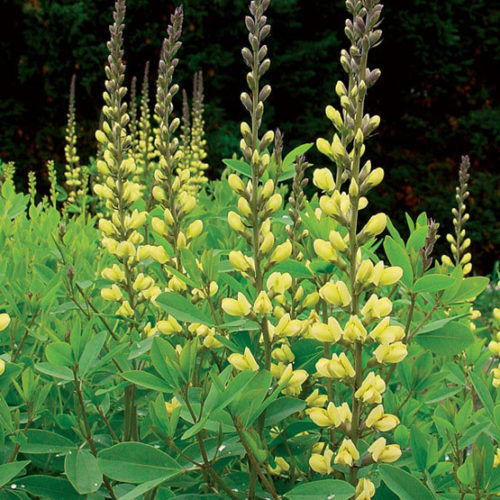
Baptisia 'Carolina Moonlight' ('Carolina Moonlight' false indigo)

Baptisia 'Carolina Moonlight' Photo/Illustration: Courtesy of North Creek Nurseries


Be the first to rate this plant

Plant Showcase - from our advertisers


Hardiness Zones: 1 2 3 4 5 6 7 8 9 10 11
Botanical Name: Baptisia 'Carolina Moonlight' bap-TEE-zsah Common Name: 'Carolina Moonlight' false indigo Genus: Baptisia
This spectacular perennial hybrid has 18-inch-tall spires of buttery yellow flowers in late spring and beautiful blue-green foliage throughout summer. Tough, exceptionally drought tolerant, and extremely long-lived, it's the southern substitute for the much sought-after lupine. 'Carolina Moonlight' has an adaptable, easy-to-grow nature and makes a great companion for other rugged plants such as ornamental grasses.
Noteworthy characteristics: Buttery yellow flowers and bluish green foliage make this cultivar of our native false indigo a standout. It is very hardy and long-lived.
Care: Provide full sun and most any soil. Foliage may be sheared or trimmed back after flowering to avoid the possibility of needing to stake the plant.
Propagation: Divide plants in late fall or early spring. This cultivar does not come true from seed.
Problems: Nothing serious.
Height 1 ft. to 3 ft.
Spread 1 ft. to 3 ft.
Growth Habit Clumps
Growth Pace Moderate Grower
Light Full Sun Only
Moisture Adaptable
Maintenance Low
Tolerance Drought Tolerant
Characteristics Native; Showy Flowers; Showy Seed Heads
Bloom Time Late Spring
Flower Color Yellow Flower
Uses Beds and Borders
Style Cottage Garden, Meadow Garden
Seasonal Interest Spring Interest, Summer Interest
Type Perennials

Plants you might also like

Hemerocallis 'Blackeyed Stella' Hemerocallis 'Blackeyed Stella'
(Daylily)
Be the first to rate this plant
Hardiness Zones: 1 2 3 4 5 6 7 8 9 10 11

Daylilies are classic, extremely popular garden plants. They feature long, arching, strappy leaves and long stems of generally 6-petaled flowers, though double flowers are popular as well. Each flower lasts only one day, hence the plant’s common name. Daylilies come in a wide range of colors, from cream and cheery yellow to peach, orange, fiery red, deep burgundy, pink, and purple. Some have contrasting throats and "eye-zones." Daylilies are ideal for a mixed herbaceous perennial border.

Echinacea purpurea ‘Bright Star’ Echinacea purpurea ‘Bright Star’
(Purple coneflower)
Be the first to rate this plant
Hardiness Zones: 1 2 3 4 5 6 7 8 9 10 11

This native meadow derivative with daisy-like flowers blooms from early summer into early autumn. 'Bright Star' has prominent, copper-orange central cones surrounded by red-purple ray petals (to 5 inches across), and grows to less than 3 feet tall.

Solidago juncea Solidago juncea
(Goldenrod, Early goldenrod, Yellow top)
Be the first to rate this plant
Hardiness Zones: 1 2 3 4 5 6 7 8 9 10 11

This is the first goldenrod to bloom, featuring bright yellow, plume-like panicles in midsummer. It has dark green leaves along reddish stems, which form a vase-shaped clump when mature. 

Solidago nemoralis Solidago nemoralis
(Goldenrod, Gray goldenrod)
Be the first to rate this plant
Hardiness Zones: 1 2 3 4 5 6 7 8 9 10 11

This is one of the smallest species of goldenrod, topping out at only 4 to 6 inches high in poor soils, and 2 feet high in fertile soils. It is considered a garden-worthy species, with gray-green leaves that form clumps and languid, one-sided yellow plumes. It is tolerant of both sandy and clay soils.

Solidago flexicaulis Solidago flexicaulis
(Goldenrod, Zigzag goldenrod)
Be the first to rate this plant
Hardiness Zones: 1 2 3 4 5 6 7 8 9 10 11

This species is aptly named for its distinctive crooked stems that bend back and forth at 45° angles between nodes. It bears starry, medium-yellow flowers atop 1- to 3-foot tall stems.