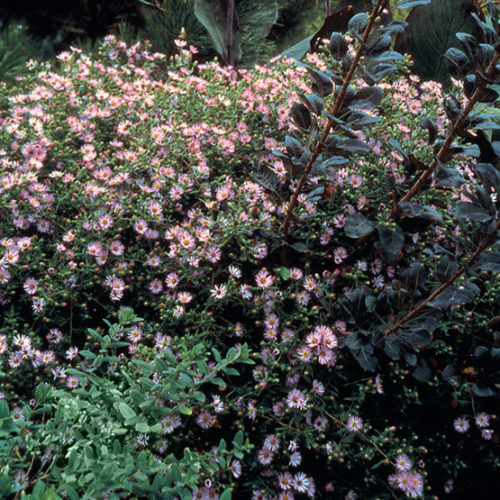
Ampelaster carolinianus (Climbing Carolina aster)

Ampelaster carolinianus Photo/Illustration: Courtesy of Plant Delights Nursery


Be the first to rate this plant

Plant Showcase - from our advertisers


Hardiness Zones: 1 2 3 4 5 6 7 8 9 10 11
Botanical Name: Ampelaster carolinianus am-pel-ASS-ter kare-oh-lin-ee-AY-nus Common Name: Climbing Carolina aster Synonyms: Aster carolinianus Genus: Aster

This perennial vine sends out abundant pale purple to lavender flowers beginning in late October. It grows to 4 to 5 feet tall, and frost does not seem to impede the blooms. It can attract bees and butterflies well into November.

To get the best flower display, give climbing aster as much sun as possible. It should also have something to lean on, like a fence, a trellis, or an ornamental shrub. Don't prune it over the winter, no matter how dead it may look. It’s better to wait to tidy up things after the new growth appears in spring.


Noteworthy characteristics: Smells wonderful.
Care: Grow in well-cultivated, fertile, moist soil in sun or partial shade.
Propagation: Most asters require frequent division.
Problems: Asters are sometimes plagued by fungal diseases. The most common are wilt disease, powdery mildew, and botrytis.
Height 10 ft. to 15 ft.
Light Full Sun to Part Shade
Moisture Medium Moisture
Characteristics Fragrant Flowers; Native; Showy Flowers
Bloom Time Fall
Flower Color Pink Flower; Purple/ Lavender Flower
Uses , Beds and Borders, Trellis
Style , Cottage Garden
Seasonal Interest , Fall Interest
Type ,Perennials

Plants you might also like

Boltonia asteroides Boltonia asteroides
(False chamomile)
Be the first to rate this plant
Hardiness Zones: 1 2 3 4 5 6 7 8 9 10 11

Boltonias are vigorous perennials grown for their sprays of aster-like flowers, which appear above clean, gray-green foliage. Their vigorous nature makes them suitable for naturalizing. They are also great in the border (and for cutting), but will benefit from frequent dividing to keep in bounds, and may be cut back in late spring for more compact plants.

Aster novae-angliae Aster novae-angliae
(New England aster)
Be the first to rate this plant
Hardiness Zones: 1 2 3 4 5 6 7 8 9 10 11

Strong, almost woody, stems bear large sprays (to 10 inches) of violet-purple flowers.

no image available Phlox maculata
(Meadow phlox, Wild sweet William)
Be the first to rate this plant
Hardiness Zones: 1 2 3 4 5 6 7 8 9 10 11

This upright, herbaceous perennial has slender, hairy stems reaching 1.5 to 3 feet tall, with clusters of lavender-rose, lilac-pink, or white flowers. The stems often have burgundy spots on them. Blooms appear in early summer and midsummer.

Phlox paniculata 'David' Phlox paniculata 'David'
(Border phlox, Summer phlox)
(26 user reviews)
Hardiness Zones: 1 2 3 4 5 6 7 8 9 10 11

This pure white phlox is valuable in the garden because of its abundant, fragrant flowers, its sturdy growth habit, and its resistance to powdery mildew. Growing to about 3 ½ feet tall and 2 to 3 feet wide, it blooms from early summer to early fall. It needs a consistently moist soil. Use it in a border or cottage garden. It will glow at dusk.

Phlox paniculata Phlox paniculata
(Garden phlox, Perennial phlox)
Be the first to rate this plant
Hardiness Zones: 1 2 3 4 5 6 7 8 9 10 11

This sturdy, upright perennial reaches 2 to 4 feet tall. In July and August, and through September with deadheading, it bears flowers in shades of white, coral, pink, red, lavender, and violet, depending on the cultivar. Some have a lighter or darker eye, and others have variegated leaves. Many of the cultivars are fragrant; scent is most noticeable at night.