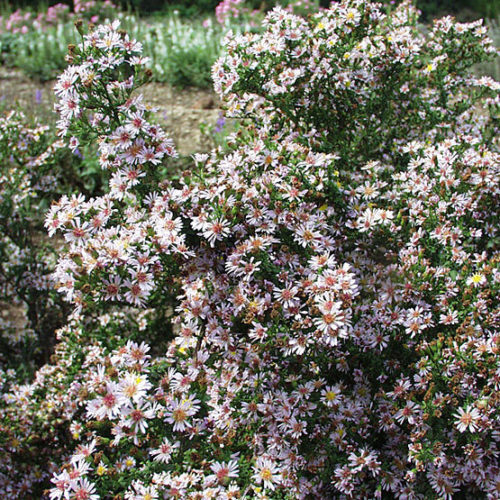
Aster lateriflorus ‘Lady in Black’

Aster lateriflorus ‘Lady in Black’ Photo/Illustration: Courtesy of Bluestone Perennials

(Based on 1 user review)

Rate this plant

Hardiness Zones: 1 2 3 4 5 6 7 8 9 10 11
Botanical Name: Aster lateriflorus ‘Lady in Black’ ASS-ter lat-er-ih-FLOOR-us Genus: Aster
Although it’s valued for its autumn blossoms, ‘Lady in Black’ creates a stir from the moment its dusky purple leaves unfurl in spring. By summer’s end, thousands of tiny dark buds dot the densely branched 3-foot-tall plant, promising an explosion of color.
Noteworthy characteristics: Dusky-purple leaves make this a long-season highlight. Attracts butterflies.
Care: Prefers full sun and moist but well-drained soil. Pinch stems back in early summer if bushier plants are desired. Tolerates light shade.
Propagation:

Divides well in autumn. Most asters require frequent division.


Problems:

Asters are sometimes plagued by fungal diseases. The most common are wilt disease, powdery mildew, and botrytis.


Height 1 ft. to 3 ft.
Spread 1 ft. to 3 ft.
Growth Habit Clumps
Light Full Sun to Part Shade
Moisture Medium Moisture
Maintenance Low
Characteristics Native; Showy Flowers; Showy Foliage
Bloom Time Fall; Summer
Uses Beds and Borders
Style Cottage Garden, Meadow Garden
Seasonal Interest Spring Interest, Summer Interest, Fall Interest
Type Perennials

Plants you might also like

Amsonia hubrichtii Amsonia hubrichtii
(Arkansas blue star)
Be the first to rate this plant
Hardiness Zones: 1 2 3 4 5 6 7 8 9 10 11

Arkansas blue star's delicate, willow-like foliage is topped with pale blue star-shaped flowers in spring. The light green foliage looks good all summer, turns a beautiful golden-yellow in fall, and can stand through most of the winter, adding interest especially when mixed with grasses and other attractive seedheads. It grows to almost 3 feet tall and wide.

Achillea 'Moonshine' Achillea 'Moonshine'
(Yarrow)
(3 user reviews)
Hardiness Zones: 1 2 3 4 5 6 7 8 9 10 11

This popular gray-leaved yarrow has 18-inch-tall yellow flower heads that last for several weeks in late summer.

Echinacea purpurea ‘Bright Star’ Echinacea purpurea ‘Bright Star’
(Purple coneflower)
Be the first to rate this plant
Hardiness Zones: 1 2 3 4 5 6 7 8 9 10 11

This native meadow derivative with daisy-like flowers blooms from early summer into early autumn. 'Bright Star' has prominent, copper-orange central cones surrounded by red-purple ray petals (to 5 inches across), and grows to less than 3 feet tall.

Rudbeckia maxima Rudbeckia maxima
(Giant coneflower, Black-eyed Susan)
Be the first to rate this plant
Hardiness Zones: 1 2 3 4 5 6 7 8 9 10 11

This choice species makes a strong vertical statement with its large, smooth, sea-green leaves and towering stems to 6 feet tall. It bears short, yellow ray florets with giant, upright cones at the center. It prefers average soil with good drainage, and is excellent in native or wild plantings.

Aquilegia chrysantha Aquilegia chrysantha
(Golden columbine, Yellow columbine)
Be the first to rate this plant
Hardiness Zones: 1 2 3 4 5 6 7 8 9 10 11

A. chrysantha is a vigorous grower that will add a real burst of color to any southern garden. This southwestern U.S. native has 3-inch yellow flowers in spring and reaches almost 3 feet tall.