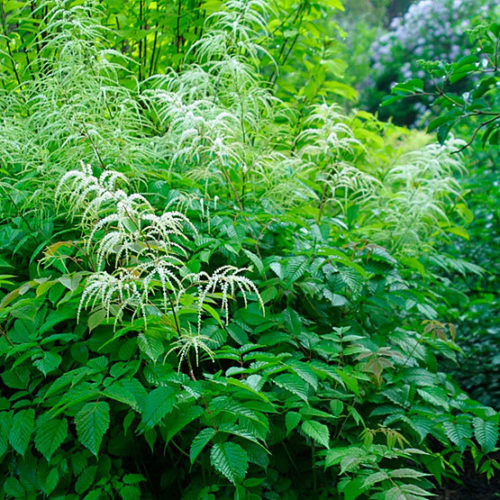
Aruncus dioicus (Goatsbeard, Goat's beard)

Aruncus dioicus Photo/Illustration: Jennifer Benner

(Based on 1 user review)

Rate this plant

Hardiness Zones: 1 2 3 4 5 6 7 8 9 10 11
Botanical Name: Aruncus dioicus ah-RUN-kus dy-oh-EYE-kus Common Name: Goatsbeard, Goat's beard Synonyms: A. sylvester, Spiraea aruncus Genus: Aruncus
Goat's beard is a perennial native to eastern North America and parts of Europe and Siberia. It is grown for its tall stature (up to 6 feet) and showy, cream-colored plumes of flowers in summer. The effect is that of a giant astilbe. Plants with male flowers produce showier and more erect plumes than plants with female flowers, whose plumes are more pendent and less creamy-white. Grow in a woodland garden or moist border, or at waterside.
Noteworthy characteristics: Tall, native perennial with showy plumes of creamy-white or greenish-white flowers in summer.
Care: Grow in moist, fertile soil in full or partial shade. This species can also tolerate drier conditions in full sun. Deadhead to control unwanted seedlings.
Propagation: Divide in early spring or fall. Sow seed in a cold frame in autumn or spring. Self-sows freely.
Problems: Generally easy to grow, but fly larvae and tarnished plant bugs may be problems.
Height 3 ft. to 6 ft.
Spread 3 ft. to 6 ft.
Growth Habit Clumps
Growth Pace Moderate Grower
Light Part Shade to Full Shade
Moisture Dry to Medium
Maintenance Moderate
Characteristics Native; Showy Flowers
Bloom Time Early Spring; Spring; Summer
Flower Color White Flower
Uses Beds and Borders, Waterside
Style Woodland Garden
Seasonal Interest Summer Interest
Type Perennials

Plants you might also like

Actaea racemosa Actaea racemosa
(Black cohosh, Black snakeroot, Bugbane)
Be the first to rate this plant
Hardiness Zones: 1 2 3 4 5 6 7 8 9 10 11

Actaea racemosa is a native woodland perennial with white, somewhat fuzzy flowers in midsummer that wave above astilbe-like, deeply cut foliage. The flowers can be unpleasantly scented, thus the name "bugbane." Formerly in the genus Cimicifuga, this plant is great for use in a woodland garden or moist border.

Anthemis tinctoria Anthemis tinctoria
(Golden marguerite, Oxeye chamomile)
Be the first to rate this plant
Hardiness Zones: 1 2 3 4 5 6 7 8 9 10 11

This clump-forming perennial produces many weeks of daisy-like flowers in summer. It is great in borders and works well as a cut flower.

Penstemon digitalis 'Husker Red' Penstemon digitalis 'Husker Red'
Be the first to rate this plant
Hardiness Zones: 1 2 3 4 5 6 7 8 9 10 11

This cultivar of our East Coast native is one of the few penstemons adaptable to wet winters and hot, humid summers. 'Husker Red' shines with ruby-toned leaves. Late spring and early summer brings sturdy 3-foot-high stems adorned by panicles of white blooms that entice bees, hummingbirds, and butterflies, but not deer or rabbits. In autumn and winter, songbirds feed on the seed. 'Husker Red' is stunning grown in groups.

Dicentra spectabilis Dicentra spectabilis
(Bleeding heart, Lyre flower)
(1 user review)
Hardiness Zones: 1 2 3 4 5 6 7 8 9 10 11

A garden favorite for many years, bleeding heart has soft green foliage and 1-inch-long rose pink and white heart-shaped flowers for several weeks in spring. Plants can form clumps 3 feet across and almost as tall. Foliage generally goes dormant in summer, so be sure to choose companion plants carefully so there isn't an empty space left in the garden. Beautiful in a border or woodland garden.

Delphinium elatum Delphinium elatum
Be the first to rate this plant
Hardiness Zones: 1 2 3 4 5 6 7 8 9 10 11

The parent of the regal hybrid Delphiniums, the species has 3- to 4-foot-tall spires of blue, violet, lavender, or white flowers. It usually requires staking.