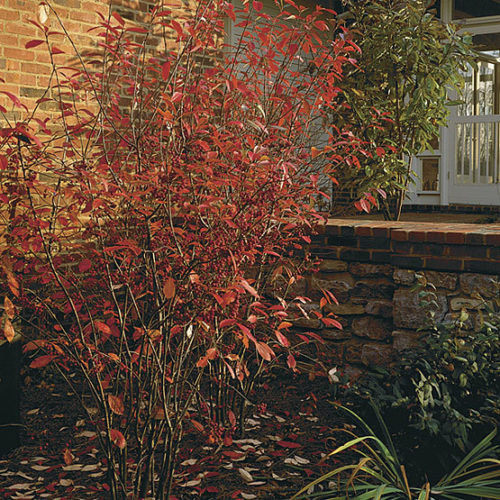
Aronia arbutifolia (Red chokeberry)

Aronia arbutifolia Aronia arbutifolia 'Brilliantissima' Photo/Illustration: Paul Moore


Be the first to rate this plant

Hardiness Zones: 1 2 3 4 5 6 7 8 9 10 11
Botanical Name: Aronia arbutifolia ah-ROE-nee-ah ar-bew-tih-FOE-lee-ah Common Name: Red chokeberry Genus: Aronia
Fragrant white flowers in spring, red fall foliage, and persistent berries for winter interest make Aronia a valuable plant in all seasons.
Noteworthy characteristics: Spreads by suckering. Needs space, but can be kept in check. A nice native alternative to burning bush.
Care: Prefers full sun to part shade and moist but well-drained soil, but can tolerate most any soil, including boggy. Full sun may produce more fruit.
Propagation: Root softwood cuttings in summer.
Problems: Leaf spot and rust are common.
Height 6 ft. to 10 ft.
Spread 3 ft. to 6 ft.
Growth Habit Spreads
Light Full Sun to Part Shade
Moisture Dry to Medium
Maintenance Moderate
Tolerance Deer Tolerant
Characteristics Fragrant Flowers; Native; Showy Fruit
Bloom Time Late Spring; Spring
Flower Color White Flower
Uses Beds and Borders, Roadside
Seasonal Interest Winter Interest, Spring Interest, Summer Interest, Fall Interest
Type Shrubs

Plants you might also like

Clethra alnifolia 'Hummingbird' Clethra alnifolia 'Hummingbird'
(Sweet pepperbush)
Be the first to rate this plant
Hardiness Zones: 1 2 3 4 5 6 7 8 9 10 11

This upright, suckering shrub bears creamy white, deliciously spicy clove-scented flowers in dense, upright spikes that last four to six weeks in July and August. It is more compact than the species. Flowers mature to spikes of dark brown capsules that provide winter interest. Its oval, glossy dark green leaves turn a pleasant yellow in autumn.

Ephedra equisetina Ephedra equisetina
(Bluestem joint fir)
Be the first to rate this plant
Hardiness Zones: 1 2 3 4 5 6 7 8 9 10 11

A member of the conifer clan, Ephedra equisetina is commonly called bluestem joint fir due to its finely textured blue stems. In spring, it features a conspicuous froth of yellow blooms that are often followed by red berries. It is perfect for naturalized areas since it reliably spreads.

Rosa rugosa var. alba Rosa rugosa var. alba
(Hedgehog rose, Ramanas rose, Japanese rose, Sea tomato)
Be the first to rate this plant
Hardiness Zones: 1 2 3 4 5 6 7 8 9 10 11

This variety has single, papery white blossoms that open from light pink buds and have contrasting yellow stamens. The heavily-scented flowers are followed by reddish-orange hips. It grows up to 6 feet high.

Rosa rugosa 'Henry Hudson' Rosa rugosa 'Henry Hudson'
Be the first to rate this plant
Hardiness Zones: 1 2 3 4 5 6 7 8 9 10 11

This rugosa rose has flattened, symmetrical, semi-double, snowy white flowers with a spicy clove scent. The blooms display well against the shrub's dense growth of deep green foliage. Crimson-hued buds add even more color to this lovely variety. The blossoms don't drop cleanly, so deadheading is necessary.

Rosa rugosa 'Polar Ice' Rosa rugosa 'Polar Ice'
('Polar Ice' rugosa rose)
Be the first to rate this plant
Hardiness Zones: 1 2 3 4 5 6 7 8 9 10 11

'Polar Ice', also known as 'Polareis,' is one of the most impressive, vigorous, and densely growing rugosa rose varieties, exemplifying every positive trait of a rugosa rose. With clusters of double, slightly nodding flowers, the green buds of 'Polar Ice' open to creamy white blooms with shell pink petals and deeper pink centers. The flowers smell lightly of baby powder, and the new, glossy, lime green foliage smells like strawberries and sweet grass. The fall foliage of this exceptional rose turns the brightest, clearest yellow of all the rugosas.