previous
  • Comfortable Alfresco Dining
    Comfortable Alfresco Dining
  • Dwarf Citrus Trees
    Dwarf Citrus Trees
  • Building a Compost Bin
    Building a Compost Bin
  • In Pursuit of the Perfect Potting Shed
    In Pursuit of the Perfect Potting Shed
  • Homegrown / Homemade
    Homegrown / Homemade
  • Thoughts From a Foreign Field
    Thoughts From a Foreign Field
  • Containers as Focal Points
    Containers as Focal Points
  • Mulch for a Healthy Garden
    Mulch for a Healthy Garden
  • Plant an Easy-to-Water Strawberry Jar
    Plant an Easy-to-Water Strawberry Jar
  • Save Money by Growing Your Own
    Save Money by Growing Your Own
  • 6 Tips for Weed Control
    6 Tips for Weed Control
  • Colorful Selections for Shade
    Colorful Selections for Shade
  • Designing with Curved Terraces
    Designing with Curved Terraces
  • Fast-Growing Trees for Impatient Gardeners
    Fast-Growing Trees for Impatient Gardeners
  • Garden Confidential: A Plant Walks into a Bar
    Garden Confidential: A Plant Walks into a Bar
  • Lawn Alternatives
    Lawn Alternatives
  • Indeterminate or Determinate Tomatoes?
    Indeterminate or Determinate Tomatoes?
  • NEW Video Series: There's a Better Way
    NEW Video Series: There's a Better Way
  • Elephant's Ears
    Elephant's Ears
  • Pretty in Pink
    Pretty in Pink
  • Make a Succulent Topiary
    Make a Succulent Topiary
  • Plants that Spark!
    Plants that Spark!
  • Slideshow: Beautiful Clematis
    Slideshow: Beautiful Clematis
  • Stylish Shady Containers
    Stylish Shady Containers
  • Fragrant Plants for Pathways
    Fragrant Plants for Pathways
next

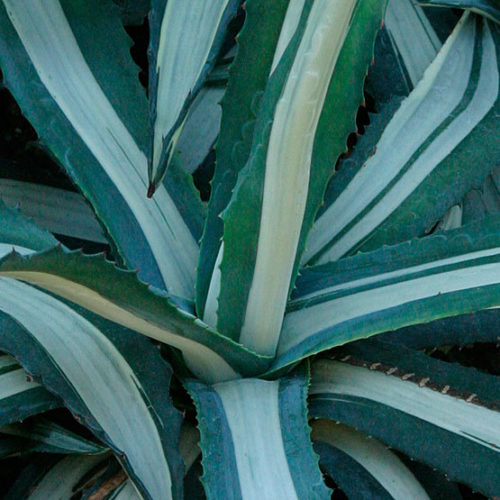
Agave americana (American aloe, Century plant)

Agave americana Photo/Illustration: Michelle Gervais

(Based on 1 user review)

Rate this plant

Plant Showcase - from our advertisers


Hardiness Zones: 1 2 3 4 5 6 7 8 9 10 11
Botanical Name: Agave americana ah-GAH-vay ah-mer-ih-KAY-nah Common Name: American aloe, Century plant Synonyms: Agave altissima Genus: Agave
This plant has a rosette of broad sword-like, succulent, gray-green leaves. It provides a statuesque presence for sunny dry sites and under glass. It's also a classic plant for urns, thanks to the architectural splendor of its simple form.
Noteworthy characteristics: Plants die after flowering and fruiting, but leave behind off-sets to create new plants. Lethal-looking, dark needlelike spines at leaf tips and along margins encourage a cautious approach.
Propagation: Remove offsets in spring or fall.
Problems: Scale insects and mealybugs on young growth; leaf blights and root rots in poorly drained soil.
Height 3 ft. to 6 ft.
Spread 6 ft. to 10 ft.
Growth Habit Clumps
Growth Pace Moderate Grower
Light Full Sun Only
Moisture Dry
Maintenance Low
Characteristics Showy Foliage
Bloom Time Summer
Flower Color White Flower
Uses Container, Specimen Plant/ Focal Point
Style Desert Garden, Xeric Bed
Seasonal Interest Winter Interest, Spring Interest, Summer Interest, Fall Interest
Type Cacti and Succulents

Plants you might also like

Agave parryi Agave parryi
(Mescal)
(2 user reviews)
Hardiness Zones: 1 2 3 4 5 6 7 8 9 10 11

This plant has a dense rosette of fleshy blue-gray leaves and produces tall, cream-colored flowers tinged with red or pink in summer.

Dyckia fosteriana 'Cherry Cola' Dyckia fosteriana 'Cherry Cola'
('Cherry Cola' dyckia)
Be the first to rate this plant
Hardiness Zones: 1 2 3 4 5 6 7 8 9 10 11

'Cherry Cola' , a relatively new cultivar, features deep, dark burgundy foliage and small but sharp teeth (handle with care!). In summer, orange blossoms appear, and hummingbirds love them. Like other Dyckias, this plant tolerates extreme heat and is perfect for hot, dry locations. -Jeff Moore, Regional Picks: Southwest, Fine Gardening issue #120

Aloe cameronii Aloe cameronii
(Red aloe)
(2 user reviews)
Hardiness Zones: 1 2 3 4 5 6 7 8 9 10 11

Aloe is best known as a medicinal plant (Aloe vera, Zones 10-11), but there are many beautiful aloes as well. Most have amazing winter flowers, and some, have interesting foliage color. Red aloe  has color that varies from green to a deep, red wine hue, depending on sun and water. and, over time, will form beautiful red-purple mounds with orange flowers. It is easily propagated from cuttings. -Jeff Moore, Regional Picks: Southwest, Fine Gardening issue #120

Hesperaloe parviflora Hesperaloe parviflora
(Red yucca)
(1 user review)
Hardiness Zones: 1 2 3 4 5 6 7 8 9 10 11

A clump-forming succulent, red yucca has arching, leathery, linear foliage rising to between 2 and 3 feet tall. Dark olive-green leaves with no thorns or spines are sparsely covered with fibrous strands along the margins. Deep coral pink flowers with golden yellow throats crowd the length of the stalks that reach three feet or more. Foliage has a reddish bronze hue during winter's chill for year-round interest.

Aeonium arboreum 'Zwartkop' Aeonium arboreum 'Zwartkop'
(Black rose)
(2 user reviews)
Hardiness Zones: 1 2 3 4 5 6 7 8 9 10 11

The "flowers" of black rose. are actually rosettes of burgundy-black leaves at the ends of stalklike stems. In winter, bright yellow flowers contrast with the dark foliage. 'Zwartkop' is a wonderful backdrop plant that can show off many companion plants to maximum advantage. -Jeff Moore, Regional Picks: Southwest, Fine Gardening issue #120