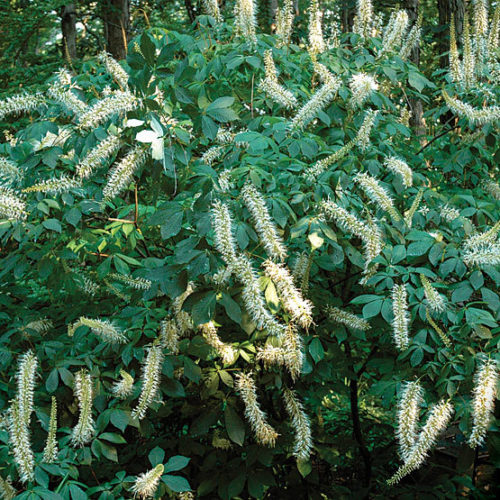
Aesculus parviflora var. serotina 'Rogers' ('Rogers' bottlebrush buckeye)

Aesculus parviflora var. serotina 'Rogers' Photo/Illustration: www.armitageimages.net


Be the first to rate this plant

Hardiness Zones: 1 2 3 4 5 6 7 8 9 10 11
Botanical Name: Aesculus parviflora var. serotina 'Rogers' ESS-kew-lus par-vih-FLOOR-ah variety ser-oh-TY-nah Common Name: 'Rogers' bottlebrush buckeye Genus: Aesculus
This is a suckering, deciduous shrub grown for it's white, bottlebrush-like flowers in early summer. The flowers are considerably longer than those of the species at up to 30 inches, and emerge a couple of weeks later. The shrub grows to 10 feet tall and 15 feet wide and prefers full sun to partial shade and moist, well-drained soil. Its layers of broad leaves turn gold in fall.Suitable for a medium to large garden.
Care: Partial shade is preferred, but full sun is tolerated with adequate moisture. Prune out deadwood and crossign branches in late winter/early spring when the shrub is still dormant.
Propagation:

 Propagate by suckers or seed.


Problems:

 Occasionally prone to canker, Japanese beetles, rust, powdery mildew, scale insects.


Height 6 ft. to 10 ft.
Spread 10 ft. to 15 ft.
Growth Habit Spreads
Growth Pace Fast Grower
Light Full Sun Only;Full Sun to Part Shade;Part Shade Only
Moisture Medium Moisture
Maintenance Low
Tolerance Deer Tolerant
Characteristics Showy Flowers
Bloom Time Early Summer; Late Spring
Flower Color White Flower
Seasonal Interest Summer Interest
Type Shrubs,Low-Maintenance,Sun,Natives

Plants you might also like

Hydrangea quercifolia Hydrangea quercifolia
(Oakleaf hydrangea)
(1 user review)
Hardiness Zones: 1 2 3 4 5 6 7 8 9 10 11

More drought tolerant than their classic cousins, oakleaf hydrangeas hail from the sandy stream banks of the lower southeastern United States. The coarsely textured and deeply lobed leaves are matte green, turning striking shades of red and purple in fall. In spring, they deliver nickel-size white bracts lined up in dense coneheads. As the summer wanes, the flower heads age gracefully into shades of pink, green, and ecru.

Fothergilla 'Blue Shadow' Fothergilla 'Blue Shadow'
(Dwarf Fothergilla, Dwarf Witch Alder )
Be the first to rate this plant
Hardiness Zones: 1 2 3 4 5 6 7 8 9 10 11

These shrubs are beautiful, compact, and easy to grow, making them obvious choices for mixed borders, foundation plantings, and naturalizing. The fragrant, bottlebrush flowers are petalless and sweetly-scented.

Robinia hispida Robinia hispida
(Rose acacia, Bristly locust)
Be the first to rate this plant
Hardiness Zones: 1 2 3 4 5 6 7 8 9 10 11

This showy flowering shrub grows to 8 feet tall and wide and features dark green, compound pinnate leaves on bristly stems and pendant clusters of fragrant, pea-like, rose-pink flowers that are attractive to bees and butterflies in late spring and early summer. The flowers are occasionally followed by bristly, reddish-brown seed pods. Native to the southeastern United States, this aggressive shrub spreads by suckers and is considered invasive in Michigan, New Jersey, Ohio, Pennsylvania, and Washington. All parts of this plant are at least mildly poisonous.

Fallugia paradoxa Fallugia paradoxa
(Apache plume)
Be the first to rate this plant
Hardiness Zones: 1 2 3 4 5 6 7 8 9 10 11

A member of the rose family (Rosaceae), Apache plume has single, white, rose-like flowers in a fine-textured shrub up to 5 feet tall and 8 feet wide. Flowering occurs from late spring until late summer, and is followed by clouds of showy, pink, feater-duster-like seed heads that are just as showy as the flowers.

Heteromeles arbutifolia Heteromeles arbutifolia
(Toyon, Christmas berry, California holly)
Be the first to rate this plant
Hardiness Zones: 1 2 3 4 5 6 7 8 9 10 11

This evergreen, California-native shrub grows to 20 feet tall and wide and produces abundant clusters of tiny white flowers in early summer, which attract beneficial insects that help control pests. This is followed by bright red berries that feed wildlife in fall and winter. The only species of its genus, Toyon is closely related to the genus Photinia.