previous
  • Big Flowers from Bigleaf Hydrangeas
    Big Flowers from Bigleaf Hydrangeas
  • A gardener's checklist for early summer
    A gardener's checklist for early summer
  • How to Grow Raspberries
    How to Grow Raspberries
  • Backyard Makeover Game
    Backyard Makeover Game
  • Lilacs: Time for a Fresh Look
    Lilacs: Time for a Fresh Look
  • Video: Make a Straw-Bale Garden
    Video: Make a Straw-Bale Garden
  • Viburnums are Versatile Shrubs
    Viburnums are Versatile Shrubs
  • Variegated Plants Create Drama
    Variegated Plants Create Drama
  • Bold and Beautiful Zinnias
    Bold and Beautiful Zinnias
  • Free Download: Rose Pruning and Bed Prep
    Free Download: Rose Pruning and Bed Prep
  • 25 Robust Summer Bloomers
    25 Robust Summer Bloomers
  • Garden Catalog Collector
    Garden Catalog Collector
  • Friendly Ways to Battle Garden Pests
    Friendly Ways to Battle Garden Pests
  • Find the Perfect Tomato
    Find the Perfect Tomato
  • 15 Deer-Resistant Plants
    15 Deer-Resistant Plants
  • Building a Compost Bin
    Building a Compost Bin
  • How to Start a Vegetable Garden
    How to Start a Vegetable Garden
  • All About Starting Seeds
    All About Starting Seeds
  • Soil Testing is Worth the Effort
    Soil Testing is Worth the Effort
  • Off With Their Heads: Deadheading Perennials
    Off With Their Heads: Deadheading Perennials
  • Make Your Own Hypertufa Container
    Make Your Own Hypertufa Container
  • The Only Shrubs You Need to Grow
    The Only Shrubs You Need to Grow
  • Enchanting Japanese Maples
    Enchanting Japanese Maples
  • 10 Perennials Easily Grown from Seed
    10 Perennials Easily Grown from Seed
  • Perfect Edges for Your Beds and Borders
    Perfect Edges for Your Beds and Borders
next

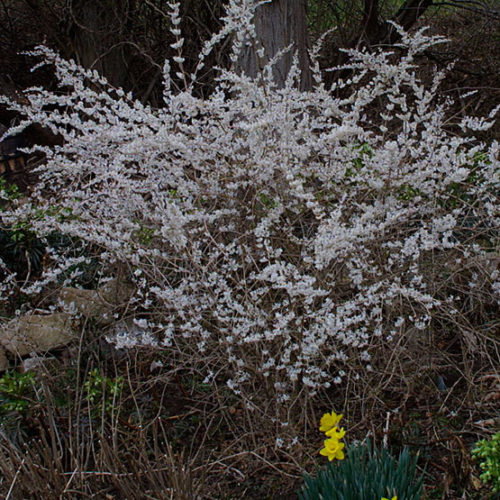
Abeliophyllum distichum (White forsythia)

Abeliophyllum distichum Photo/Illustration: Steve Aitken


Be the first to rate this plant

Plant Showcase - from our advertisers


Hardiness Zones: 1 2 3 4 5 6 7 8 9 10 11
Botanical Name: Abeliophyllum distichum ah-bee-lee-oh-FIL-lum DISS-tih-kum Common Name: White forsythia Synonyms: Korean abelialeaf Genus: Abeliophyllum
This deciduous shrub is related to the forsythia, but differs in that it has white (rather than yellow) flowers that open in early spring before true forsythia. It is a member of the olive family (Oleaceae). In early spring, before the new leaves form, purplish buds all along the grey naked branches open into small white four-petaled, almond-scented flowers with yellow stamens. After flowering, green, glossy abelia-like leaves appear.
Noteworthy characteristics: White forsythia is native to a small area of central Korea. It is seriously endangered in the wild as it is regarded as a medicinal plant with properties similar to witch hazel, and is illegally harvested for the black market trade in Korea. It is widely grown as a cultivated garden plant, however, so there is no risk of extinction other than in the wild.
Care: White forsythia likes full sun but will tolerate some shade. It is not fussy about soil conditions but will do poorly in drought-like conditions. In the coldest areas, it is best to either protect the plant from dessicating winter winds, or grow it close to a wall for extra warmth. Prune after it flowers to encourage new wood for next year's flowers. As much as one-third of the shrub may be removed annually. A hard prune every three to four years will control twigginess. Its branches can be cut and brought inside in early spring for forcing in vases.
Propagation: Root greenwood or semi-ripe cuttings in summer; layer in summer.
Problems: Infrequent.
Height 3 ft. to 6 ft.
Spread 3 ft. to 6 ft.
Growth Pace Moderate Grower
Light Full Sun to Part Shade
Moisture Medium Moisture
Maintenance Low
Characteristics Fragrant Flowers; Showy Flowers
Bloom Time Spring
Foliage Color Colorful/Burgundy Foliage
Flower Color White Flower
Uses Beds and Borders
Style Herb Garden, Cottage Garden
Seasonal Interest Winter Interest, Spring Interest
Type Shrubs

Plants you might also like

Rosa rugosa var. alba Rosa rugosa var. alba
(Hedgehog rose, Ramanas rose, Japanese rose, Sea tomato)
Be the first to rate this plant
Hardiness Zones: 1 2 3 4 5 6 7 8 9 10 11

This variety has single, papery white blossoms that open from light pink buds and have contrasting yellow stamens. The heavily-scented flowers are followed by reddish-orange hips. It grows up to 6 feet high.

Rosa 'Frau Dagmar Hastrup' Rosa 'Frau Dagmar Hastrup'
(Hedgehog rose, Ramanas rose, Japanese rose, Sea tomato)
(1 user review)
Hardiness Zones: 1 2 3 4 5 6 7 8 9 10 11

This choice rose has single, gently cupped light-pink flowers that exude an intense, clove-scented perfume. It blooms in spring and sporadically throughout the season, and produces red hips. In autumn, the foliage turns deep maroon, which changes to yellow tinged with coppery highlights. It grows to 3 to 4 feet high and wide.   

Viburnum carlesii Viburnum carlesii
(Koreanspice viburnum)
Be the first to rate this plant
Hardiness Zones: 1 2 3 4 5 6 7 8 9 10 11

This deciduous shrub with toothed, dark green leaves bears pink buds in late spring that open to white or pink-flushed flowers borne in domed clusters. The intoxicating fragrance is reminiscent of spice cake. The plant also has attractive red foliage and berries in the fall. It grows to about 6 feet tall and wide.

Rosa 'Blanc Double de Coubert' Rosa 'Blanc Double de Coubert'
(Hedgehog rose, Ramanas rose, Japanese rose, Sea tomato)
(1 user review)
Hardiness Zones: 1 2 3 4 5 6 7 8 9 10 11

The white of this rose has a purity of color that is without equal. It produces semi-double, very fragrant flowers from spring to fall, which are sometimes followed by orange hips. It grows to 6 feet high and wide.   

Rosa 'Betty Prior' Rosa 'Betty Prior'
(Floribunda rose)
(1 user review)
Hardiness Zones: 1 2 3 4 5 6 7 8 9 10 11

This rose produces single, carmine-pink, slightly fragrant blooms nonstop from June until frost. It grows 2.5 to 5 feet high and wide.