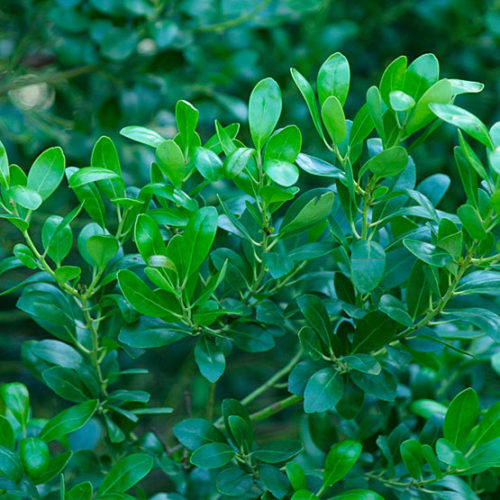
Ilex glabra (Gallberry, Inkberry holly)

Ilex glabra Photo/Illustration: Michelle Gervais


Be the first to rate this plant

Hardiness Zones: 1 2 3 4 5 6 7 8 9 10 11
Botanical Name: Ilex glabra EYE-leks GLAB-rah Common Name: Gallberry, Inkberry holly Genus: Ilex
The inkberry holly has narrow, glossy, spineless leaves and tiny black fruits. The narrow foliage produces a much finer texture than that of many other hollies. A slow-growing, evergreen shrub native to eastern North America, it produces greenish white, inconspicuous flowers in spring, followed by jet black drupes the size of peas. The fruit can persist until the next spring unless eaten by birds. Ilex glabra is rather more casual in form than the spinier hollies and can be used in borders, around ponds, as foundation plantings, or in woodland gardens.
Noteworthy characteristics: Native to the eastern United States. Evergreen, spineless foliage. Black fruit is consumed by birds.
Care: Moist but well-drained, organically rich soil in full sun. Plant or transplant in spring. Pruning, if any, should be done in late winter or early spring.
Propagation: Sow seed in a cold frame in autumn. Ilex are slow to germinate from seed, sometimes taking several years. Take semi-ripe cuttings in summer or early fall.
Problems: Aphids may attack new growth. Scale insects, leaf miners, and Phytophthora root rot can sometimes be problems.
Height 6 ft. to 10 ft.
Spread 6 ft. to 10 ft.
Growth Pace Slow Grower
Light Full Sun to Part Shade
Moisture Medium Moisture
Maintenance Moderate
Characteristics Attracts Birds; Native
Bloom Time Summer
Foliage Color Evergreen
Flower Color White Flower
Uses Beds and Borders, Hedge, Screening, Waterside
Style Woodland Garden
Type Shrubs

Plants you might also like

Rosa 'Blanc Double de Coubert' Rosa 'Blanc Double de Coubert'
(Hedgehog rose, Ramanas rose, Japanese rose, Sea tomato)
(1 user review)
Hardiness Zones: 1 2 3 4 5 6 7 8 9 10 11

The white of this rose has a purity of color that is without equal. It produces semi-double, very fragrant flowers from spring to fall, which are sometimes followed by orange hips. It grows to 6 feet high and wide.   

Ilex decidua Ilex decidua
(Possumhaw holly)
Be the first to rate this plant
Hardiness Zones: 1 2 3 4 5 6 7 8 9 10 11

While the fresh green leaves and smooth, light gray stems are enough to make possumhaw holly an attractive shrub, the appeal of this plant is more evident in late fall. Bunches of small berries form along the branches and turn bright red as the leaves fall off. Only female plants bear fruit (plant at least one male plant for best berry production), which finally becomes palatable to wildlife in the early spring. Possumhaw tends to sucker from the roots, so it's best to allow it to form a multitrunk screen.

Ilex × meserveae  Ilex × meserveae 
(Blue holly)
Be the first to rate this plant
Hardiness Zones: 1 2 3 4 5 6 7 8 9 10 11

Blue holly, so named for the glossy blue-green leaves, is a dense, vigorous shrub that can reach 15 feet tall and 10 feet wide. Insignificant flowers bloom in late spring. Female plants have glossy red fruit. There are many cultivars available.

Viburnum prunifolium Viburnum prunifolium
(Blackhaw Viburnum)
Be the first to rate this plant
Hardiness Zones: 1 2 3 4 5 6 7 8 9 10 11

Blackhaw Viburnum is a large shrub or small tree with clusters of creamy white flowers followed by pink-rose berries, which birds love to eat. Its distinctive bronze-green foliage on reddish purple stems turns blue-black in the fall. Blackhaw grows to 12 to 15 feet high and 8 to12 feet wide.

Lindera benzoin Lindera benzoin
(Spicebush)
(1 user review)
Hardiness Zones: 1 2 3 4 5 6 7 8 9 10 11

This dioecious shrub has much to offer the garden. Male plants have showier, tiny, pale yellow flowers in early spring, but the female counterparts take center stage in early fall, when they're laden with half-inch-diameter berries that turn from green to yellow to high-gloss crimson. About the same time, the leaves turn a hypnotic soft yellow and make the red berries visually pop. Spicebush becomes a large, 5- to 8-foot-tall shrub that is slightly wider than tall. It is the preferred food for the black and blue spicebush swallowtail butterfly larvae.