

Off With Their Heads: Deadheading Perennials
Removing spent blossoms keeps perennials tidy and triggers more flowers
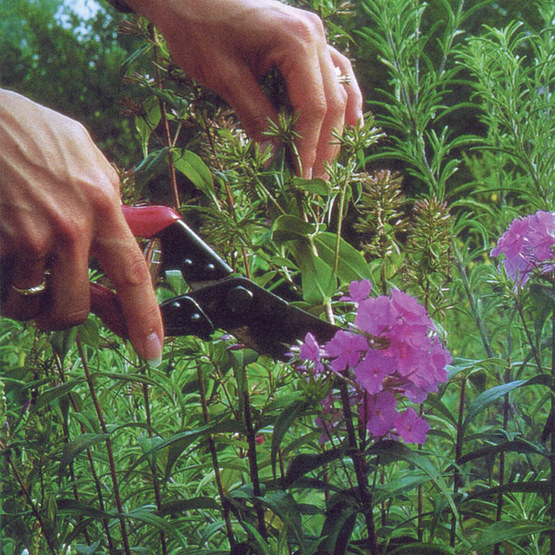
As a garden designer and speaker, I often talk about how foliage texture and form can provide the backbone to a perennial garden. But as a gardener, I have to admit that I want a lot of flowers in addition to interesting foliage. Planting long-blooming perennials is one way to keep the floral display going. Deadheading—the practice of removing spent blossoms—is another way to keep your garden in flowers.
Deadheading refreshes a plant’s appearance, controls seed dispersal, and redirects a plant’s energy from seed production to root and vegetative growth. However, I do it primarily to prolong the bloom period or encourage a second flush of blooms on some perennials. I also do it to keep other perennials tidy.
Deadheading is a maintenance practice that can be done throughout the growing season, from spring until autumn. The best time to deadhead a flower is when its appearance begins to decline. How often you’ll have to deadhead a particular plant depends on the life span of its blooms, which can range from a day to several weeks, depending on the species. Weather also greatly affects a flower’s longevity. During moist, cool summers, flowers will last much longer than they will during a season of sweltering heat. Torrential rains also take their toll on blossoms.
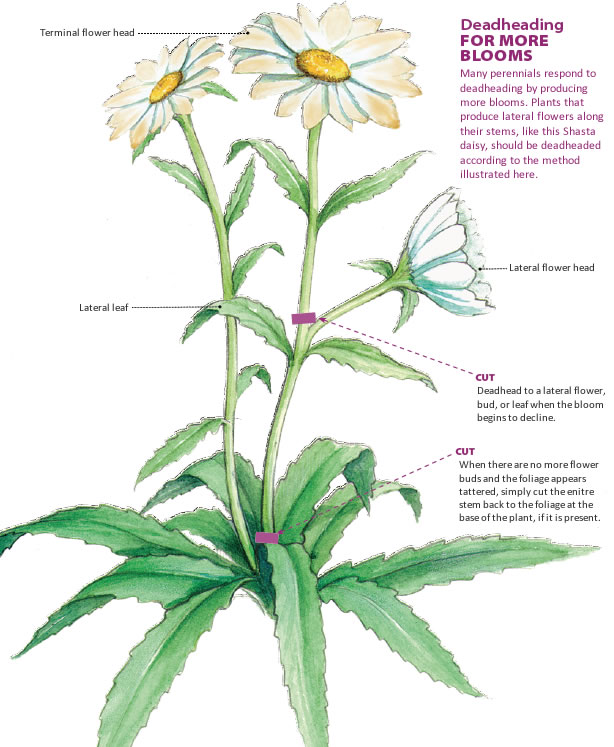
Choosing the exact point to make a deadheading cut can seem confusing, since perennials have different flower forms. Because deadheading, like other types of pruning, is so species specific, it can be difficult to group plants into categories. For most plants, however, all you need to remember is to prune spent flowers and stems back to a point where there’s a new lateral flower or bud. If no new flower is apparent, prune the stem back to a lateral leaf.
Many gardeners find deadheading enjoyable and relaxing. In fact, for me, it’s very meditative and centering. But if you do not fall into this camp, the best way to keep from feeling overwhelmed is to visit your garden daily and do a little at a time. I’ve found that once I get into a schedule of deadheading on a regular basis, the waves of blooms in my garden can be extended by weeks or even months.
Deadheading for rebloom
Many perennials respond to deadheading by producing more blooms. Plants like the Shasta daisy (Leucanthemum × superbum cv.), that produce lateral flowers along their stems should be deadheaded according to the method illustrated here.
How to deadhead for rebloom
Alternate method
Perennials that have spikelike blossoms that bloom from bottom to top, like delphinium (Delphinium spp. and cvs.) and the other examples marked by an asterisk (*) on the list below, should also be deadheaded as shown above, but only after the stem is about 70 percent finished flowering.
Plants that may rebloom after deadheading
Allwood pinks (Dianthus × allwoodii cvs.)
Baby’s breaths (Gypsophila paniculata and cvs.)
Bee balms (Monarda didyma and cvs.)
Blanket flowers (Gaillardia × grandiflora cvs.)
Butterfly weed (Asclepias tuberosa)
Checker mallows* (Sidalcea malviflora and cvs.)
Cheddar pinks (Dianthus gratianopolitanus and cvs.)
Columbines (Aquilegia spp. and cvs.)
Culver’s root* (Veronicastrum virginicum)
Dame’s rockets (Hesperis matronalis and cvs.)
Delphiniums* (Delphinium spp. and cvs.)
False sunflowers (Heliopsis helianthoides and cvs.)
Foxgloves* (Digitalis spp. and cvs.)
Garden phloxes (Phlox paniculata cvs.)
Gauras (Gaura lindheimeri and cvs.)
Geums (Geum spp. and cvs.)
Globe thistles* (Echinops ritro and cvs.)
Golden marguerites (Anthemis tinctoria and cvs.)
Hardy begonia (Begonia grandis ssp. evansiana)
Hollyhocks* (Alcea rosea cvs.)
Italian bugloss (Anchusa azurea)
Jupiter’s beard (Centranthus ruber)
Lavenders (Lavandula spp. and cvs.)
Lilyleaf ladybell (Adenophora liliifolia)
Lupines* (Lupinus spp. and cvs.)
Masterworts (Astrantia major and cvs.)
Meadow phloxes (Phlox maculata and cvs.)
Monkshoods (Aconitum spp. and cvs.)
Mountain bluet (Centaurea montana)
Painted daisies (Tanacetum coccineum and cvs.)
Patrinia (Patrinia scabiosifolia)
Penstemons* (Penstemon barbatus and cvs.)
Perennial salvias* (Salvia nemorosa and cvs.)
Pincushion flowers (Scabiosa spp. and cvs.)
Purple coneflower (Echinacea purpurea)
Purple toadflaxes* (Linaria purpurea and cvs.)
Queens-of-the-meadow (Filipendula ulmaria and cvs.)
Rose campions (Lychnis coronaria and cvs.)
Shasta daisies (Leucanthemum × superbum cvs.)
Sneezeweed (Helenium autumnale)
Spike speedwells* (Veronica spicata cvs.)
Spiderworts (Tradescantia × andersoniana cvs.)
Stokes’ asters (Stokesia laevis and cvs.)
Sweet violets (Viola odorata and cvs.)
Tickseeds (Coreopsis spp. and cvs.)
Upright hollyhock mallow (Malva alcea var. fastigiata)
Yarrows (Achillea spp. and cvs.)
Yellow corydalis (Corydalis lutea)
Perennials to deadhead to improve appearance
Baskets of gold (Aurinia saxatilis and cvs.)
Bearded irises (Iris spp. and cvs.)
Bergenias (Bergenia cordifolia and cvs.)
Catmints (Nepeta × faassenii and cvs.)
Clustered bellflowers (Campanula glomerata and cvs.)
Common rue (Ruta graveolens)
Coral bells (Heuchera spp. and cvs.)
Daylilies (Hemerocallis spp. and cvs.)
Goatsbeards (Aruncus dioicus and cvs.)
Golden stars (Chrysogonum virginianum and cvs.)
Hellebores (Helleborus orientalis and cvs.)
Hostas (Hosta spp. and cvs.)
Jacob’s ladders (Polemonium caeruleum and cvs.)
Japanese anemones (Anemone × hybrida cvs.)
Lady’s mantles (Alchemilla mollis and cvs.)
Lambs’ ears (Stachys byzantina and cvs.)
Lavender cottons (Santolina chamaecyparissus and cvs.)
Lungworts (Pulmonaria spp. and cvs.)
Mulleins (Verbascum spp. and cvs.)
Obedient plants (Physostegia virginiana and cvs.)
Pearly everlastings (Anaphalis triplinervis and cvs.)
Peonies (Paeonia spp. and cvs.)
Red hot pokers (Kniphofia spp. and cvs.)
Rodgersias (Rodgersia aesculifolia and cvs.)
Rose mallows (Hibiscus moscheutos and cvs.)
Scotch thistles (Onopordum nervosum and cvs.)
Sea thrifts (Armeria maritima and cvs.)
Wall germanders (Teucrium chamaedrys and cvs.)
Wall rock cresses (Arabis caucasica and cvs.)
Western bleeding hearts (Dicentra formosa and cvs.)
Western mugworts (Artemisia ludoviciana and cvs.)



Comments
it says to click on the image for entire illustration...but that option is not available it seems....:(
Log in or create an account to post a comment.
Sign up Log in