When I was new to gardening, I depended upon the kindness of friends and strangers to help fill my beds. Unfortunately, I was too green to realize what treasures I had in hand until I’d wasted them.
Related Videos:
Collecting Seeds
When an elderly friend gave me her heirloom, ruffled, pink, annual poppies (Papaver somniferum), I sowed them freely in a new bed of perennials. The first year they did fine, no doubt because I’d planted hundreds of seeds. By the second year, though, the perennials had filled in, leaving no bare space for poppies to sprout. I scavenged a few plants when I saw they were struggling and transplanted them to open areas of my garden, but in vain. Poppies need to be moved with their roots undisturbed, intact in a shovelful of soil. The bare-rooted seedlings I’d pulled up hung on for a few weeks, then declined and died. By that time, my friend had passed on to the great garden in the sky, and the new owner had turned her glorious gardens back to grass.
No problem, I thought—I’d just purchase seeds. Turns out that those pretty, frilly flowers were the result of decades of natural selection in her garden. After years of self-sowing and my friend pulling out the plants with single-petaled flowers or off colors, they’d settled into a variety that reliably reproduced itself year after year. I spent more money than I want to admit buying seeds from every available supplier before I realized the sad truth. Her variety of poppies wasn’t offered commercially. So I started from scratch, saving seed from the prettiest poppies until I had something close to my friend’s ruffled beauties. Now, I can smugly say I have my own strain of annual pink poppies from which I religiously gather seed year after year to perpetuate what I call the ‘Sally’ strain.
Collecting seeds is one of those activities that makes me feel like a wealthy woman. As the seed supply spills out of the first, small envelopes into manila 8210s and Mason jars, I take as much pleasure as Midas in counting my riches of coreopsis (Coreopsis lanceolata and other spp.), calliopsis (Coreopsis tinctoria), hollyhocks (Alcea rosea), and moonflowers (Ipomoea alba), among others. By the time I’m finished in fall, I will have shelves stuffed with the makings of next year’s garden.
Start simply, with flowers
Packet prices can add up in a hurry, even if you have only a small bed to fill. A few minutes of shaking ripe seed into an envelope in the early fall can produce a summer garden next year that is filled with mallows, petunias, marigolds, and other favorites—all grown for free. Saving your own seeds enables you to use your garden budget for major nonplant investments, like that teakwood table and chairs you’ve been lusting after.
You can save seeds from all kinds of plants. Annuals are the easiest because they’re the most prolific at producing seeds, but perennials and biennials are entirely possible. However, some plants aren’t worth gathering seed from because they reproduce much faster by division. I don’t fool with bee balm (Monarda didyma), daylilies (Hemerocallis cvs.), irises (Iris spp.), or showy evening primrose (Oenothera speciosa), for example. Although I could grow them from seed, why bother? A quick thrust with a trowel and I have a good start ready to plant.
It never occurred to me to save seed from bulbs until a few years ago, but now I do it all the time. Small, early spring bulbs like scillas (Scilla siberica) and snowdrops (Galanthus nivalis) are particularly rewarding. Instead of waiting half a lifetime to have an ocean of blue scillas under my trees, I accomplished it in five years by collecting seed and nurturing the tiny plants that sprouted, planting them one by one in a gradually outward-spreading area.
Birds gave me the idea of growing vines, shrubs, and trees from seed. They “deposited” the start of many of the plants in my woodsy front yard, from virgin’s bower (Clematis virginiana) to American holly (Ilex opaca) and hawthorn (Crataegus spp.). I appreciate the birds’ efforts, but I like my plantings a little less willy-nilly, so now I do my own collecting of berries and seeds for woody plants.
Flowers are best for beginners, because most of them need no special treatment to encourage seeds to sprout. Self-sowing plants, like California poppies (Eschscholzia californica), spider flowers (Cleome hasslerana), and cottage garden columbines (Aquilegia vulgaris), are perfect to practice on.
Not all plants grown from seed look like their parents. Those that do are called “heritage seeds.” They’re a specialty of some catalogs and, more informally, among backyard gardeners. Like my friend’s pink poppies, or the wonderful ivory-seeded sunflowers (Helianthus annuus ‘Tarahumara White’) developed by Tarahumara Indians of the Southwest, these plants always “come true” from seed.
By collecting seed from many plants in your garden, you’re bound to be rewarded with surprises. One of my favorite garden flowers is an oddball-striped, russet marigold that brightens my summer garden. It cropped up from a batch of seed I saved from an expensive named variety, and I gradually weeded out the strays until it bred nearly true. Now I hand out envelopes of the seeds, confident that most of the young’uns will look a lot like Mom Marigold, but knowing that friends may get their own just-as-welcome surprises in the batch.
If you want to start plants from seed…
Check out All About Starting Seeds for links to what you need to know about equipment and techniques.
Gather seeds as they ripen
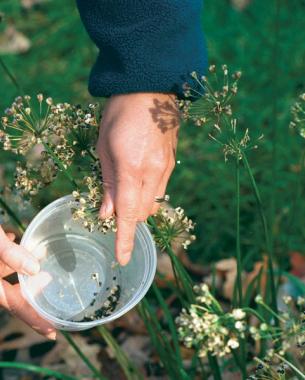
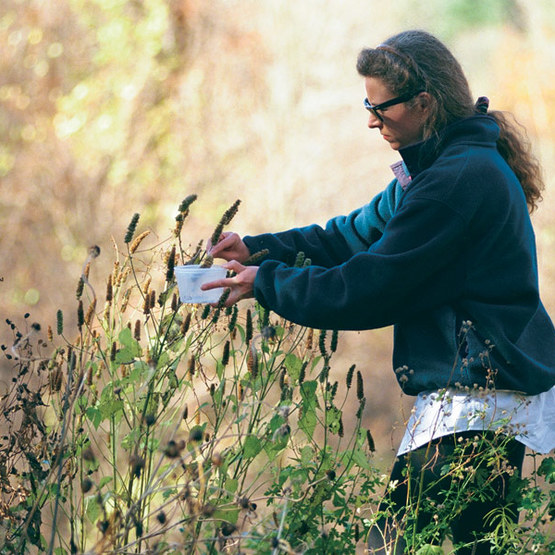
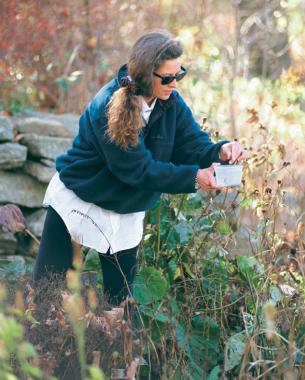
When I see flowers fading, I keep an eye on the forming seeds. As the seed heads turn brown with ripeness, I snip them off. Usually, I cut carefully, one seed head at a time. But when seeds are ripening fast, as when my bank of Klondike cosmos (Cosmos sulphureus) goes to seed, I clip seed heads wholesale, gathering them in a brown paper bag or any plastic container. If this sounds like a lot of work, it isn’t. I carry a supply of zip-top baggies in my pocket as I stroll the garden, which I do at least once a day. Nipping off seed heads or shaking out seeds takes just minutes.
I collect seed as it ripens through the season—that means starting in March, when small bulbs are already ripening their plump pods, and continuing until frost blackens the garden and knocks down the morning glories (Ipomoea tricolor and I. nil) so that I can reach the fat clusters of pods. Peak season is late summer, when perennials and annuals are blooming fast and furious. Another big push comes in fall, when I outrace the birds to collect berries from shrubs and trees.
Learning when seeds are ripe enough to collect is like picking tomatoes: experience teaches you when they’re at their peak. Actually, it’s more like picking green tomatoes, though, because the seeds will continue to ripen off the plant—just as a tomato does—once they’ve reached a certain point of development.
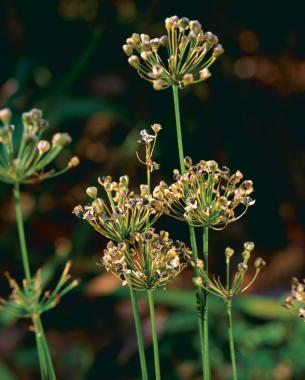
I’ve learned that I can collect seeds when they’re still green, as long as I let them continue ripening in the pod or seed head, which most of them will do even if they’re removed from the plant. The seed heads of dill (Anethum graveolens) shatter quickly as they ripen, and sometimes I miss my chance. So I clip the flat heads as soon as the green seeds have reached a good size and set them on sheets of newspaper in the garage to finish maturing. I do the same thing with columbines, too, clipping the erect chambered seedpods when they’re green, and with annual poppies and spider flowers, which self-sow too quickly.
Don’t pick seed heads immediately after the petals fade, though. Wait until the seeds themselves, if they’re visible, have reached mature size if not ripeness. I think of this as the sunflower rule: I hold off picking the heads of these cheerful flowers until I can see that the seeds have plumped up. If I pick them while they’re still shrunken and flat, they never fill out. Same thing with seeds in pods, like scarlet runner beans (Phaseolus coccineus) and lupines (Lupinus spp.): Hold off harvesting until the pods fatten from the seeds within. Seeds need the living plant to give them nourishment while they swell into full size in the seed coat.
Air-dry seed heads in shallow boxes
Once you have your seeds, find a protected area to ripen and dry them. Shallow cardboard boxes that soft drinks are shipped in or clean pizza boxes work well. Their low rims don’t hinder the air circulation that’s vital to drying. Newspaper is also good, but I’m a klutz, and the boxes offer protection from accidentally sweeping seeds onto the floor.
Spread seed heads and pods in a shallow layer, allowing space between them. It’s important to dry them immediately so that mold doesn’t set in. If you collect berries or other fruits, either remove the seeds from the fruit before drying, or dry them fruit and all and dissect them later.
When the pods and seed heads feel totally dry—which can take anywhere from a week to four weeks —shake the seeds into an envelope or paper bag. Sieve the seeds to remove chaff and litter, then transfer them to small envelopes or lidded jars for storage. Don’t forget to label them: Write the plant’s name and the date on your containers, then store them in a cool, dry place until planting time.
Tricks for handling tough seed heads
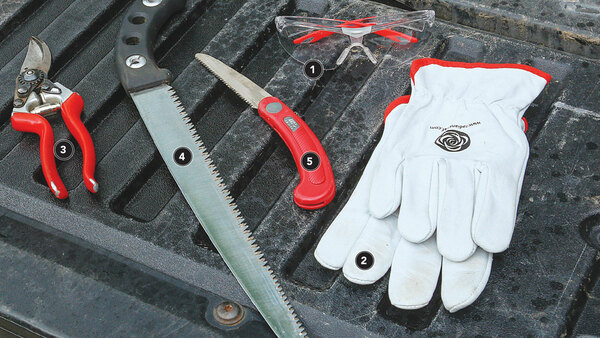
Collecting seed from dried seed heads and pods can sometimes be a challenge, thanks to the plant’s own defenses. Some seed heads are painful to handle, like the prickly heads of Mexican sunflower (Tithonia rotundifolia) and purple coneflower (Echinacea purpurea). With seeds like this, I snip off the seed head and place it in a paper bag, and the seeds drop of their own accord. If I have to peel apart a stubborn seed head, I wear gloves to protect my best tools—the ones at the ends of my arms.
Other seeds can be messy to dissect. Those with attached parachutes, like most varieties of clematis, globe amaranth (Gomphrena globosa), and little bluestem grass (Schizachyrium scoparium), require painstaking work to separate seed from feathery chaff. Is all this nitpicking necessary? Not if you’re going to be planting the seeds yourself. I plant them, attachments and all, and they germinate just fine.
Composite flowers—including sunflowers, coneflowers, and daisies—produce many nonviable seeds along with the good ones, so not every seed will grow. To find the plump ones, you can sort through your collected seed or just plant them extra thick.
That’s my whole approach to seed-saving. I keep it simple. Trial and error are just part of the game. Successes are wonderful, and failures make grand learning experiences. If Mother Nature can do it, why can’t I?




Comments
wow! This is great! I'm bookmarking this!
http://www.thetravelingdyosa.com
I'm glad I found your article. I have been wondering how necessary separating the chaff is. After reading this I may try planting it all. Thank u
Do you sell your seeds?
I've been gardening for a few years and am still new with it. I truly enjoy it & have spent these years learning through trial and error. It wasn't until last year that I discovered I can grab all the seeds from the marigold's I planted and save them for years to come. I was so excited & have so many. I must admit that I was quite surprised as to how many seeds came off one marigold flower!! However, my question is: Do all annuals reproduce seeds or do certain ones only reproduce? If only certain ones do, could you be so kind to let me know which ones? Thanks in advance.
I have also some rare flowers, did not know how to collect seed from it but just found answer. Thanks.
I accidentally picked my marigold seeds too early, can I still dry and save those seeds for when I want to plant them again?
How long before I can pluck the seeds from my mexican sunflower to plant? I read it needs to be "ripe." Well, what exactly IS ripe? I've been plucking the seeds out of the dying sunflower and immediately (pretty much) putting it back into the soil. This method doesn't seem to work so well with the Mexican sunflower but it did with a yellow sunflower (whose name I forgot). So, basically, the question is, how long does the seed need to dry out before planting anew?
You may find this interesting?
https://youtu.be/1-Jn1jHCHdk
Great article! I'm new to gathering seeds, and wanted to know if I have to wait till next season to plant my seeds? I just collected Red Hot Poker seeds from plants where the "ovaries" have dried, and are starting to crack open. Are they ready to plant?
Thankyou so much for providing this information on this page. We all know gambling industry is opting for the online platforms day by day. New and new games with new technology is coming in the market. But you can not decide which website is reliable for playing and which is not. Here I have solution to your problem. You can play these games https://casinosanalyzer.kr/slots-online/50-Dragons here without any doubt. This is the best website for games.
Log in or create an account to post a comment.
Sign up Log in