

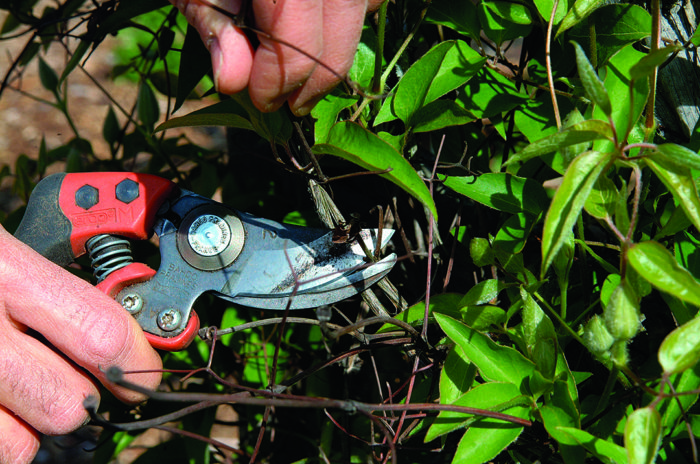
When confronted with a tangle of spindly clematis vines to prune, many gardeners get no further than scratching their heads and wondering where to begin. The confusion is most likely caused by the specific pruning needs of the many species and varieties. Some clematis vines like to be cut to the ground each year. Others just need a simple shearing to keep them looking good. But how do you know what kind of pruning a clematis needs? The key to success is figuring out which of the three pruning groups your clematis belongs to. By identifying the group and following the instructions, the task will seem much less daunting.
Below you’ll find pruning instructions for each group, along with a few representative varieties. See What group is my clematis? for many more varieties listed by group. If you are still not sure what type of clematis you have or which group it belongs to, let the plant grow freely for a year or two and watch how it flowers. You will then be able to assign it to a group.
Why prune clematis anyway?
If left unpruned, clematis vines become overloaded with decrepit stems that produce few flowers. By the same token, more vigorous species and varieties that are left unchecked bear most of the flowers high atop the plants and run the risk of tearing down their supporting structure or pulling themselves down under their own weight. Pruning clematis vines stimulates new growth, which increases the number of flowers, encourages flowers at a level where you can best enjoy them, and takes weight off the plant to keep it from toppling over.
Pruning also helps to keep clematis vines healthy. Clematis wilt, or fungal stem rot, occasionally strikes this plant, causing shoots, leaves, or sometimes whole vines to collapse and brown, usually in early summer. Pruning back wilted shoots to healthy growth, or, if needed, pruning the whole plant almost to ground level prevents the disease from spreading and stimulates new stem growth from the remaining healthy tissue. Also, pruning the dense tangle of stems opens the remaining shoots to air and light and reduces the number of leaves that can hold moisture, which encourages wilt and other diseases.
Spring bloomers
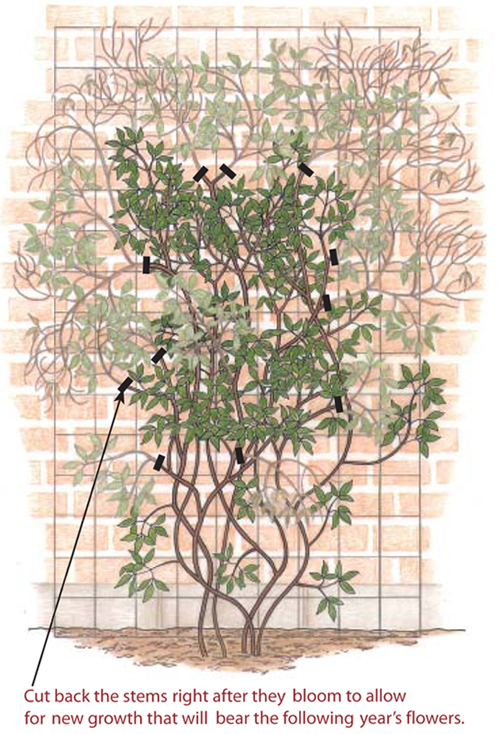
Group 1 vines flower in spring, on growth from the previous year.
Prune these vines right after they finish blooming in spring. The new stems that grow will then have enough time to make flower buds for the following year.
How much to remove when pruning depends on the vine’s vigor and how large a support you’ve provided for it. Vigorous sorts, such as varieties of C. armandii, can be cut back almost to the ground. On the other hand, very little pruning is necessary for C. alpina and C. macropetala and other slow-growing varieties.
Older portions of the stems of some of these spring bloomers, such as C. montana, are often reluctant to resprout after being cut back, so avoid cutting these plants back into very old wood, keeping in mind that the plant will get somewhat larger each year. The best thing to remember is that, no matter how you prune Group 1 plants, the new shoots that appear after pruning are the ones that will bear flowers the following season. To some degree, the less you shorten stems when pruning, the earlier the blossoms will appear.
Some Group 1 members
• C. alpina and cvs.
• C. armandii and cvs.
• C. cirrhosa and cvs.
• C. macropetala and cvs.
• C. montana and cvs.
Repeat bloomers
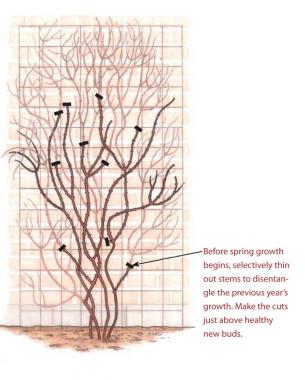
Group 2 vines bloom in late spring or early summer, then again sporadically, on new shoots and old stems.
The vines that bloom mostly on older stems have their heaviest flush of flowers in late spring, while those that bloom mostly on new shoots are more prolific in the latter part of summer.
Group 2 vines require a bit more pruning finesse than do the vines of the other groups. If you cut back these types drastically right after the first bloom, you miss out on much of the summer show; if you do so just before growth begins, you miss the spring flush.
A few approaches are effective when pruning this group. The most refined approach is to lightly thin out and disentangle stems before growth begins in late winter or early spring, and then go over the plant again after the earliest flowers fade in late spring or early summer, severely shortening the stems that bore those flowers. If the plant tends to bloom more heavily later rather than earlier in the season, you can be more heavy-handed when thinning stems before growth begins in early spring.
A simpler option when pruning Group 2 clematis vines is to severely prune the plant back by half in alternate years. Another approach is to cut the whole plant back drastically every few years just before growth begins, with little or no pruning in the intervening time; in this case, you give up only the earliest blossoms in the season you prune.
Some Group 2 members
• C. florida and cvs.
• Large-flowered hybrid cultivars, such as:
‘Bees’ Jubilee’
‘Elsa Späth’
‘General Sikorski’
‘Henryi’
‘Nelly Moser’
‘Niobe’
‘The President’
‘Will Goodwin’
‘Vyvyan Pennell’
Summer or fall bloomers
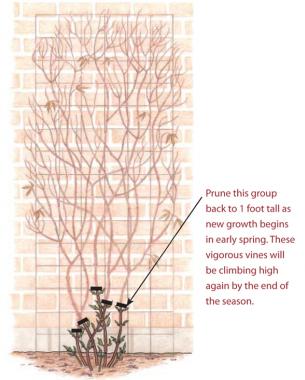
Group 3 vines flower in late summer or in fall, on new growth produced earlier in the season.
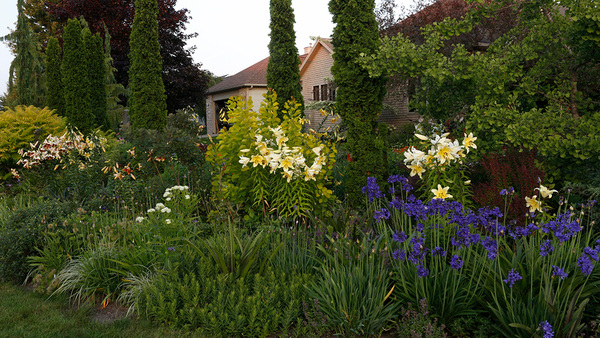
These are the easiest vines to prune. Just before the season’s growth begins, or as it is beginning, lop all stems back to strong buds within a foot or so of the ground. For me, this pruning method is especially important to keep my sweet autumn clematis (C. terniflora) from swallowing up my garage with its rampant growth and spilling the bulk of its fragrant white blossoms on the roof.
However, there is no need to cut a late-blooming clematis back so severely if you are going to let it ramble up into a tree where you want its blossoms held high. Furthermore, certain plants in this category, such as C. orientalis cultivars and C. tangutica, start blooming earlier and then continue longer if they are not cut back so hard.
If these instructions still seem confusing, the “do almost nothing” method can work with most clematis as long as you don’t mind an unmanageable vine. A drastic pruning every few years may sacrifice some blooms in the short term, but it will bring the plant to a more manageable size and, in getting rid of decrepit old stems, stimulate young replacement stems that will put more flowers at eye level.
Some Group 3 members
• C. X durandii
• C. heracleifolia and cvs.
• C. integrifolia and cvs.
• C. orientalis and cvs.
• C. recta and cvs.
• C. tangutica and cvs.
• C. terniflora
• C. texensis and cvs.
• C. viticella and cvs.
• Large-flowered hybrid cultivars, such as:
‘Comtesse de Bouchaud’
‘Ernest Markham’
‘Gipsy Queen’
‘Jackmanii’
‘Lady Betty Balfour’
‘Perle d’Azur’
‘Ville de Lyon’
Learn more about clematis
The Many Faces of Clematis
Get to know the wide variety of flower shapes and sizes this popular vine offers.
Clematis with Everything
An avid collector uses shrubs and perennials as living trellises for these flowering vines.
Three Myths about Clematis
Think you know clematis? Think again.







Comments
Thanks for sharing helpful info
I appreciate the alternatives you offered with the different methods. I can never keep straight which group my Clematis belong to. I think I'll add the group number to their plant labels.
When does the late flowering clematis show it's first growth? Planted terniflora last year, everything else is starting to bloom and grow and I see no growth on any of the 6 vines I planted last year. Patience? or start over?
Terniflora blooms in autumn. I hope yours did last fall!
If you're still answering questions, I have one. This year (2017) my Jackmanii clematis started sending out shoots and green leaves very early and then we had a hard freeze, ice storm, general mess that lasted for several days. After everything cleared out, all of the new leaves are brown. Is my plant still alive? If so, should I prune it back a bit at this point? Thanks!
Clematis are very tough plants. Although the tops have been damaged by the frost, the roots are still alive and will start shooting new growth again in no time. Cheers!
I am very bummed.... my 8 year old clematis is only growing new shoots this year...and is not budding at all from previous years growth which is does every year.... I am saddened! whats wrong...i have never had this happen and am at a loss! i have never messed with it ever..i have always let it be.... is that the problem?? HELP
Can I plant another group 3 clematis alongside my sweet autumn clematis and prune them both back as the new growth appears in the spring, or will the rampant growth of the autumn clematis swallow the other up?
Log in or create an account to post a comment.
Sign up Log in