

When my sister and her husband asked our landscaping firm to design and build the garden for their new home in Vancouver, Washington, we were both flattered and challenged. The budget was more than adequate, but the property offered little aesthetic promise. Their 45-foot by 85-foot backyard, which consisted of little more than lawn, was boxy, flat, and somewhat sunken.
To combat the monotony of the small, rectangular lawn, we suggested changing the terrain from flat to rolling by creating a series of berms. While the rolling berms would add height, we also wanted to create depth, so we designed a naturalistic dry streambed. The streambed was laid out diagonally, bisecting the lot, creating near and far spaces separated by the stream. This also helped eliminate the boxy feeling of the property, as diagonal lines tend to lead the eye toward more distant spaces and borrowed views to make the garden feel larger.
A dry streambed adds depth
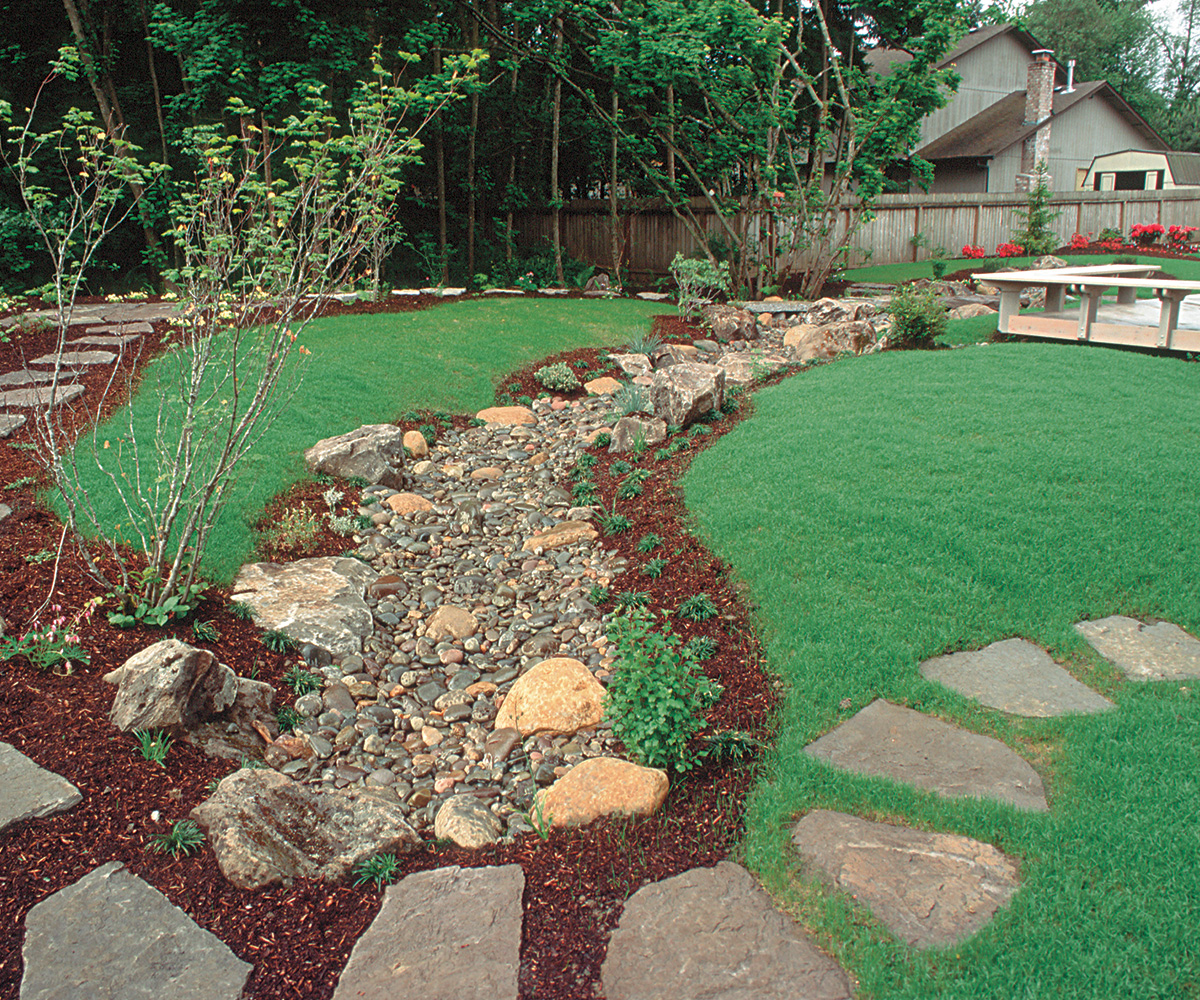
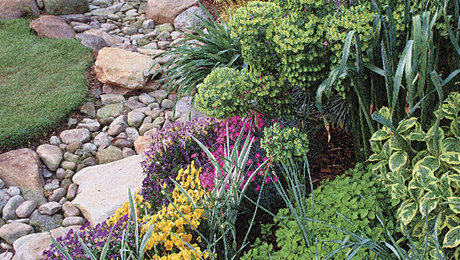
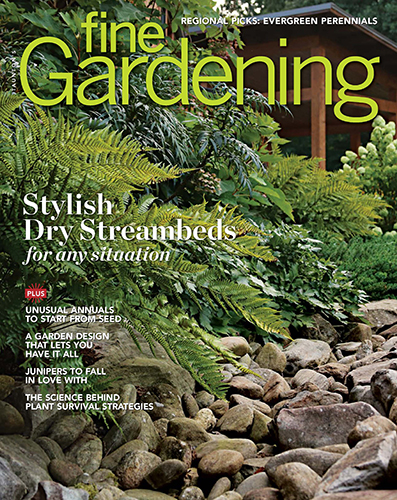
Dry streambeds should be located on low ground, with the surrounding earth graded higher to imply running water’s erosive tendencies. And while a dry streambed remains dry most of the time, it also serves an important role in handling runoff during rainstorms. So when grading a site, not only does your streambed have to be lower than the surrounding terrain, but it also must follow a downward grade so that water runs through it without puddling. In this case, the streambed runs to a hidden storm drain, where the runoff is carried away.When building a dry streambed, you want to create the illusion of a passage of water. Gentle curves in the streambed add authenticity and create a sense of rhythm. Boulders placed strategically in and around the streambed add credibility and help to frame the composition, while rounded river stones fill the streambed, adding dimension and breaking up the terrain. Plantings add a nice finishing touch.
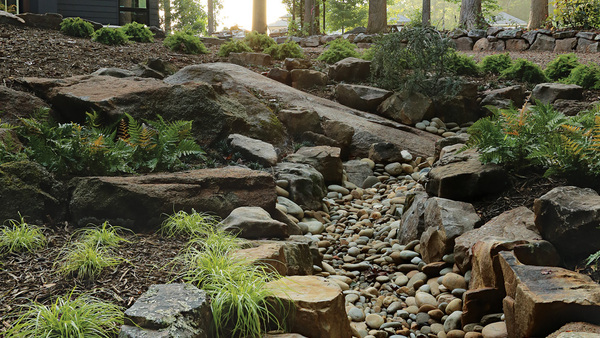
We used two kinds of rock in this garden. For the larger boulders, we opted for locally quarried basalt. Some of these boulders were used in and along the edge of the streambed to imply continuous geologic ridges over which the stream meandered. In the streambed itself, we used rounded river cobbles of various sizes. The larger cobbles were rescued from a highway construction site. These stones made the stream bed a success by adding a realistic scale to the design.

A mix of plants and boulders helped create a natural-looking beginning and end to the streambed. At the stream’s “origin,” we installed a bubbling boulder, which had been drilled so that water could be plumbed through it. The boulder sits on a metal screen over a concrete basin, and the pump is located in the basin. This feature, though not essential, adds the sight and sound of water year-round, even though the water does not flow the length of the streambed.
Ornamental grasses like Acorus gramineus ‘Ogon’ and ‘Variegatus’, leather leaf sedge (Carex buchananii), sweet flag (Acorus calamus), blue oat grass (Helictotrichon sempervirens), and soft rush (Juncus effusus), along with irises (Iris spp.) and bog plants, punctuate the stream bank, much as they might in nature. They add authenticity to the setting when grouped in and around the stream and when juxtaposed with the boulders.
Identifying design goals
As a designer, I always sound out clients to find out how they intend to use their space, as well as what preferences they may have for plants and materials. I also look at soil conditions and drainage problems, since both of these influence the overall success or failure of a project. Here are a few of the practical goals we had for this project:
- Create a visually alluring space to view from the kitchen, breakfast room, and family room.
- Create an outdoor entertainment area, preferably at the same floor level as the family room.
- Retain some lawn as play space for the children.
- Solve drainage problems. (Surface runoff had nowhere to go but into the downhill neighbor’s yard.)
Berms give the feeling of rolling terrain
The term “berm” is used to describe a mounded, sometimes undulating, and usually longitudinal earth form. The berms we created in this garden flank the streambed on both sides, and are shaped to conform to the meandering streambed. As such, their shapes are softly curved. The largest, which is located in the far corner of the property, measures roughly 30 by 40 feet and rises 4 feet from the original grade. Opposite that, on the other side of the streambed, another berm planted primarily in turf grass measures 18 by 35 feet and is about 2 feet high.
In addition to using excavated soil from the dry streambed, we brought in about 40 cubic yards of loamy soil to create our mounds. All of the soil, along with the rocks for the streambed, was moved by hand or with the help of a motor-propelled flatbed carrier.
To create a destination in the garden, a small, stone terrace was placed at the top of the largest berm at the rear of the property. From this point, a meandering stepping stone path leads back toward the deck, crossing the stream with a large stone slab. It then circles the garden, leading back to the stone terrace.
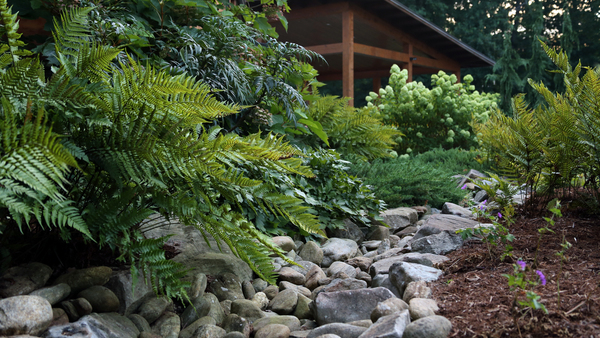
Although one berm is mostly lawn, the other features plantings for year-round interest in color, texture, and form. So they would blend in naturally with the woodland beyond—a northwestern rainforest—mostly native plants were used. They were sited in microclimates similar to their natural habitats, such as the moist streamside and cool woodland edge. Thimbleberry (Rubus odoratus), dogwoods (Cornus spp.), alders (Alnus spp.), and a variety of ferns—maidenhair fern (Adiantum pedatum), deer fern (Blechnum spicant), coastal wood fern (Dryopteris arguta), lady fern (Athyrium felix-femina), and western sword fern (Polysticum munitum)—were planted along the woodland edge. Evergreen huckleberry (Vaccinium ovatum), salal (Gautheria shallon), and common bearberry (Arctostaphylos uva-ursi) made a natural transition from streambed to lawn areas.
An automatic sprinkler system was installed to provide irrigation during dry spells. And finally, the planting beds were mulched to inhibit weed growth, conserve moisture, and prevent erosion.
Five years from start to finish
 |
 |
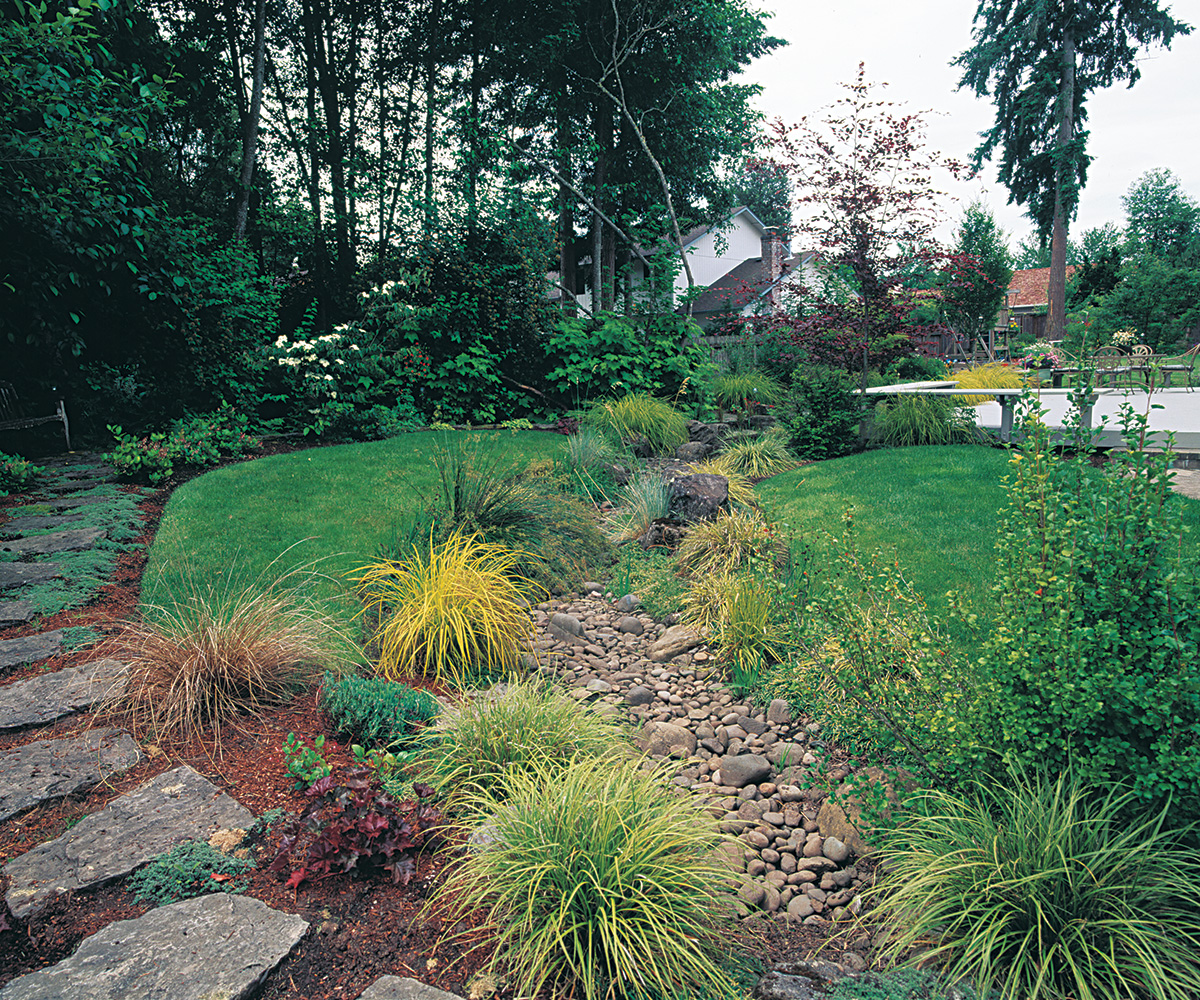 |
From excavated yard to flourishing garden in just a few years. This series of photos shows the garden during excavation (1994), not long after planting (1995), and after the garden had had time to grow (1999). All photos were taken from approximately the same location.
A deck adds further dimension
The deck serves as a viewing platform in the sense that it belongs more to the house than to the garden. It conveys an air of lightness, as it partially projects over the streambed. Although it is elevated, it is not the highest point in the garden. Indeed, one can look down on the deck from the seating area atop the highest berm. Just outside the kitchen door, next to the family room, we constructed a deck over a smaller, existing concrete patio. It was designed primarily for entertaining, so we built in railings that double as benches. Both the deck and the benches were stained gray to match the house, as well as to protect the wood.

Because the deck serves as a spring point into the garden, we placed a number of plants alongside it. On the south end is a lovely tricolor beech (Fagus sylvatica ‘Purpurea Tricolor’); a pair of paperbark maples (Acer griseum) anchors the north end. Both the beech and maples offer a leafy canopy, and their exfoliating bark, which can be inspected up close, creates visual interest in every season. Oregon grape holly (Mahonia aquifolium) and leather leaf sedge are planted nearby, their fronds and leaves softening the deck’s hard edges.
The garden has provided many hours of pleasure for my sister and her family. Unlike the original landscape, which offered little interest, the yard now draws you in, allowing you to feel there are many routes from which to choose, as well as fantasies to pursue.








Comments
Log in or create an account to post a comment.
Sign up Log in