
Most clematis admirers say that it was the showy, large-flowered hybrids that first caught their eye. In my case, it was the small blue flowers of Clematis integrifolia that I stumbled upon at a local nursery that got me hooked. This 15-inch-tall delight was unlike any clematis I had seen. I did a little research and soon found myself buying more and more clematis vines.
While the original plan for my garden was focused on cutting flowers, including my favorite old garden roses, I could not imagine a garden that didn’t include my new-found clematis friends. I quickly discovered that I could incorporate them into my plan not only to cover bare walls but, more important, to mingle with my roses and perennials and fill empty spaces with color when my flowering shrubs fell out of bloom.
Over the last 10 years, my garden has expanded across my 50-by-100-foot lot, and the lines between my cutting garden, perennial border, shade garden, and raised vegetable beds have become a bit blurry. I now rely on my collection of more than 200 varieties of clematis to knit it all together. Of course, roses and clematis are a classic pairing, but experimenting with various shrubs and perennials has helped me to find other excellent partners for clematis.
Further Reading
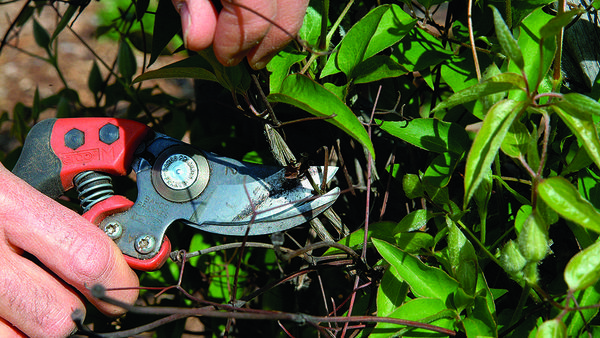
Pruning Clematis
Shrubby sidekicks make excellent comrades
Photo/Illustration: Linda Beutler.
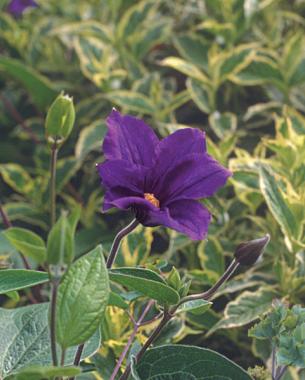
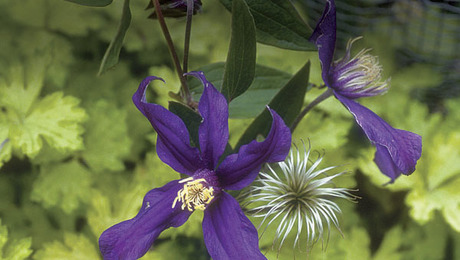
If you’re one of those gardeners who doesn’t care for roses (I have heard that there are such people), there are many other spring- and summer-blooming woody shrubs that make excellent comrades for clematis. Spring-blooming weigelas (Weigela spp. and cvs.) and lilacs (Syringa spp. and cvs.) are perfect foils for delicate early-spring-flowering Clematis alpina cultivars and Clematis macropetala. Weigela florida ‘Variegata’, which has the bonus of foliage outlined in a cream color, is especially lovely later in the spring when combined with blue-flowered, semi-vining Clematis × durandii, which faints gracefully onto the bush without overwhelming it.
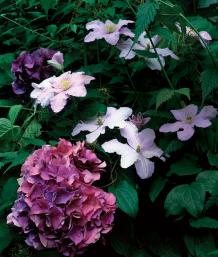
Many clematis thrive when located in partial or dappled shade. In a shady area of my garden, the large-flowered hybrid ‘Silver Moon’ (Clematis ‘Silver Moon’) romps around in a ‘Merritt’s Supreme’ hydrangea (Hydrangea macrophylla ‘Merritt’s Supreme’). The lower light levels afforded by partial shade preserve the soft-colored blossoms of certain clematis cultivars, like the pale-lavender ‘Silver Moon’ and the pink pajama-striped hybrid ‘Bees’ Jubilee’ (Clematis ‘Bees’ Jubilee’), which tend to bleach out in full sun.
Another favorite combination of mine is the delicate foliage of ‘Sutherland Gold’ European red elderberry (Sambucus racemosa ‘Sutherland Gold’) and the periwinkle blossoms of ‘Fuji-musume’ (Clematis ‘Fuji-musume’). The fast-growing elderberry foliage turns green as it matures, so I prune it back throughout the growing season to coax it into producing new golden leaves, which are stunning next to the flowers of ‘Fuji-musume’.
Clematis with roses: A classic
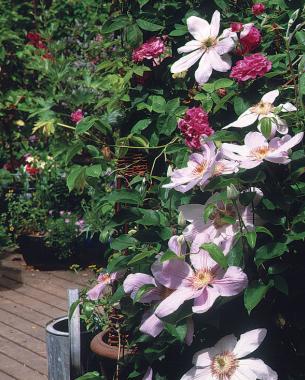
Old garden roses have a limited color palette compared to modern roses, but their soft colors make a luscious confection when blended with the blues, purples, lavenders, and reds of the spring-blooming large-flowered clematis. At left, a ‘Peveril Pearl’ clematis winds around the stems of a ‘Reine des Violettes’ rose. Most old garden roses bloom in May and June, so careful clematis selection will yield a partner that not only blooms with the rose, but will also bloom again later in the summer, lending color where there is none.
Clematis is a perennial pal
Clematis vines that bloom on new growth, like Clematis ‘Guiding Star’ and herbaceous forms like Clematis integrifolia, C. recta, and C. heracleifolia, make good partners with a host of herbaceous perennials. These rambling plants will happily peek out from the flowers and foliage of their perennial neighbors. Although some gardeners insist on staking these clematis plants upright, I like to let them do what they will.
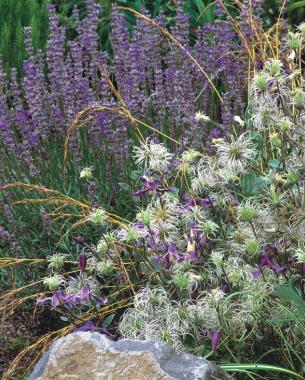
In Chinese folk medicine, clematis leaves are blended with other dried plants to make herbal teas to relieve a sore throat. For that reason as well as aesthetic reasons, it seems natural to me to use clematis in the herb garden. Clematis integrifolia will lean languidly over lavenders (Lavandula spp. and cvs.), or make a nice contrast with culinary sage (Salvia officinalis), especially the variegated ‘Icterina’ or purple-leafed ‘Purpurascens’.
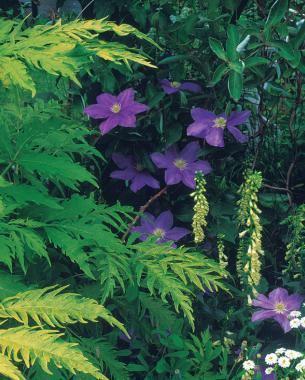
Japanese hybridizers have developed many fine short Clematis integrifolia cultivars, some of which are lightly fragrant, like the white-flowering ‘Hakurei’. The large charismatic blue-purple flowers of ‘Roguchi’ are shade-tolerant enough to ably wind their way through golden-leaved hostas like ‘August Moon’, giving my garden some pizzazz with the attractive blue and yellow duo.
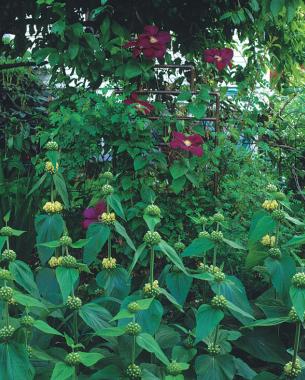
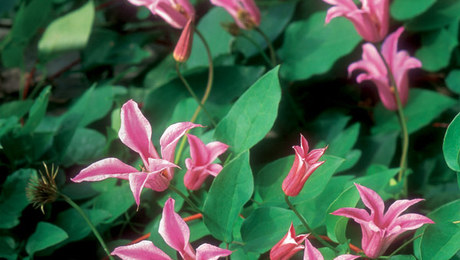
Large-flowered clematis hybrids, with their longer period of bloom, can act like a bridge, linking a succession of blooms over a season. For instance, ‘Monte Cassino’, a rich red clematis, makes a worthy partner with both yellow-flowering shrub roses and perennials. In my garden, Father Hugo’s rose (Rosa hugonis) and ‘Monte Cassino’ put on a spectacular show in early to midspring. But after the rose fades, Jerusalem sage (Phlomis russeliana) picks up where the rose left off, continuing the same pleasing dusky-red and soft-yellow color combination through the rest of the spring season.
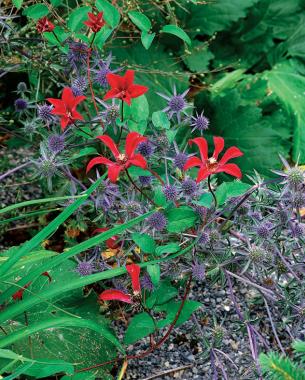
Mixing small-flowered clematis hybrids with herbaceous perennials is where I really have some fun. Brightly colored cultivars like ‘Gravetye Beauty’ (Clematis ‘Gravetye Beauty’) add great presence to a combination when paired with an imposing flat sea holly (Eryngium planum). The crimson-red flowers of ‘Gravetye Beauty’ seem to float above sea holly’s violet-blue umbels from midsummer to autumn.
With such a vast selection of colors, flower forms, and growth habits to choose from, it is best to proceed fearlessly when introducing clematis to your garden. Be guided by the prevailing wisdom, but be a little irreverent, too, so your garden will be your own. Clematis can be dazzling when combined with most other blooming plants, and they are great fillers for areas with seasonal blahs. If you get truly hooked, you may end up like me, trying clematis with everything.



Comments
I love clematis also, however I have a problem with wilt with the clematis.....I have them all over my yard and sometimes they are ok but other times they die back...does anyone know if I can prevent this or what I can do to stop it?
This webpage provides free animal jam codes from here completely free of cost.
Amid the long industrialist rise that pursued the Second World War, the little powers of authentic progressive Marxism were decreased to a minor bunch, disconnected from the majority. Do My Homework For Me - DoMyAssigmentForMe
Log in or create an account to post a comment.
Sign up Log in