
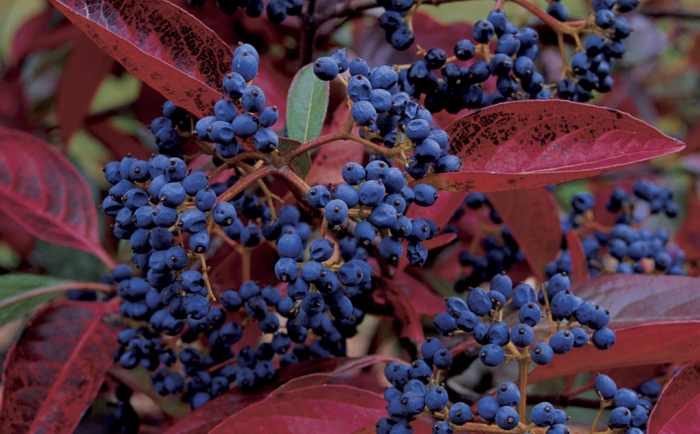
With the growing season coming to a close and winter just around the corner, fall is a bittersweet time of the year. When shopping for plants during the cacophony of spring, it is difficult to also plan for fall in the garden. Yet once autumn has arrived and your landscape blazes with colorful foliage, you will be glad that you did. What is a more fitting send-off to a fine growing season than a riotous swan song of maroon, yellow, orange, and red? When many people think of fall leaf color, native trees such as sugar maple (Acer saccharum, USDA Hardiness Zones 4–8) and quaking aspen (Populus tremuloides, Zones 1–8) come to mind. A number of native shrubs, however, blaze just as brilliantly and at a scale more suitable for smaller gardens.
Leaves and berries are the best sources of fall color
‘Winterthur’ smooth witherod viburnum
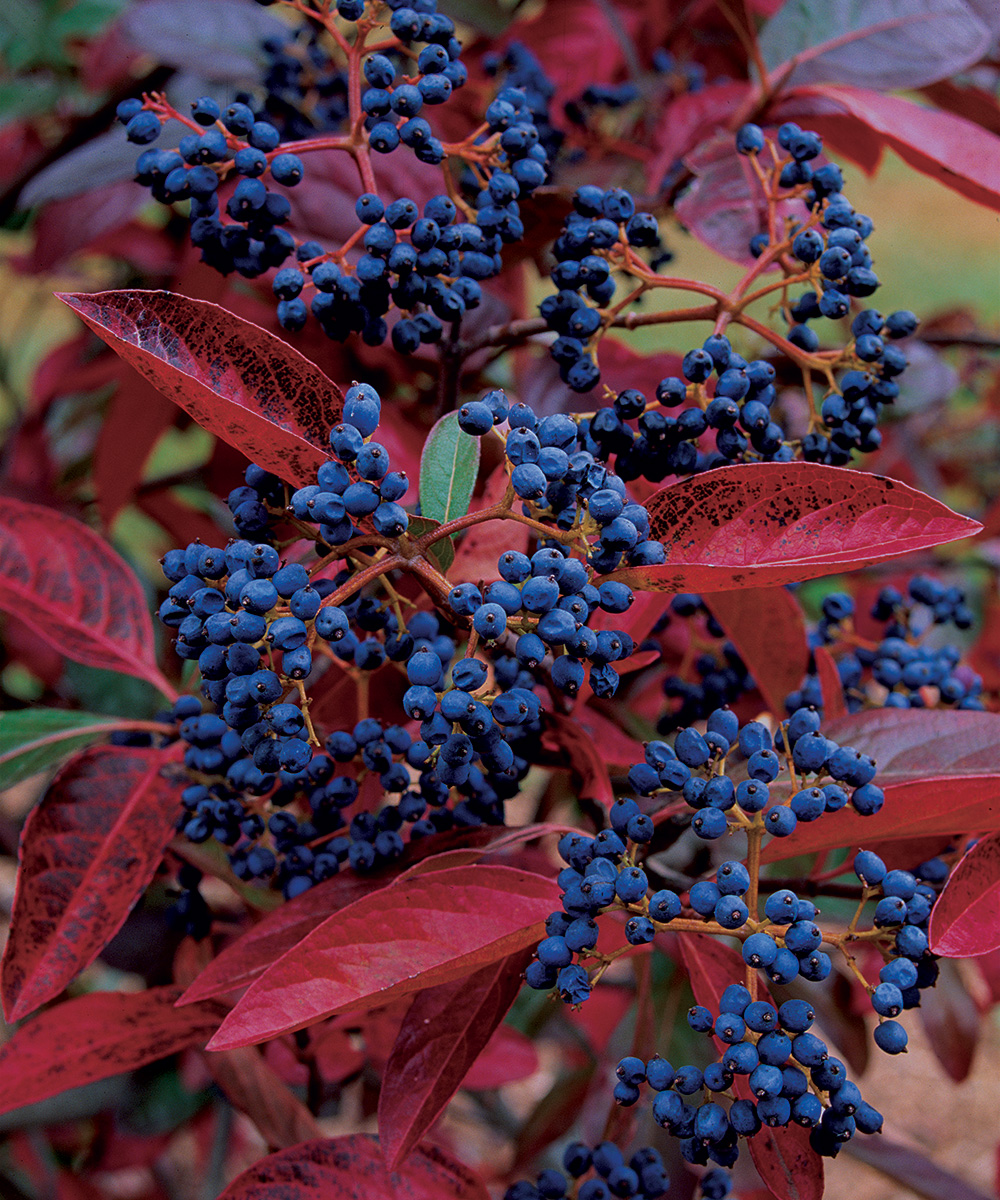
Name: Viburnum nudum ‘Winterthur’
Zones: 5–9
Conditions: Full sun to light shade; wet to moderately dry soil
Native habitat: Woods, swamps, and thickets from Connecticut to Texas and Florida
In some cases, there are shrubs that will light up the fall garden with both leaf color and fruit. ‘Winterthur’ smooth witherod viburnum begins its display in late summer, as clusters of 12-inch-diameter fruit begin to blush pink and become more intense over the course of a few weeks until the whole shrub looks bedecked in bubble gum. The fruit quickly change to a deep blueberry blue as the glossy, leathery leaves become infused with maroon and red. Although the species typically stands 6 to 12 feet tall and wide, ‘Winterthur’ maintains a compact, 6-foot-round, multistemmed habit that produces abundant fruit and a more intense fall color. In late spring, it’s covered with small, off-white flowers.
‘Gro-low’ fragrant sumac
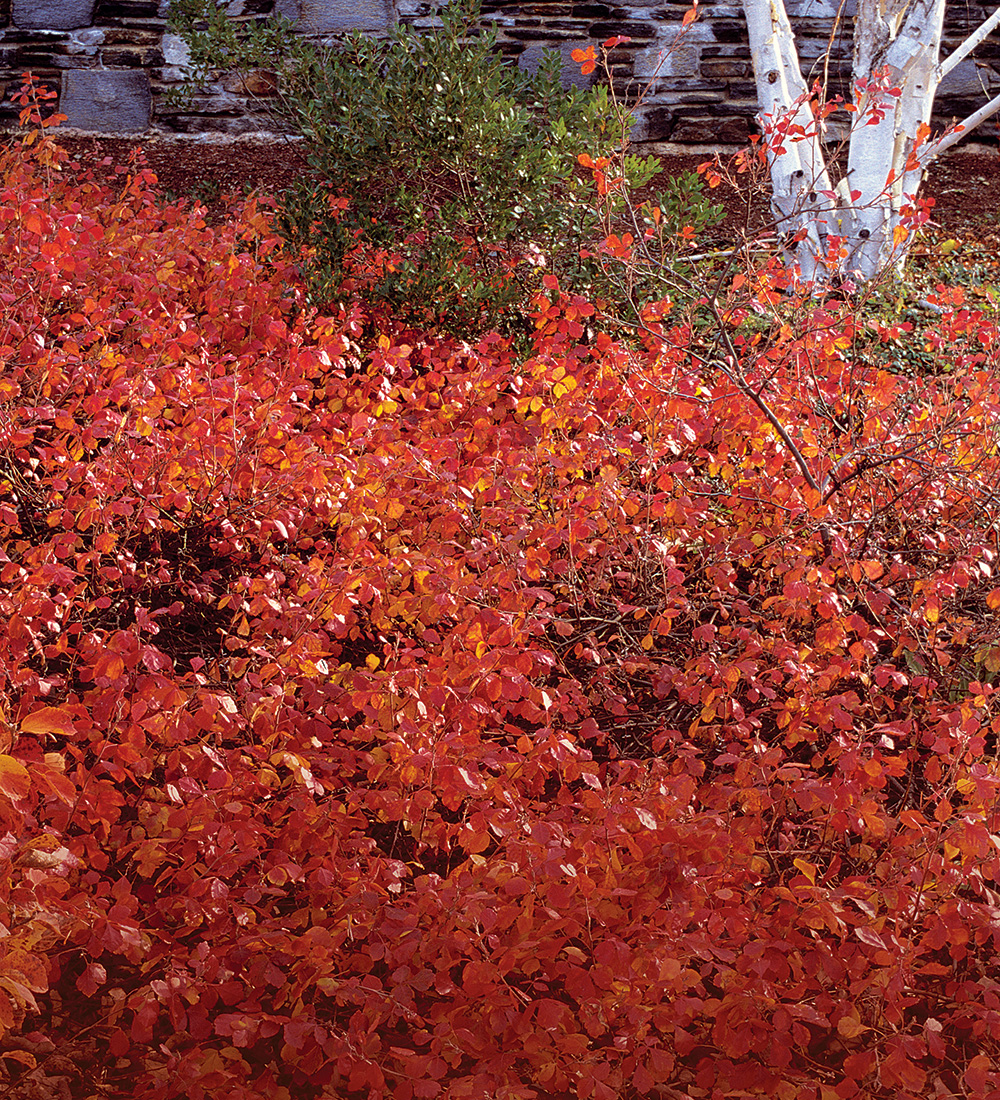
Name: Rhus aromatica ‘Gro-low’
Zones: 2–8
Conditions: Full to partial sun; moist to dry, well-drained soils; thrives in difficult areas
Native habitat: Dunes, open spaces, dry woods, and banks in much of North America
“Harlequin” is a good word to describe the fall color of ‘Gro-low’ fragrant sumac. Like all members of its clan, this shrub is a marvel in autumn, when its leaves become a crazy quilt of red, orange, and yellow before scattering in the breeze. Because most people find large sumacs, such as staghorn sumac (Rhus typhina, Zones 3–8), too coarse for the garden, this small-leaved, compact selection is a great alternative and easy to accommodate. ‘Gro-low’ has nearly prostrate, fast-growing stems that provide cover on erosion-prone slopes and other difficult areas. With time, it becomes an interwoven mass of branches 1 to 2 feet high and 6 feet across. The three-part leaves bear a resemblance to poison ivy and poison oak but are not poisonous. In fact, the females of this dioecious species (having male and female flowers on separate plants) produce red berries in early fall that can be steeped and made into a tasty tea. A male plant is required, however, for females to produce fruit.
Spicebush
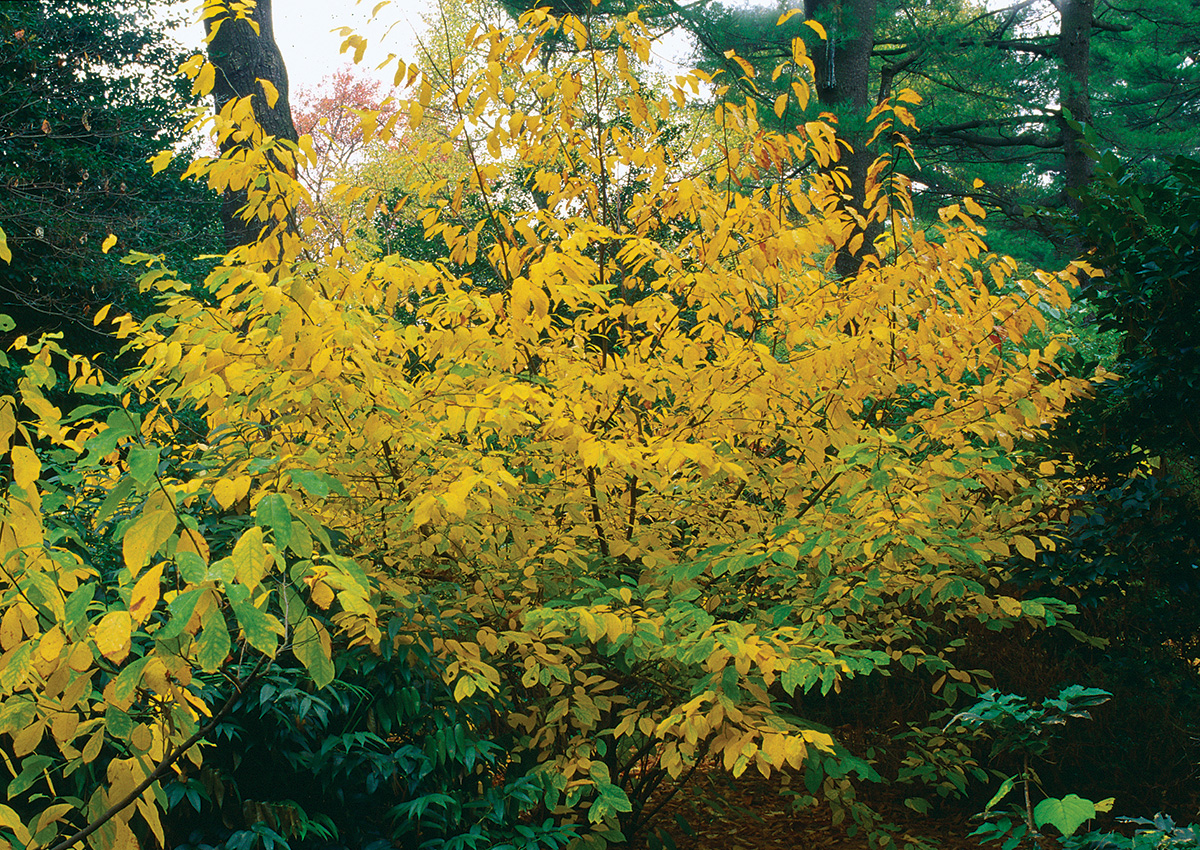
Name: Lindera benzoin
Zones: 4–9
Conditions: Partial sun to light shade; wet to moderately dry soils
Native habitat: Wooded wetlands, pond shores, and uplands in the eastern half of the United States
To get two autumn performances for the price of one, consider putting a female spicebush where it can regularly be viewed. Like ‘Gro-low’ fragrant sumac, spicebushes are dioecious, so when purchasing plants, buy a male and a female plant to get berries. The male plants have showier, tiny, pale yellow flowers in early spring, but the female counterparts take center stage in September, when they’re laden with 1/2-inch-diameter berries that turn from green to yellow to high-gloss crimson. About the same time, the leaves turn a hypnotic soft yellow and make the red berries visually pop—in part, I think, to reveal the nutritious fruit to hungry birds. Spicebush becomes a large, 5-to-8-foot-tall shrub that is slightly wider than tall. Occasional shoots emerge from the base of the trunks to renew those that have faltered. It is the preferred food for the black and blue spicebush swallowtail butterfly, whose big-eyed caterpillars are found munching in the canopy during summer.
‘Brilliantissima’ red chokeberry
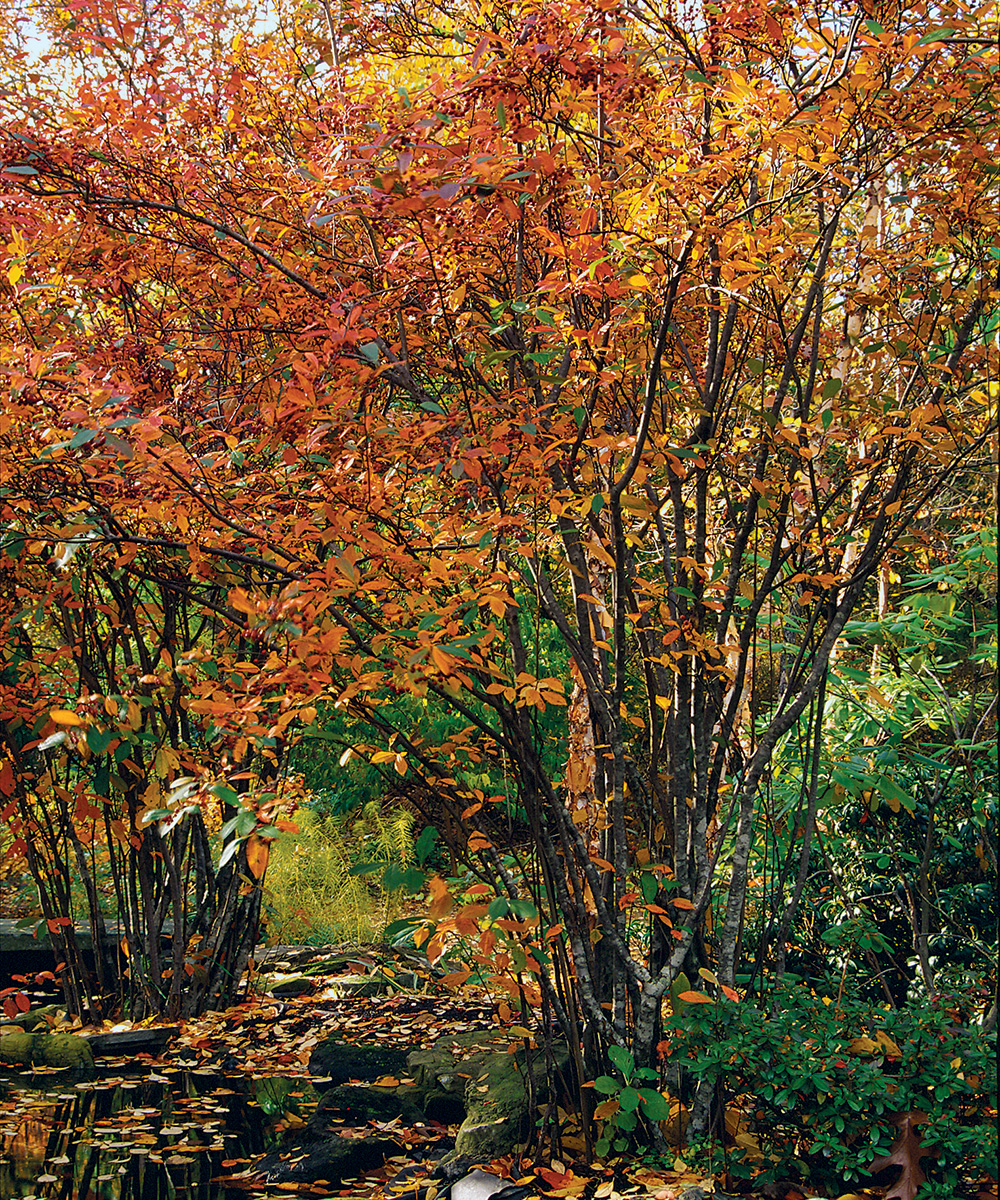
Name: Photinia pyrifolia ‘Brilliantissima’
Zones: 4–9
Conditions: Full to partial sun; average soils; tolerant of dry conditions once established
Native habitat: Swamps, bogs, and drier thickets in primarily coastal areas from Labrador to Texas
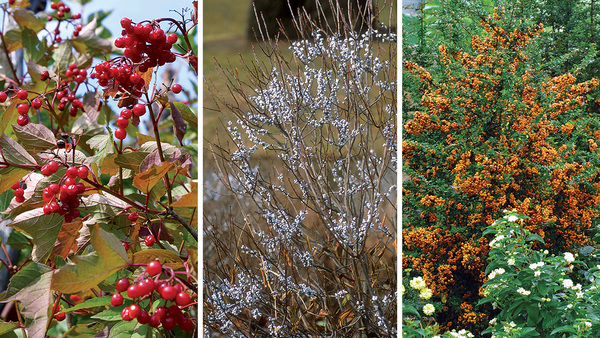
‘Brilliantissima’ red chokeberry is also spectacular in fall. It rivals hollies in the quantity and crimson color of its fruit. The 1/4-inch-diameter, crabapple-like berries hang in clusters amid brilliant foliage that matures to scarlet. Like the species, ‘Brilliantissima’ develops into a handsome, multistemmed, vase-shaped shrub that reaches 8 to 12 feet tall and about half as wide.
Plants with many seasons of interest rise to the top
Highbush blueberry
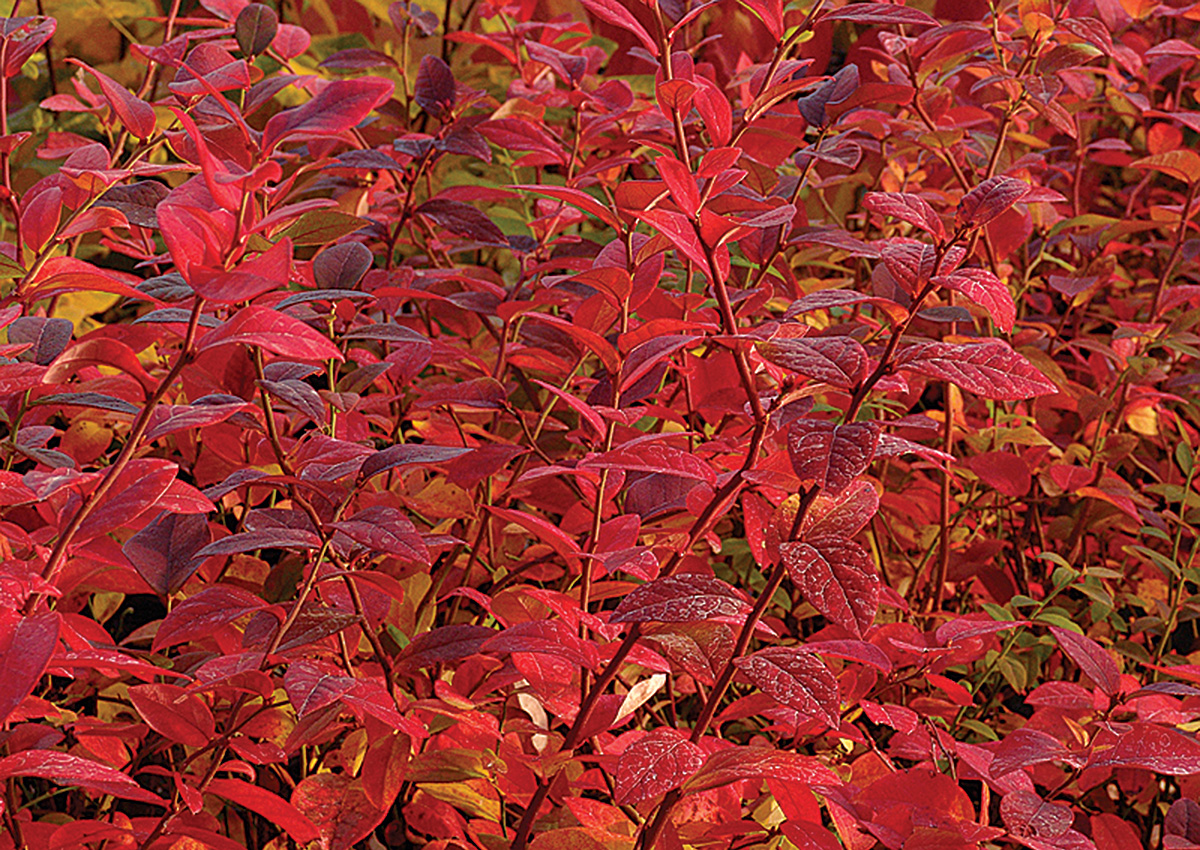
Name: Vaccinium corymbosum
Zones: 3–7
Conditions: Full to partial sun; moist to moderately dry soils; prefers acidic conditions
Native habitat: Swamps and bogs, old fields, and watersides in Nova Scotia to Michigan and south to Texas and Florida
Many shrubs with fall interest also shine at other times of the year. Highbush blueberry provides four seasons of fanfare, starting with twisted peeling stems in winter; profuse white or pink blossoms in spring; savory blue fruit in summer; and long-lasting foliage the color of a rich red wine in fall. No garden blessed (or cursed) with acidic soils should be without this shrub. The maroon-to-scarlet fall shades are effective for a solid month or more, as the leaves—especially on vigorous branches in full sun—are reluctant to fall. Highbush blueberry grows to 5 to 10 feet tall and wide. There are many larger-fruited orchard selections available for different parts of North America. Check with your local nursery or extension service to find selections that do well in your area. The best fruit set occurs when you plant at least two cultivars that will bloom concurrently to ensure cross-pollination.
‘Henry’s Garnet’ Virginia sweetspire
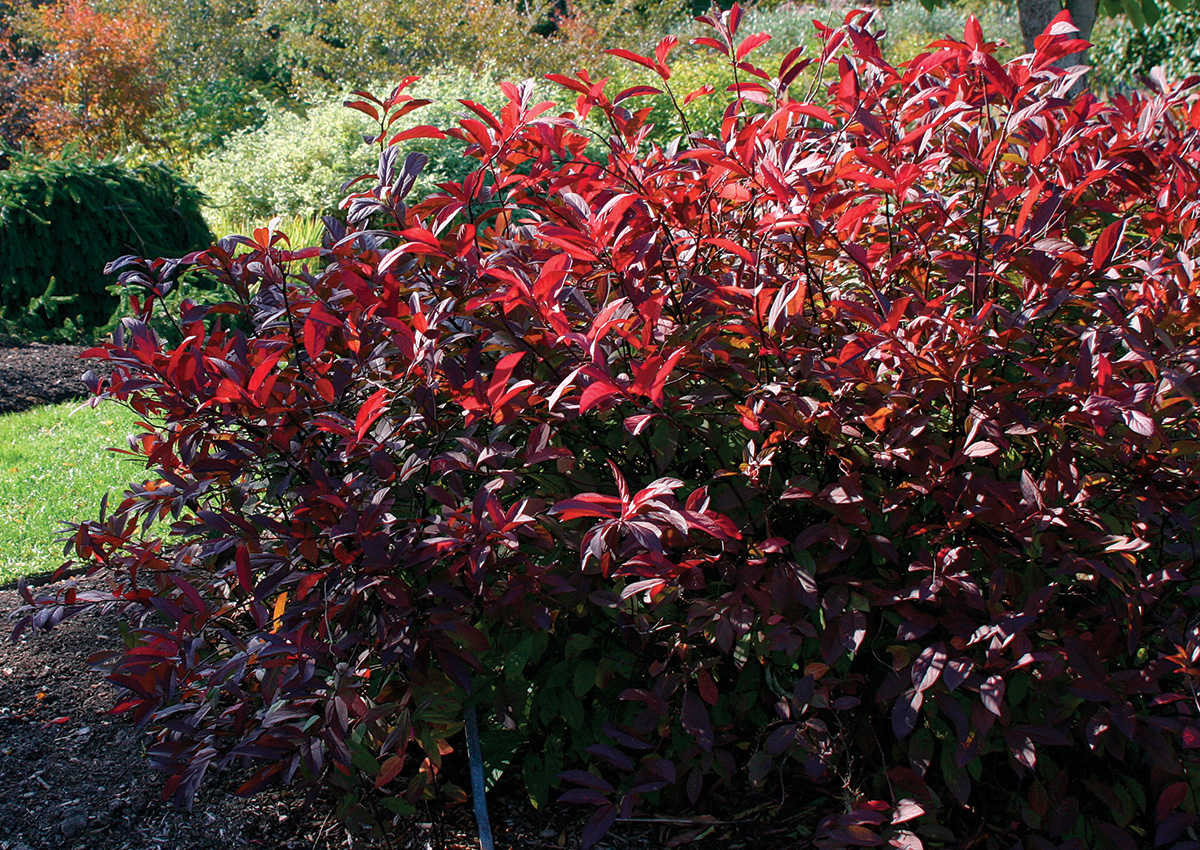
Name: Itea virginica ‘Henry’s Garnet’
Zones: 5–9
Conditions: Full sun to light shade; wet to moderately dry soils; drought tolerant and adaptable to clay soils
Native habitat: Swamps, wet woods, and coastal plains from the Mid-Atlantic to Missouri and south to Texas and Florida
Like the highbush blueberry, Virginia sweetspire is in no hurry to drop its leaves in autumn. The popular ‘Henry’s Garnet’ is the easiest variety to find and is extremely dependable and showy. It is an arching, 3-to-5-foot-tall shrub that holds its leaves well into fall, allowing the maroon, yellow, and orange tones to develop and reveal themselves over time more like a good novel than a short story. Though most known for its autumn color, Virginia sweetspire produces an early-summer show, featuring slender, drooping racemes of white flowers that attract all sorts of pollinating insects. Its suckering, slowly spreading, 6-foot-wide habit makes it a good choice for slopes and mass plantings.
‘Snowflake’ oakleaf hydrangea
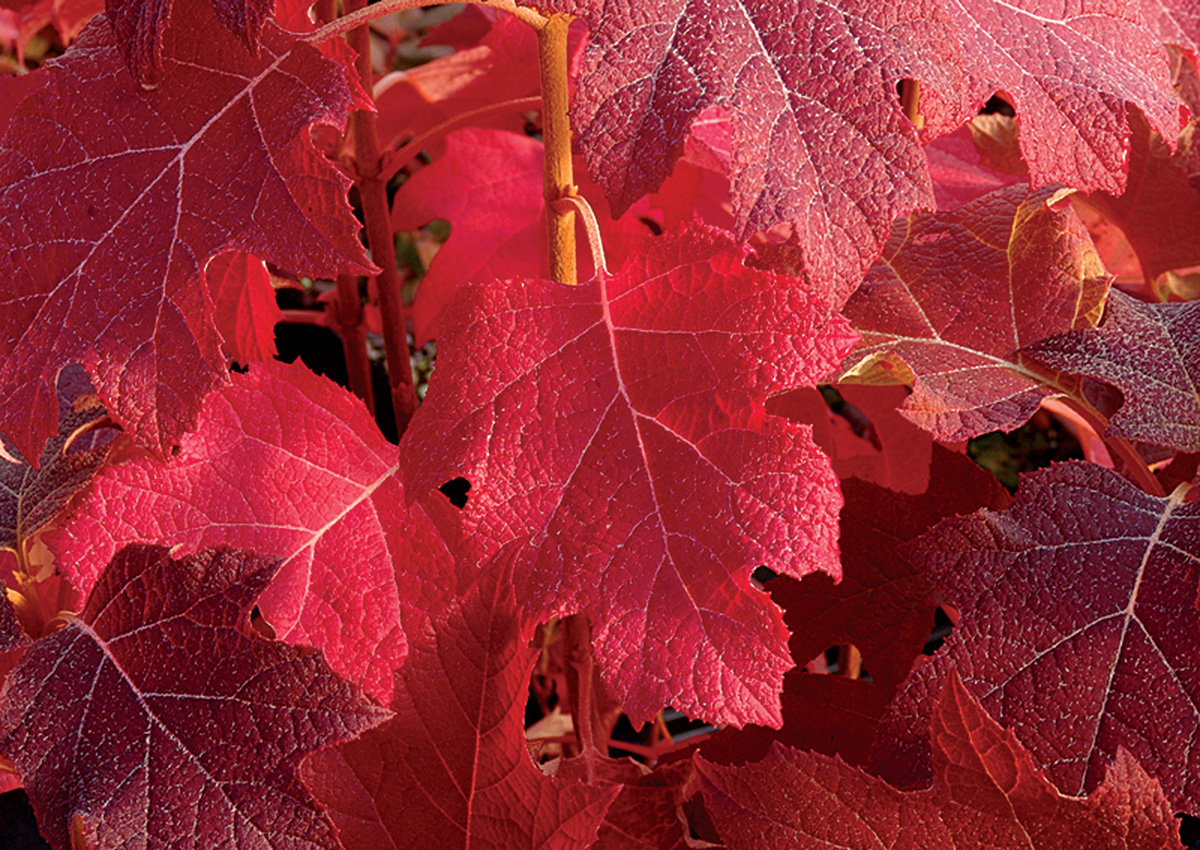
Name: Hydrangea quercifolia ‘Snowflake’)
Zones: 5–9
Conditions: Full sun to light shade; moist to moderately dry soils
Native habitat: Woodlands, bluffs, and talus slopes in Georgia and Tennessee and south to Louisiana and Florida
The fall color of ‘Henry’s Garnet’ Virginia sweetspire is similar to another southeastern shrub that has made it big in gardening circles. Oakleaf hydrangea kindles its smoky maroon color slowly in fall, and some of the large, rough, oak leaf–shaped foliage usually hangs on until December. A number of selections are widely available, but my favorite is ‘Snowflake’. At 4 to 7 feet tall and wide, it is more compact than most oakleaf hydrangeas, and it graces the garden with two additional seasons of interest in the form of summer blooms and attractive winter bark. The foot-long, cone-shaped inflorescences are composed of many individual white-petaled “flowers,” which are actually bracts that hide the tiny, true flowers beneath. Though a typical oakleaf hydrangea carries these bracts in sets of four, ‘Snowflake’ keeps producing more until they stack like saucers atop the ones below. As the starry bracts age, they turn green, then pink, creating a melody of white, lime, and rose. The flowers are most prolific on old wood; any pruning that needs to be done should be completed just after the flowers fade. ‘Snowflake’ and other cultivars of oakleaf hydrangea may die back to the ground in severe winters, which will affect blooming that year.
Cinnamon clethra
Name: Clethra acuminata
Zones: 5–8
Conditions: Full sun to light shade; moist soils; benefits from more shade farther south
Native habitat: Rich mountain woods and along streams in the southern Appalachians from Pennsylvania to Georgia
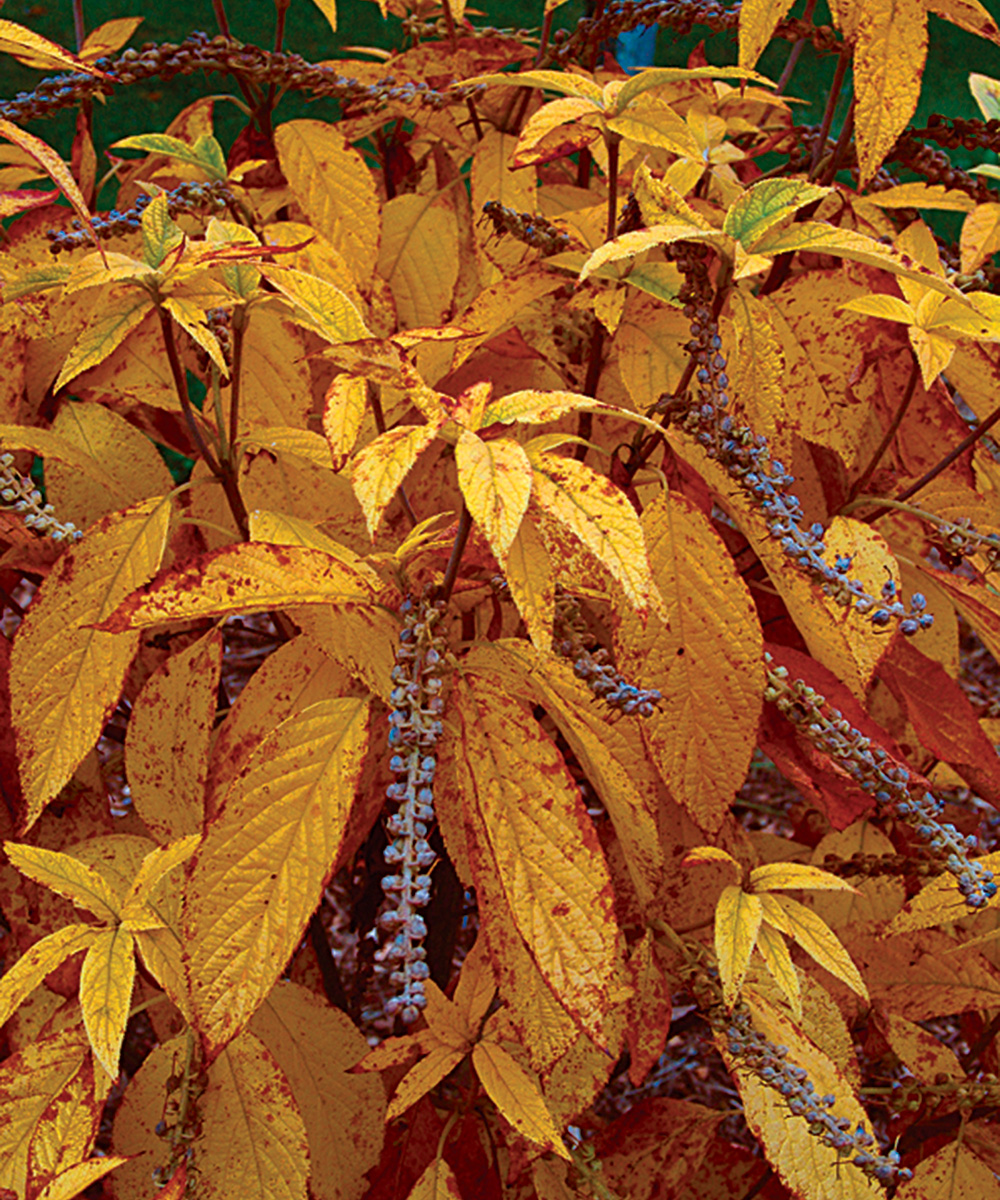
After the leaves drop, the shaggy, peeling, metallic tan bark of oakleaf hydrangea provides interest through the winter as it reveals a warm cinnamon hue below the surface. It reminds me of another lovely native shrub with peeling bark: cinnamon clethra. Larger in all respects than common sweet pepperbush (Clethra alnifolia, Zones 3–9), this sizable shrub or small understory tree grows 8 to 12 feet tall and wide. In early summer, long, slender racemes composed of small ivory flowers appear, then give way to peppercorn-shaped seed capsules that swoop out from the branch tips in fall. About the same time, lance-shaped leaves become a glowing golden yellow before falling to reveal the reddish brown bark. The bark peels in small, irregular patches in the fashion of sycamores (Plantus occidentalis, Zones 5–8) to expose a dusty gray underbark. Cinnamon clethra is a good choice for a woodland garden, where the tiered branches and elegant stems look captivating against newly fallen snow.
Common witch hazel
Name: Hamamelis virginiana
Zones: 3–8C
Conditions: Full sun to full shade; moist to seasonally wet or moderately dry soil
Native habitat: Stream banks, sandbars, and woodlands east of the Mississippi
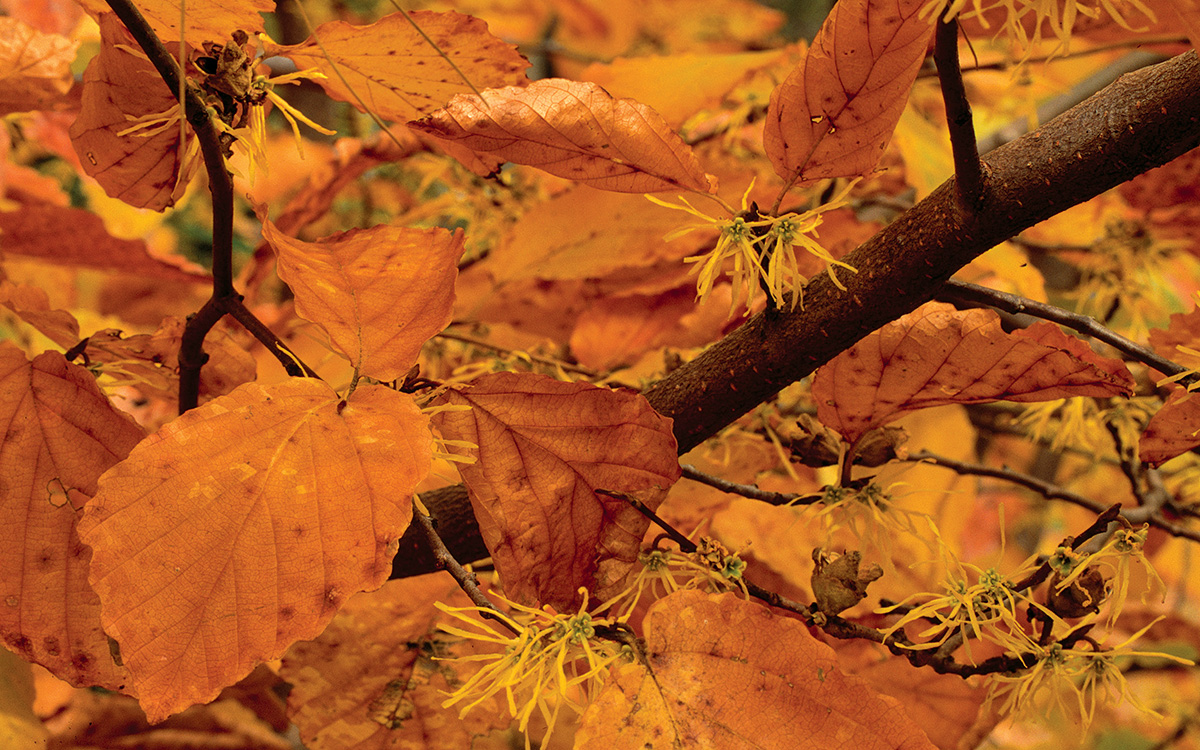
Though one doesn’t often think of fall-flowering shrubs, there are a few that brave the approaching cold to bloom at this time of year. The most audacious is common witch hazel, which unfurls its wispy, four-petaled golden flowers just as its leaves turn a striking yellow. It has an elegant, V-shaped profile that typically matures to 12 feet tall and wide in cultivation. A noteworthy but hard-to-find cultivar named ‘Mohonk Red’ boasts copper orange flowers against its sunny yellow fall leaves.
Large fothergilla
Name: Fothergilla major
Zones: 5–8
Conditions: Full sun to light shade; moist to wet soils; the best fall color develops from at least three hours of direct sun
Native habitat: Ridge tops, riverbanks, and dry slopes in the southern Appalachians from North Carolina and Tennessee to Georgia and Alabama
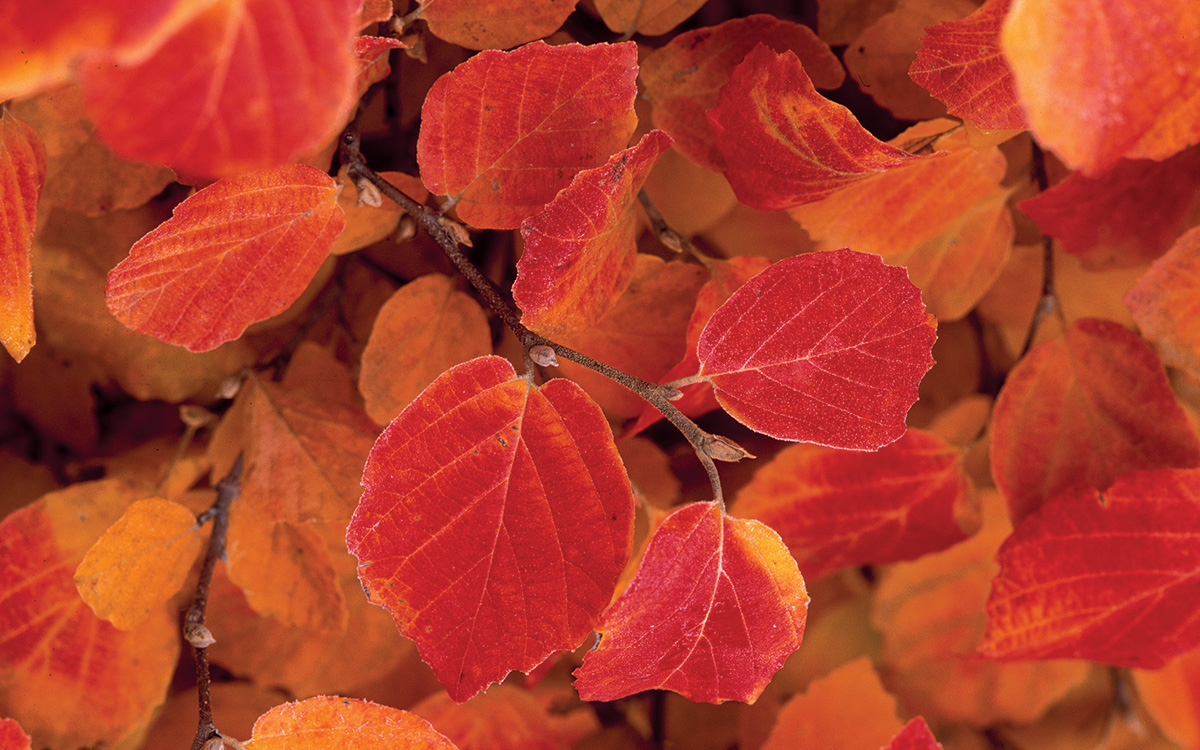
For a sizzling combination, pair witch hazel with the cherry red fall hues of its cousin, large fothergilla, or the cultivar ‘Red Licorice’, a new selection with autumn color more reliable than the species. Large fothergilla generally grows to be a large shrub or small understory tree, reaching 12 feet tall and wide. Like common witch hazel, it forms oval leaves scalloped along the edge and deeply channeled in a herringbone pattern. Unlike witch hazels, however, fothergilla’s flowers appear in early spring along with new leaves. The white bottlebrush blooms announce their arrival with a rich, honeyed perfume.
I hope that, like the witch hazel, you will see the fall not as a time of mourning for the dog days just passed but rather as a time of celebration for a summer well spent. There is certainly no better backdrop for daydreams of spring than a curtain ablaze with red, yellow, and orange. So next time you are shopping for shrubs, remember to consider fall as well, and all the glory it brings.






Comments
Now I know why my blue hostas never stay blue!!
Excellent article highlighting many of the lesser known shrubs for fall color - note how many of these are either natives or cultivars of natives! Great job!
I enjoyed the article but noted almost exclusively eastern US natives. Rhus aromatica was ID'd as nationwide, but a search of Washington native plants came up empty. A search on Rhus turned up Rhus glabra, also native throughout North America: "Smooth sumac is a favorite in gardens because of its interesting architectural structure, beautiful fall color and striking rusty red fruit clusters. Sumac spreads readily by shallow roots and will form a colony over time."
Log in or create an account to post a comment.
Sign up Log in