
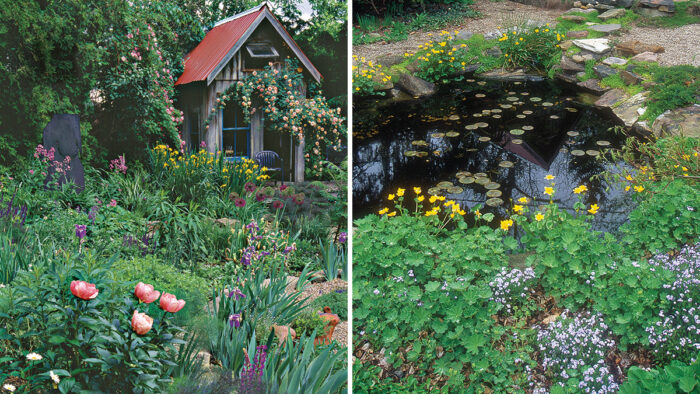
When I bought my house, it had a prosaic yard but no garden. The front was graced by a mature spruce on the north side, and a 20-foot-deep swath of level lawn ended in a steep slope to the street, making mowing difficult. I was lucky that my backyard was screened from close neighbors by surrounding mature hedges of arborvitae along one side and yew on the other. The sweeping limbs of a spruce offered a zone of mystery at the rear.
The simple clapboard house cried out for the casual, fragrant plantings of a cottage garden. With this design scheme in mind, I gradually transformed my modest lot until my entire site was filled with a profusion of colorful plantings and water features.
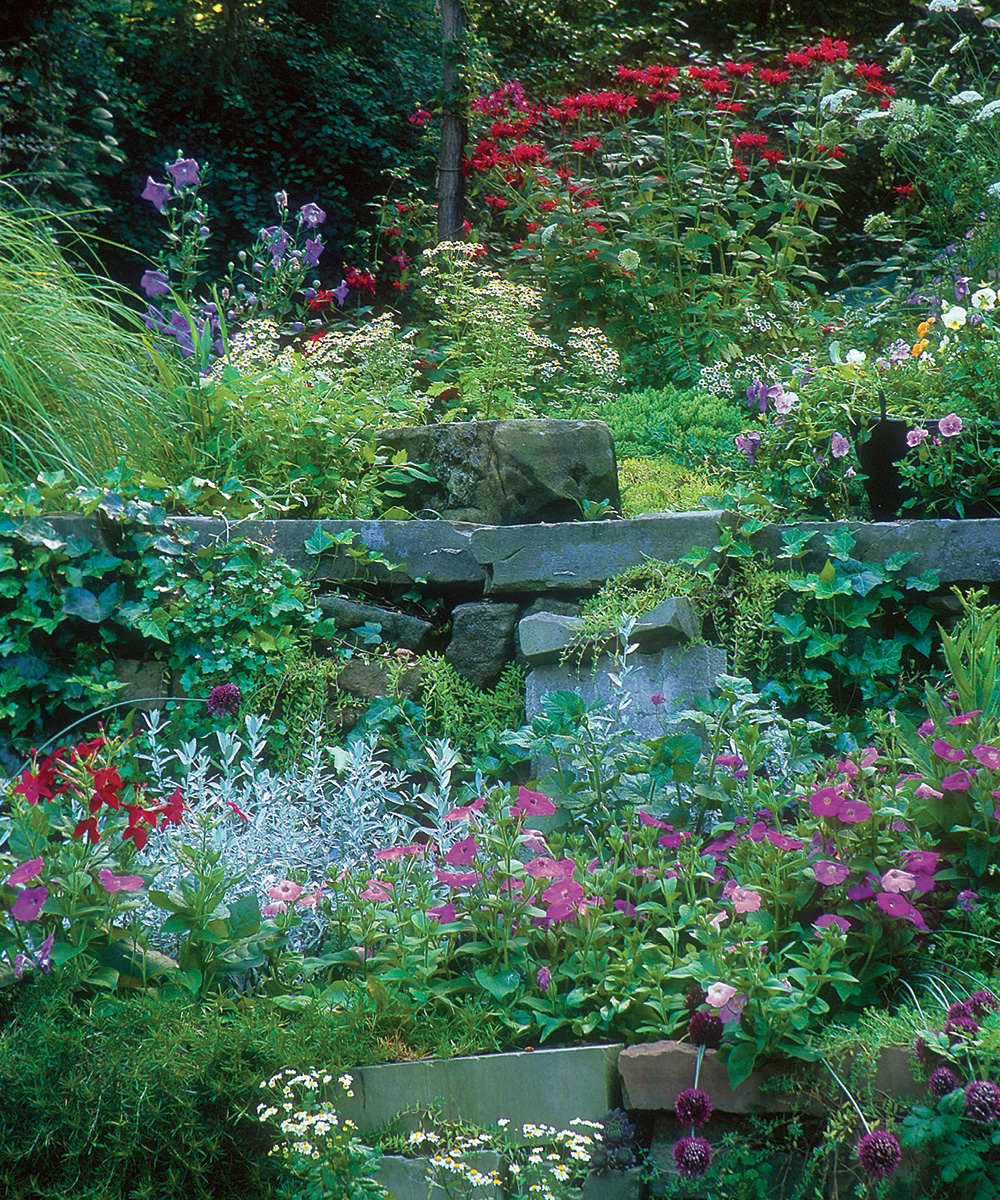
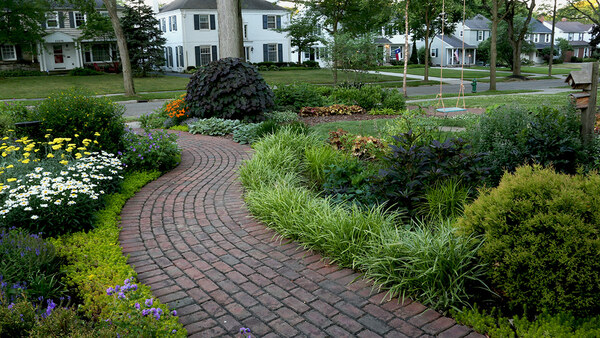
I decided to organize my front-yard plantings around stonework and a water feature. I made a pond in the front yard, and I left a small gravel path to encircle it. Then I terraced the slope with scrounged stones. This terracing also served as a structural element to balance the rambling plantings. Finally, I thickly planted the pond surround, terrace, and foundation of the porch in a cottage-garden style so I could enjoy constant color, starting with spring bulbs and ending with the autumn golds of ornamental grasses.
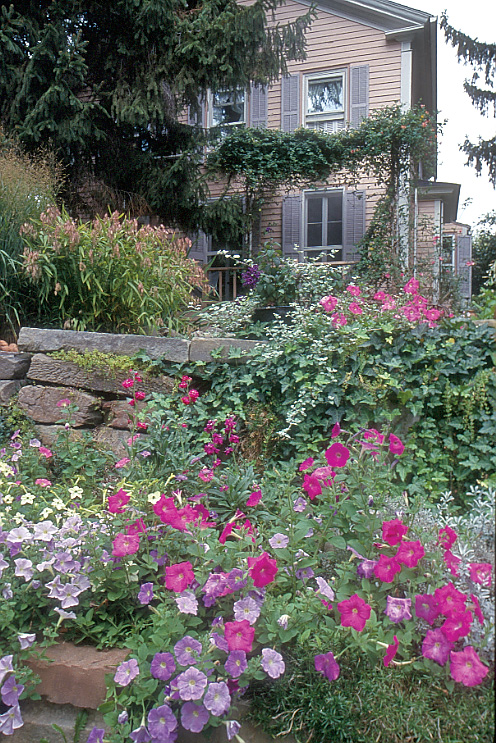
On one side of the terraced bank, I introduced switch grass (Panicum virgatum, USDA Hardiness Zones 5–9) for its see-through stems and fine yellow seed heads, which hang on all winter. I placed rock-garden plants such as creeping phlox (Phlox subulata cvs., Zones 3–8), soapworts (Saponaria spp. and cvs., Zones 3–9), and sea pinks (Armeria spp. and cvs., Zones 3–9) among the terraced rocks. Pale pink, lavender, and white species petunias (Petunia spp., annual) ramble down the bank and mingle with tall, fragrant flowering tobaccos (Nicotiana spp. and cvs., annual), which carry the same colors on high. In keeping with the spirit of a cottage garden, I also included many common plants. Self-sowing forget-me-nots (Myosotis spp. and cvs., Zones 4–9), alyssum (Alyssum spp. and cvs., Zones 4–9), and columbines (Aquilegia spp. and cvs., Zones 3–8), along with splashes of brick red bee balm (Monarda didyma cvs., Zones 4–10), fill the gravel paths. I also planted old-fashioned Hall’s honeysuckle vine (Lonicera japonica ‘Halliana’, Zones 4–10) for the fragrance it offers through the bedroom window as it climbs the porch.
The pond became a home for waterlilies (Nymphaea spp. and cvs., Zones 3–11) and the spring yellow outline of marsh marigold (Caltha palustris, Zones 3–7) topped by yellow flag irises (Iris pseudacorus, Zones 5–8), whose roots cleanse the water. Toads offer a raucous bedtime chorus, to be matched later in the spring by frogs. Fish spawn and increase, keeping mosquitoes out; dragonflies flash iridescent wings in summer, making the porch overlooking this cottage garden more than just a languid resting place.
Five Traditional Elements of a Cottage Garden |
A garden house serves as a focal point
I felt the rear garden needed a pond as well, so I created not one but two more in the backyard. But even before I added them, I knew I needed focal points that would draw the eye through the still-imaginary billowing vegetation.
On one side, I built a trellis for sweet autumn clematis (Clematis paniculata, Zones 5–11), which would eventually tie into the nearby spruce and offer a sheltered area next to the lower pond. On the opposite side of the backyard, my nephew built a garden house with a deck overhanging the upper pond. I wanted this structure to look as if it had always been there, in keeping with the casual plantings. To achieve this effect, it was set at an angle and nestled among venerable lilacs. We salvaged old windows and lumber for siding, so when the 8-foot-wide by 10-foot-long building was finished, it had the fairy-tale look of a structure having sprouted from the ground. By the time my cuttings of fragrant old roses had matured to circle the door, the back ponds were repeating the natural delights of the front pond, complete with waterlilies, fish, toads, frogs, dragonflies, and even mallards, coming to check out nesting possibilities. Occasionally, a great blue heron appears, hunting for prey.
I designed a swelling tide of plants leading from the house and terrace to the ponds. Miscanthus sinsensis ‘Autumn Light’ (Zones 6–9) stands guard over the upper pond, and the architectural sprawl of a sumac blends with annual spider flowers (Cleome hassleriana cvs.), cosmos (Cosmos bipinnatus cvs.), and sunflowers (Helianthus annuus cvs.). The scene is rounded out by catmint (Nepeta spp. and cvs., Zones 3–8), lavender (Lavandula spp. and cvs., Zones 5–9), and daylilies (Hemerocallis cvs., Zones 3–10). In the gravel paths, thyme (Thymus spp. and cvs., Zones 4–9), ‘Siskiyou’ evening primrose (Oenothera speciosa ‘Siskiyou’, Zones 5–8), German chamomile (Matricaria recutita, annual), and love-in-a-mist (Nigella damascena and cvs., annual) bloom according to their season.
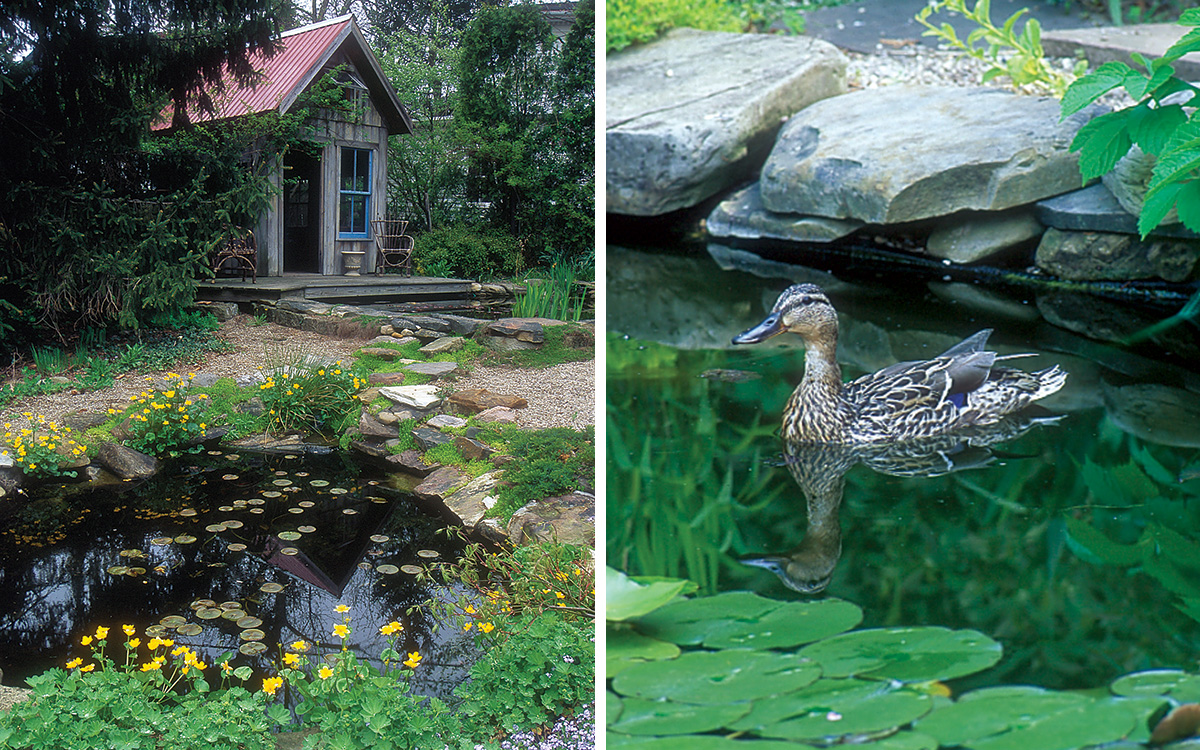
The relaxed plantings provide a haven for wildlife. There seems to be enough for everyone: chipmunks running under rocks, squirrels nibbling spruce cones like corncobs, rabbits nesting under the garden house. The garden has become an aviary with birds singing, nesting, and darting through the shrubs and tearing away seeds from the sunflowers even before they are ripe. Summer evenings take on another atmosphere when fireflies leave the foliage to dot the garden with tiny lights.
Five ways to give a cottage garden a well-designed twistThe most important thing to remember is that you are working with a garden, not a wilderness. As wild as a cottage-garden style may seem, you decide what supports or detracts from the look you’re after. 1. Don’t be a plant snob. Seek out new or overlooked plants that would enhance a desired look. For instance, the talented Dutch landscape designer Mien Ruys used edible plants such as burdock (Arctium spp.) and coltsfoot (Tussilago farfara) in her gardens, even though they are often considered weeds. 2. Balance an informal look with some definition. Don’t worry if plants extend past their boundaries. Let swaths of one plant intermingle with swaths of another, but don’t forget to include punctuation points. Be ready to move plants that are in the wrong place, and transplant seedlings or even mature plants to spots where they can create more impact. 3. Add structure. Use paths, terracing, trellises, ponds, and other hardscaping elements to provide formality and focal points within your design. 4. Rely on natural elements for enclosure. Hedges of trees and shrubs can create a pleasing backdrop for a cottage garden. 5. Invite wildlife. Create a haven for birds and other animals by including some type of water element and plantings that provide sources of food. |
Edit to keep things in check
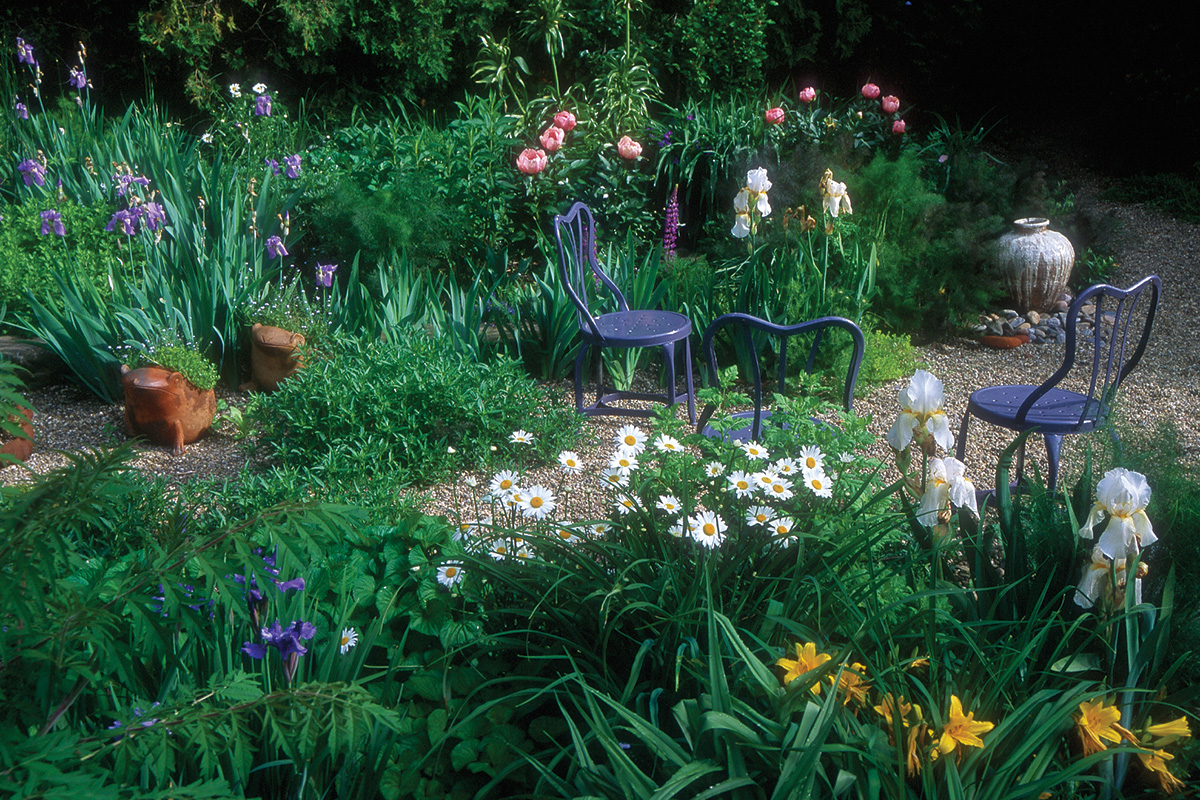
It may sound like all this took place without much effort. In fact, I spent much time editing: ruthlessly pulling out, pruning, cutting back, and transplanting. And, of course, improving the soil is essential to encouraging lavish growth. Having access to well-rotted horse manure, I dressed my beds with it in spring and fall. I also made the paths to the ponds by adding a 4-inch-deep layer of pea gravel on top of a 4-inch-deep layer of sand to hold the gravel in place. Gravel is a wonderful medium for plants as it provides a protective cover against cold or heat and holds in moisture during our August droughts. In spring, these paths are rivers of blue forget-me-nots, which are easily removed when the flowers are spent but which self-sow the following year. In my abundantly self-seeding garden, volunteers often choose what might seem to be inappropriate places. One summer, a sunflower grew into an old twig chair, offering a parasol hat to those choosing this unique seat.
I recently moved from this house to an even smaller cottage down the street. Although it was difficult to leave a garden I had cultivated for more than two decades, I carried with me years of lessons and the joys of tending that small bit of the planet. Now I’m excited to pour some of this knowledge into the creation of another free-spirited cottage garden. Perhaps next year there will be a new chorus of toads.
Valerie Strong is a garden designer based in Hudson, Ohio.
Photos: Ian Adams










Comments
Lovely garden! What is not mentioned is the fact that many "simple" flowers in cottage gardens will serve pollinators. Humming birds and Moths included. The author dows not mention native plants but these could easily be included. Native Monnarda and many different Liatris ...depending on eco region. Also it would be easy ti avoid double flowers as pollinators cannit reach the pollen. Hiw about including some shrubs that provide berries for the birds?
Oh dear. What a lovely garden. But.....I suppose you'll think me an old curmudgeon but I shiver at the thought of Hall's Honeysuckle, burdock and coltsfoot. Coltsfoot has taken over parts of a beautiful mountain side here in Virginia. The Japanese honeysuckle, and burdock, well, they're everywhere. A standard argument from gardeners who plant such things is that they'll keep an eye on it. How about the person who buys your house after you? And after them? Will they too keep an eye on it? Birds, insects, mammals and wind spread the seeds to MY property. Please consider this in your next garden.
Log in or create an account to post a comment.
Sign up Log in