
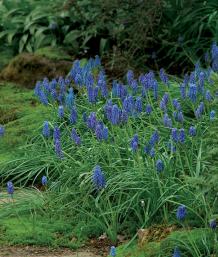
Not far from my home, there’s a meadow that becomes misted blue with grape hyacinth (Muscari spp. and cvs.) every April. One of my neighbors photographed, enlarged, and framed the bucolic panorama to hang over his fireplace, a tribute to one of the reliable though ephemeral splendors of spring. When he died a few years ago, his wife arranged for him to be buried in the cemetery that overlooks the exquisite scene he’d so treasured.
I learned that the original title-holders of that property tried to oust the beautiful but poisonous bulbs from their cow pasture, even to the point of stripping the field of turf, apparently without much success. So the present display, embroidering several acres, has been colonizing unchallenged for only about 25 years. Nowadays horses graze there, respectfully coexisting, implying perhaps that horses have an aesthetic sense as well as an appreciation for the sublime.
Muscari, a genus name derived from the Greek word for musk, alludes to the delicious fragrance of many of the brood, which originated mostly in Italy, Greece, North Africa, Turkey, Armenia, and the Caucasus. The flowers of this genus typically cluster like grapes on the stalk, hence the common name grape hyacinth. Some say the folksy name “starch lilies” relates to their aroma, but elsewhere I’ve read that the mucilaginous bulbs were actually once used for stiffening linen. In ecclesiastical gardens they’re sometimes labeled as “lent flowers” or “church steeples.”
Choose the right plant for the spot
For formal plantings where you want more control, select sterile or slow-spreading varieties like Muscari latifolium, but choose fertile plants like ‘Blue Magic’ grape hyacinth for naturalizing.
These bulbs like full sun and sandy soil
Unflagging in frost, attractive to bees, carefree in any but the soggiest situations, grape hyacinths add true blue beauty and are a notable garden asset. Hardy in USDA Hardiness Zones 4 to 8, muscari are happiest in sandy, free-draining, alkaline soil in full sun, but the bulbs are reasonably forgiving and virtually pest-proof. This year, though, for the first time, I’ve noticed that deer or some other phantom critters had chomped the winter foliage of ‘Valerie Finnis’ (M. neglectum ‘Valerie Finnis’, often erroneously classified as M. armeniacum, and possibly a cross between the two), one of my prized cultivars. Ordinarily, they seem to leave grape hyacinths alone, but the desperate deer in my garden added even daffodils to their menu.
For the best results, plant grape hyacinths in autumn, 3 to 4 inches apart and 2 to 3 inches deep. Most varieties that have been in the ground at least a year will send up leaves in the fall that last through winter until the flower blooms, then fade. I find this attribute a virtue, providing something green to look at all winter and marking their location so I can avoid disturbing them when adding plants to the garden in fall. To propagate by division, lift, split, and replant the bulb clusters in late summer when the plants are dormant.
Plant several varieties for successive bloom
Muscari azureum displays its sky-blue flowers in early spring, followed by the fluffy heads of ‘Blue Spike’ grape hyacinth in mid-spring. Towards the end of the season, long-lasting dark-blue ‘Saffier’ appears along with the feathery violet inflorescences of ‘Plumosum’.
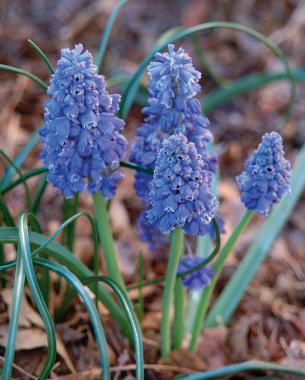
I like to combine these bulbs with other spring bloomers like tulips (Tulipa spp. and cvs.), daffodils (Narcissus spp. and cvs.), squills (Scilla siberica cvs.), windflowers (Anemone blanda cvs.), and candytufts (Iberis sempervirens). They also mingle well in the semi-shade with primrose (Primula spp. and cvs.), leopard’s bane (Doronicum spp. and cvs.), corydalis (Corydalis spp. and cvs), and hellebores (Helleborus spp. and cvs). Or why not try them with pale-colored pinks (Dianthus spp. and cvs.) or species tulips, such as Tulipa saxatilis? Grape hyacinths show off well as filler between other plants and tucked into ground covers and, of course, they can form a glorious field of dreams: If you plant them, they will come.
Photo/Illustration: Brent Heath
Photo/Illustration: Brent Heath
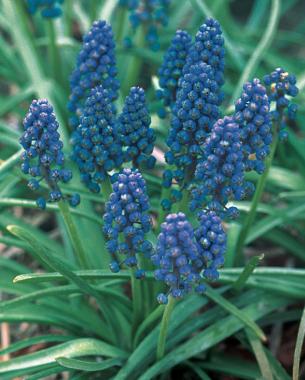
The bulbs in my neighborhood meadow are M. armeniacum, scented like clove carnation. Best for naturalizing, they seed and proliferate readily. Some M. armeniacum cultivars, such as ‘Saffier’ and double-flowered forms like ‘Blue Spike’ and ‘Fantasy Creation,’ increase only by division. While this makes the latter three poor meadow candidates, their advantage is that they never appear where you don’t want them, and they also bloom longer than those hastening through spring eager to set seed.
Flowers come in many shades of blue
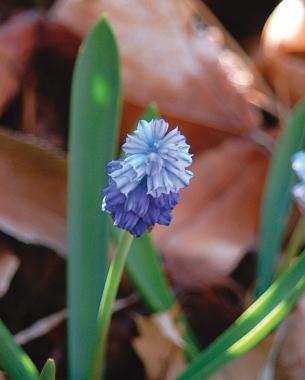
I have clumps of my favorite kinds of muscari planted throughout my garden, one of which is M. azureum (syn. Hyacinthus azureus and Pseudomuscari azureum). It’s the first grape hyacinth to bloom, usually in March. Each spring I eagerly await its sky-blue frilled bells with indigo stripes. Although the blossoms are not long-lived they self-sow freely, providing more flowers to enjoy the following year.
Shortly after M. azureum fades, my prized long-lasting M. armeniacum ‘Saffier’ blooms from mid through late spring. Its strong, rigid flower stalks start celery-green and mature to robust medium-blue blossoms with distinct pale-green lips at the mouth of each floret. The constricted openings prevent access to pollinating insects, resulting in blooms that last a full month and making them excellent cut flowers.
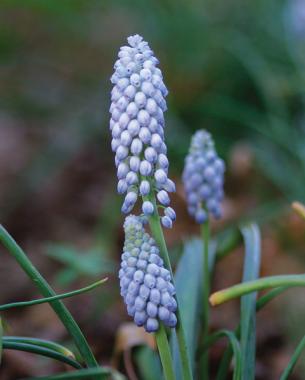
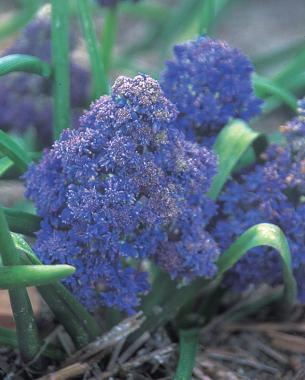
April-flowering M. armeniacum ‘Blue Spike’ is another nice one. It has the largest inflorescence of the species, with fully double flax-blue fluffy heads (each pedicel carries multiple individual flowers instead of one) and narrow, linear leaves. ‘Fantasy Creation’, a sport of ‘Blue Spike’, has a large pyramidal raceme resembling broccoli. Its blue flowers gradually turn purple, then green, fading toward yellow. The inflorescence doesn’t wilt and rarely sets seed but merely dries, making it useful for dried flower arrangements.
I also like M. aucheri ‘Blue Magic’ because of its true-blue hue in mid-spring. But for a most unusual color, try M. neglectum ‘Valerie Finnis’. It’s a tall, brilliant powder-blue showstopper that shows beautifully with pink-cupped daffodils. Its namesake, Valerie Finnis, was a famous British plantswoman and photographer.
Take advantage of unusual forms and colors
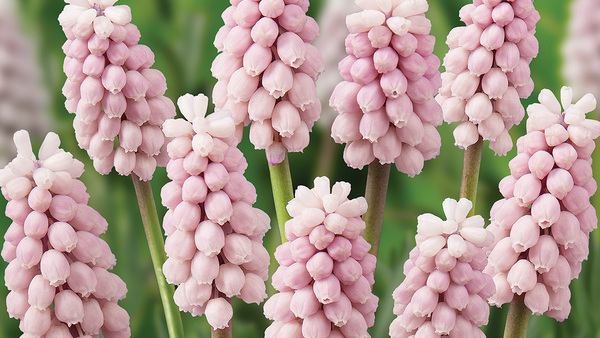
The conical flowers of Muscari paradoxum and the broccoli-like blossoms of ‘Fantasy Creation’ provide interest, while the powder-blue blossoms of ‘Valerie Finnis’ add stunning color to any garden.
Photo/Illustration: Brent Heath
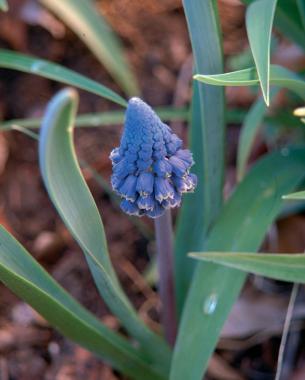
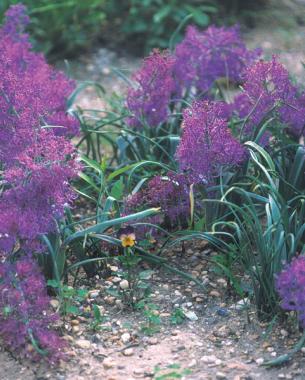
The oddball M. comosum, the tassel hyacinth (dubbed “lunatic flower” by British bulb enthusiast the Rev. Jacob Joseph for its loose topknot of bright violet strands waving wildly above dark, drooping cylindrical bells), begot M. comosum ‘Plumosum’, the feather hyacinth. With slender airy filaments, it indeed resembles a red-violet plume, totally unlike its grapy cousins in color and form, and makes a good 10-inch cut flower. The bulbs themselves have a distinct pink color, and they produce toothlike bulblets that grow to flowering size in just one season.
The flowers of M. paradoxum (syn. Bellevalia pycnantha) are also stunning, reaching 8 to 12 inches tall. The blossoms burst in April and May, with yellow-rimmed opaque blue-black skirts tapering to a perfect conical shape, which is set off by glaucous deep-green foliage.
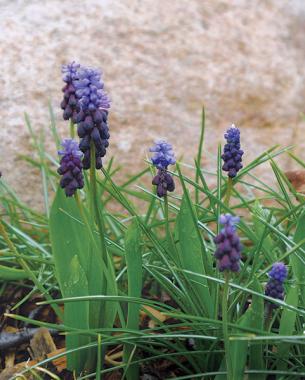
And last but not least, it took M. latifolium, first written about in 1886, about a century to appear on the market, even though it grows easily and seeds willingly. The peculiarity of this 10-inch-tall species is that it has one broad leaf—occasionally two—which encircles the stem at the base. It also has showy dark-indigo florets on the lower part of the stem and pale-blue sterile ones on top. It received a Royal Horticultural Society Award of Merit in 1956 and was Holland’s flower bulb of the year in 1996.
With the many exciting varieties on the market and more to come, I’m predicting that before long muscari madness will befall us all.
Forcing grape hyacinths in containers
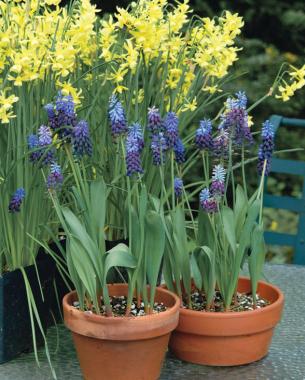
All grape hyacinths force reasonably well indoors, some being easier and others more challenging. For example ‘Christmas Pearl’ (M. armeniacum ‘Christmas Pearl’) doesn’t require a cold period, as others do, but ‘Blue Spike’ is more difficult and takes longer to perform. Here’s how to do it: Pot up plenty of bulbs (they’re small) in autumn. After 12 to 16 weeks rooting time in a cool (around 40°F), dark environment, move the pots to indirect sunlight at about 60°F to trigger leaf and flower growth. When the shoots are 4 to 6 inches tall, move the pots to a sunny window to stimulate blooming. A temperature of about 68°F is ideal at this stage. Most bulbs require three to four weeks from the time they are removed from cold storage before they bloom. When buds take on color, return them to indirect sunlight to make the blossoms last. Don’t allow the soil to dry out. To retard blooming, move the pots out of direct sunlight to a cooler spot until you want growth resumed. After flowering, hardy bulbs should be planted outdoors where they may rebloom within a year or two.











Comments
Must be glad for the given this amazing article for me just need to play online hearts card game and join the great fun with all friends.
Outsourcing field is a Homework Assignment Help with experienced scholarly essayists with tremendous information and aptitudes in scholastic composition.
A Mass Texting Service me is now used by thousands of businesses worldwide so it has become increasingly popular. However, it has grown since then with the emergence of real-time communications. Now, businesses can connect their systems with the service and send automated messages in real-time using API.
Texting is the one communication channel which is still as effective as it was decades ago. This is why businesses are now using it to communicate with their employees and customers in real-time. Developers can simply connect their platforms with a texting service using Text API and get started right away.
Thank you for posting very useful tips! I found your website perfect for my needs.I always like your article because you have provide every time informative post..Thanks!
Best 4 Channel Amp
Yes i am totally agreed with this article and i just want say that this article is very nice and very informative article. hole io skribbl io
Thank you for posting very useful tips , will share it Today
Amazing blog about gardening products. The writer has explained about gardening in an proper way. If you're finding about more things you can easily find it on India B2B Platform
Indeed, grape hyacinths (Muscari) are charming flowers that are known for their vibrant blue color and delightful fragrance. They are early spring bloomers that add a touch of beauty to gardens and landscapes. Hello Neighbor
Log in or create an account to post a comment.
Sign up Log in