previous
  • Fragrant Plants for Pathways
    Fragrant Plants for Pathways
  • Elephant's Ears
    Elephant's Ears
  • NEW Video Series: There's a Better Way
    NEW Video Series: There's a Better Way
  • Make a Succulent Topiary
    Make a Succulent Topiary
  • In Pursuit of the Perfect Potting Shed
    In Pursuit of the Perfect Potting Shed
  • Garden Confidential: A Plant Walks into a Bar
    Garden Confidential: A Plant Walks into a Bar
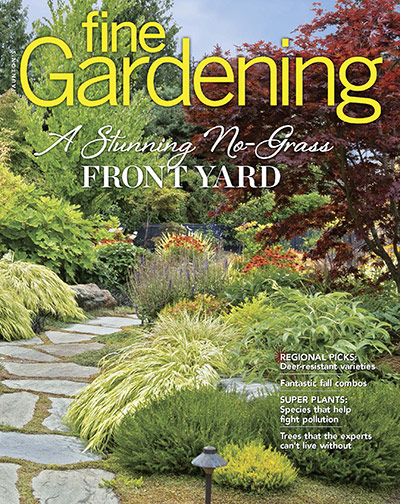
  • Lawn Alternatives
    Lawn Alternatives
  • Mulch for a Healthy Garden
    Mulch for a Healthy Garden
  • Designing with Curved Terraces
    Designing with Curved Terraces
  • 6 Tips for Weed Control
    6 Tips for Weed Control
  • Save Money by Growing Your Own
    Save Money by Growing Your Own
  • Plant an Easy-to-Water Strawberry Jar
    Plant an Easy-to-Water Strawberry Jar
  • Pretty in Pink
    Pretty in Pink
  • Containers as Focal Points
    Containers as Focal Points
  • Homegrown / Homemade
    Homegrown / Homemade
  • Plants that Spark!
    Plants that Spark!
  • Colorful Selections for Shade
    Colorful Selections for Shade
  • Indeterminate or Determinate Tomatoes?
    Indeterminate or Determinate Tomatoes?
  • Fast-Growing Trees for Impatient Gardeners
    Fast-Growing Trees for Impatient Gardeners
  • Comfortable Alfresco Dining
    Comfortable Alfresco Dining
  • Building a Compost Bin
    Building a Compost Bin
  • Thoughts From a Foreign Field
    Thoughts From a Foreign Field
  • Slideshow: Beautiful Clematis
    Slideshow: Beautiful Clematis
  • Dwarf Citrus Trees
    Dwarf Citrus Trees
  • Stylish Shady Containers
    Stylish Shady Containers
next

Browse Plants

Narrowed By:Characteristics: Attracts Butterflies+ Flower Color: Red+ Botanical Name: D - F
Displaying 1 - 8 of 8 listings   Sort By: Sort
Dahlia 'Kaiser Wilhelm' Dahlia 'Kaiser Wilhelm'
Be the first to rate this plant
Hardiness Zones: 1 2 3 4 5 6 7 8 9 10 11

Of the maybe 10,000 named dahlias introduced in the 1800s—when dahlias ranked right up there with roses in popularity—only three survive. One of them is 'Kaiser Wilhelm', introduced in 1892. Its 3-inch flowers have neatly curled petals of soft custard-yellow brushed with burgundy, and a green button eye just like that of an old rose. The plant can grow to 5 feet.

Dianthus barbatus 'Summer Sundae' Dianthus barbatus 'Summer Sundae'
(Sweet William)
(1 user review)
Hardiness Zones: 1 2 3 4 5 6 7 8 9 10 11

'Summer Sundae' Sweet William is a nice mix of red, pink, and white flowers held in rounded groups at the tops of stems. Plants bloom from late spring to early summer. The flowers are lightly fragrant. Use in a cottage garden or border, or in containers. It flowers the first year from seed.

Dianthus deltoides Dianthus deltoides
(Maiden pink)
(1 user review)
Hardiness Zones: 1 2 3 4 5 6 7 8 9 10 11

This mat-forming species with dark green leaves is one of the easiest to grow.  Blossoms range from white to red and are usually single and without fragrance. Use as bedding or in rock gardens.

Dianthus deltoides 'Arctic Fire' Dianthus deltoides 'Arctic Fire'
(Maiden pink)
(1 user review)
Hardiness Zones: 1 2 3 4 5 6 7 8 9 10 11

This mat-forming species with narrow, dark green leaves is one of the easiest to grow. Blossoms with red eyes open in early summer and may rebloom if sheared back after flowering.

Echinacea 'Sundown' Echinacea 'Sundown'
(Coneflower)
Be the first to rate this plant
Hardiness Zones: 1 2 3 4 5 6 7 8 9 10 11

This is one of the exceptional Big Sky™ series (E. paradoxa crossed with E. purpurea), bearing fragrant, russet-orange petals and reddish-brown central cones. These hybrids have all inherited the large green leaves, strong branching stems, wide flower petals, and profuse blooming tendencies of E. purpurea.

Echinacea 'Twilight' Echinacea 'Twilight'
(Coneflower)
Be the first to rate this plant
Hardiness Zones: 1 2 3 4 5 6 7 8 9 10 11

This is one of the exceptional Big Sky™ series (E. paradoxa crossed with E. purpurea), bearing fragrant rose-colored petals and stunning red central cones on 24-inch plants. These hybrids have all inherited the large green leaves, strong branching stems, wide flower petals, and profuse blooming tendencies of E. purpurea.

Echinacea purpurea 'Magnus' Echinacea purpurea 'Magnus'
(Purple coneflower)
(12 user reviews)
Hardiness Zones: 1 2 3 4 5 6 7 8 9 10 11

This native meadow derivative has vibrant, daisy-like flowers that bloom from midsummer into early autumn. Its prominent, dark orange central cones are surrounded by larger (to 7 inches across) and more horizontal, reddish-pink, ray petals than the species.

Echinacea purpurea ‘Bright Star’ Echinacea purpurea ‘Bright Star’
(Purple coneflower)
Be the first to rate this plant
Hardiness Zones: 1 2 3 4 5 6 7 8 9 10 11

This native meadow derivative with daisy-like flowers blooms from early summer into early autumn. 'Bright Star' has prominent, copper-orange central cones surrounded by red-purple ray petals (to 5 inches across), and grows to less than 3 feet tall.


Displaying 1 - 8 of 8 listings   Sort By: Sort